
Lieferung heute & morgen

Qualitätsgarantie

Willkommens-Angebote freischalten: KOSTENLOSE Lieferung | Bis zu 80 % RABATT | Kostenlose 30-Tage-JoyPlus-Testphase
App herunterladen
A children’s shelf with book storage and toy organisation should fulfil several purposes in everyday life: display picture books clearly, keep toys tidy and allow children to access their belongings independently. In practice, however, some models disappoint not because of their design, but because of unsuitable dimensions, a lack of anti-tip protection or poorly planned compartments.
Before buying, it is therefore worth looking at the actual product specifications rather than relying on general marketing claims. Important factors include the overall height, footprint, material details, load capacity and fixing options.
A low shelf for children can be easy to reach. Even so, stability remains important: children pull themselves up on furniture, lean against it or try to take items from higher compartments. A stable piece of furniture should therefore be secured to the wall after assembly in accordance with the instructions, provided that anti-tip protection is included.
A low bookcase is not a seat, ladder or climbing frame either. The maximum load capacity must not be exceeded.
An open shelf for children offers quick access, but it can become cluttered when there are lots of small toys. Additional boxes or a removable container are more practical for building blocks, doll accessories and toy cars. Anyone who buys based solely on the number of compartments often overlooks how they are actually arranged.
A children’s bedroom shelf measuring 80 or 86 cm wide needs more than just enough room for the furniture itself. Before buying, you should take skirting boards, doors, radiators and the space needed to move around in front of the shelf into account. Depth is equally important: a wider compartment is not automatically suitable for large picture books or collections of games.
For toddlers and pre-school children, open, easily accessible compartments are generally easier to use than tall cupboard units. With a Montessori shelf, the top shelf should be positioned so that the child can reach frequently used books and toys without climbing.
The right height depends on the child’s age, height and intended location. A piece of furniture measuring 70 to 78 cm high can be easy for many children to reach. With a height of 104 cm, you should check whether the upper shelves can actually be used regularly.
A book and toy shelf should be able to accommodate different types of items:
Also pay attention to the stated maximum load capacity. Heavy books should preferably go in the lower sections, so that the centre of gravity is not unnecessarily shifted upwards.
The selected models use, among other materials, MDF or coated wood-based materials, together with solid wood feet. The designations MDF (E1) and PB (E1) are material and emissions specifications provided by the manufacturer. They do not replace checking the assembly and safety instructions.
Rounded, smoothly finished edges reduce sharp transitions during everyday use. Nevertheless, parents should inspect the furniture after assembly for protruding screws, loose connections and wobbly components. Wall fixing must always be carried out in accordance with the relevant instructions.
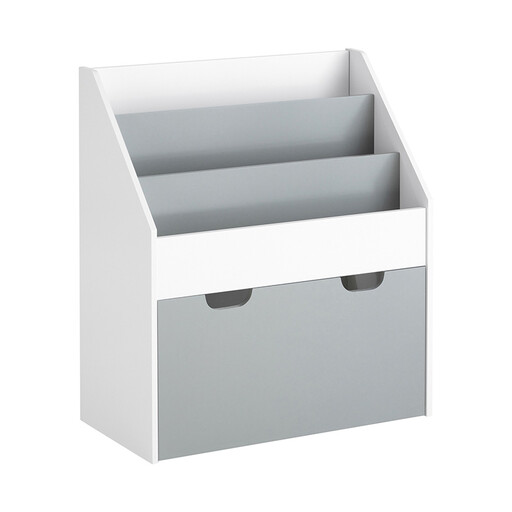
Why this product suits this profile: The combination of three book compartments and a removable toy box makes good use of a compact footprint of approximately 63 × 30 × 70 cm. It is suitable for small children’s bedrooms or a limited play area.
The box complements the open compartments and prevents small individual items from being left visibly scattered everywhere. The instructions highlight wall fixing, weight limits and regular checks.
Three compartments, removable box with castors, rounded edges, MDF (E1), approximately 25 kg maximum load capacity.
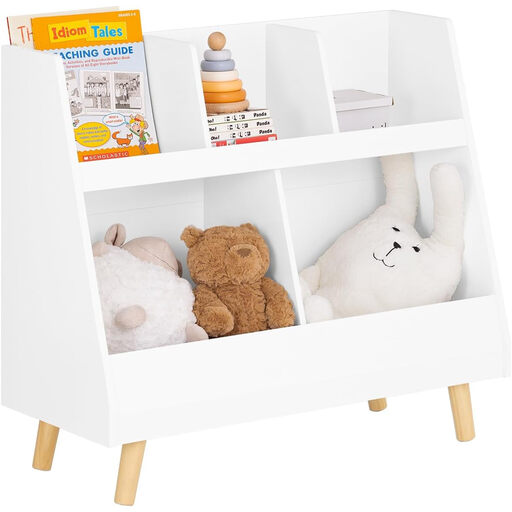
Why this product suits this profile: Five open sections distribute books, puzzles, toys and soft toys across a footprint of 86 × 36 cm, with a height of 78 cm. The top shelf can be used to display picture books clearly.
The clear division into five compartments makes it easier to assign each item a dedicated place. Rounded edges, a painted surface and solid wood feet are listed as specific product features; assembly and securing are still required.
Five compartments, MDF (E1), pine wood feet, painted surface, stated maximum load capacity of 25 kg and compact trapezoidal shape.
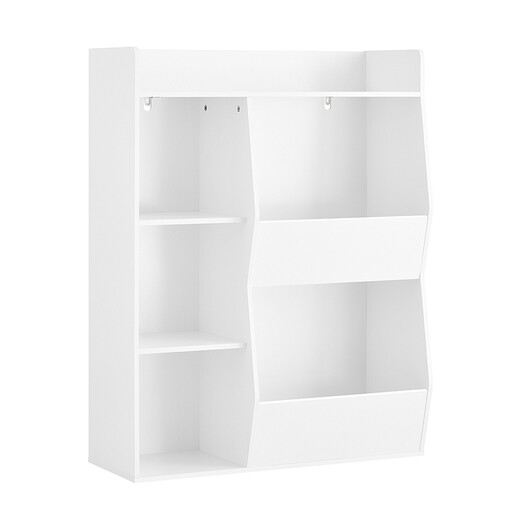
Why this product suits this profile: The five open shelves provide plenty of visible storage for books and toys. Measuring 80 × 34 × 104 cm, this shelf is suitable for families looking to make use of vertical space.
The open layout makes the available storage easy to see without making an unsupported safety claim. Rounded edges and a stated anti-tip system are among the product features; the unit must be secured to the wall.
Five open shelves, PB (E1), 80 × 34 × 104 cm, stated maximum load capacity of approximately 53 kg and integrated anti-tip system.
We have put together a complete, regularly updated list of products that fully meet these strict selection criteria and the safety regulations applicable in the EU.
Place the shelf on a level, sturdy surface and keep the designated movement area clear. After assembly, all screws and connections should be checked. For furniture with anti-tip protection, wall mounting in accordance with the instructions is an essential step.
The following arrangement can help with everyday use:
The right height depends on the child’s age and height. For toddlers and pre-school children, low compartments that can be reached without stretching or climbing are a sensible choice. The overall height is not the only factor that matters; the position of the shelves used most frequently is also important.
If the manufacturer provides anti-tip protection, it should be used in accordance with the assembly instructions. Even a heavy shelf can tip over if a child pulls on it or climbs on it. The furniture must therefore not be used as a ladder, seat or climbing aid.
Assigning each item a permanent place reduces the need for daily sorting: books get their own compartments, small parts go in storage boxes, and larger toys go in open sections. The boxes should not be overfilled. It is also advisable to check the screws and stability regularly, particularly after moving house or frequently relocating the shelf.