
Lieferung heute & morgen

Qualitätsgarantie

Willkommens-Angebote freischalten: KOSTENLOSE Lieferung | Bis zu 80 % RABATT | Kostenlose 30-Tage-JoyPlus-Testphase
App herunterladen
A children’s step stool should give toddlers more independence – whether they are washing their hands, brushing their teeth or helping in the kitchen. At the same time, safety comes first: a base that is too narrow, an unsuitable height or unclear weight-capacity information can make everyday tasks unnecessarily difficult.
That is why it is worth taking a close look at the construction, dimensions and intended use before buying. The following tips will help parents and carers assess marketing claims and choose a suitable step stool for children.
A high maximum load initially only describes the weight that the construction can support according to the product information. It does not, by itself, indicate how safely a child can climb up or move sideways. The following factors are also important:
Despite a high stated weight capacity, a narrow stool may be unsuitable if the child loses their balance while climbing up.
A height-adjustable step stool or learning tower only offers a practical advantage if the adjustment levels are clearly specified. Check whether the standing or stepping surface can actually be adjusted to suit the child’s height and the intended location.
With a Montessori learning tower, you should also consider the side barriers. An open step stool is more compact, while a learning tower can provide greater support when standing at a kitchen worktop. The two product types therefore serve different purposes.
Descriptions such as “child-friendly”, “sturdy” or “environmentally friendly” should be supported by specific details. Relevant information includes:
A general statement about safety is no substitute for checking the product data or supervising use.
For a bathroom model, the height should be suitable for the basin. A children’s bathroom step stool must be positioned so that the child can reach the basin without having to lean too far forwards or sideways. Wide steps and side handles can make climbing up easier.
For a children’s learning tower, the overall height is also important. Check whether the tower fits beneath the worktop and is placed on a level, dry floor. In the kitchen, it should not be used directly next to hobs, naked flames or sharp objects.
Joints using dowels, mortise-and-tenon connections or reinforced elements can contribute to the structural stability of wooden and engineered-wood products. Nevertheless, screws should be checked regularly. The stated load capacity must not be exceeded.
A sturdy step stool is not automatically suitable for sitting on. If the product is intended to be used as a children’s chair step stool, the seat height, standing position and manufacturer’s information must explicitly support this use.
Wood, bamboo, MDF and coated engineered wood differ in weight, surface finish and care requirements. Do not assume that they are waterproof. For the bathroom, a surface that can be cleaned with a damp cloth and then allowed to dry is recommended.
A wooden children’s step stool can fit attractively into living spaces, but it should still be checked regularly for cracks, loose parts or swollen areas. A folding children’s stool saves space, but it should be fully opened and securely locked before every use.
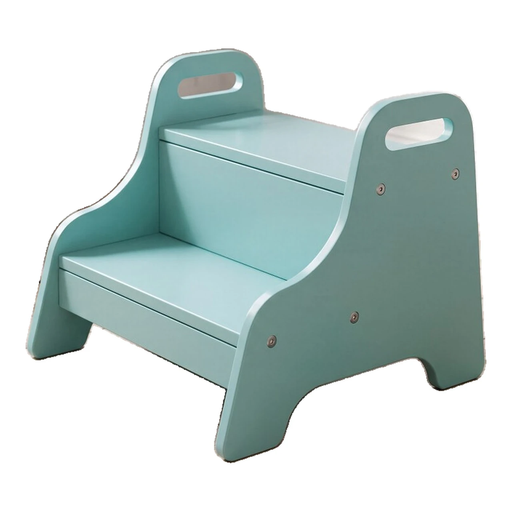
Why this product suits this profile: This compact children’s stool is designed for everyday tasks at the basin, in the kitchen or in the child’s bedroom, and requires only a few assembly steps.
The product description specifies a wide step, integrated side handles and a reinforced mortise-and-tenon joint. This provides concrete construction details rather than just general marketing claims.
Engineered wood with water-based paint, a smooth surface and cleaning with a damp cloth, according to the product information.
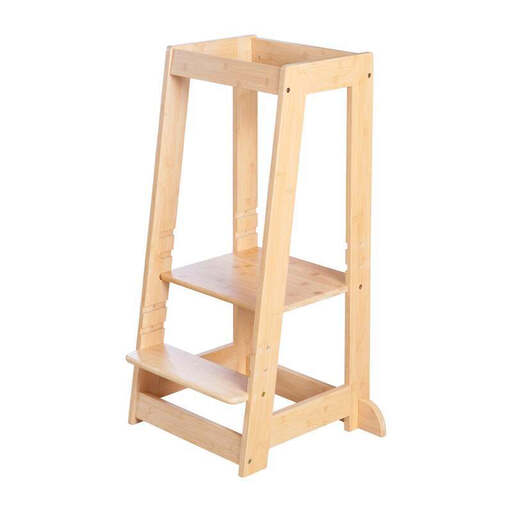
Why this product suits this profile: This learning tower is aimed at families looking for a height-adjustable solution for the kitchen worktop and sink.
The product details specify three basic heights of 34,5, 39,5 and 44,5 cm, as well as adjustable steps. The extended side feet are also described in specific terms.
FSC-certified bamboo, according to the product information, three levels and a stated maximum load capacity of 80 kg.
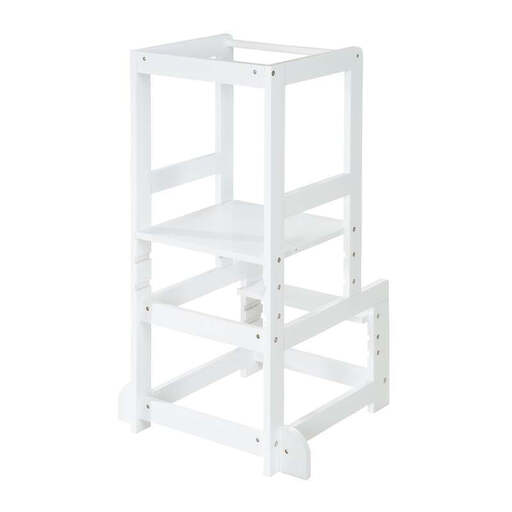
Why this product suits this profile: This model is designed for regular activities at the sink and work surface and is supplied without assembly, according to the product description.
The height adjustment, three levels and maximum load capacity of 80 kg are listed in the product details. A level surface is still required before every use.
Height-adjustable standing and stepping surface, white finish and no assembly required according to the description.
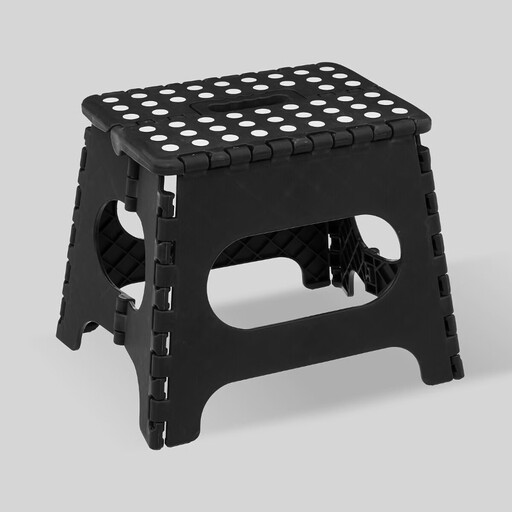
Why this product suits this profile: This 33 cm-high folding stool can be stored away to save space and used in the kitchen, bathroom or utility room.
The compact dimensions of 27 × 26,7 cm and the folding function are clearly specified. Before use, check that the stool is fully opened and that the floor is non-slip.
Folding design, 33 cm height and compact footprint according to the product description.
Regardless of which children’s step stool you choose, you should:
A step stool is not a toy. Jumping, climbing over the sides or leaning out can affect its tip resistance.
We have put together a complete, regularly updated list of products that fully meet these strict selection criteria and the safety regulations applicable in the EU.
The height depends on the intended area of use. At a basin or worktop, the child should be able to reach the surface without leaning too far forwards. Adjustable models offer more flexibility; with simple stools, the dimensions should be compared with the intended location before purchase.
There is no general answer to this. A learning tower usually has side barriers and is designed for longer periods of standing at work surfaces. A children’s stool is more compact and easier to store. In both cases, a level surface, correct assembly and supervision are essential.
Its service life depends on the material, workmanship, load and care. Check the joints and surfaces regularly. A damaged or unstable product should no longer be used, regardless of when it was originally purchased.