
Lieferung heute & morgen

Qualitätsgarantie

Willkommens-Angebote freischalten: KOSTENLOSE Lieferung | Bis zu 80 % RABATT | Kostenlose 30-Tage-JoyPlus-Testphase
App herunterladen
Children’s toys should be fun, support development and work reliably in everyday life. The selection ranges from educational toys for toddlers and baby toys from 6 months to soft toys, licensed characters and Blind Box collectible figures. However, the sheer variety can make comparisons difficult.
Common unsuitable purchases are not caused by price alone. Unclear age recommendations, underestimated noise levels or accessories that are quickly lost in everyday use can also be problematic. The following criteria can help you narrow down your choice objectively.
Activity tables, activity cubes and interactive baby toys often promote their many play modes. However, what matters is whether the functions match the child’s stage of development. A baby may get less use out of a complex button panel than from a few easy-to-reach gripping, turning or sound elements.
Pay attention to the number, arrangement and ease of use of the functions. For younger children, large, permanently attached elements are generally more practical than small accessories.
The recommendation “from 1 year” should not be understood as suitable for every child. Motor skills and behaviour develop at different rates. If a toy contains small parts, it is generally unsuitable for children under 3 years of age where the manufacturer warns of a choking hazard.
With a soft toy, for example, sewn-on or embroidered details need to be assessed differently from loose accessories. Blind Box products containing small figures and balls are expressly not intended for toddlers.
Musical toys for children can quickly become persistently loud in the home. With a children’s drum kit, children’s piano or musical toy for babies, volume control and a mute function are therefore important purchasing criteria. Also check whether batteries are included, which battery type is required and whether the battery compartment can be closed securely.
Compare the manufacturer’s recommendation with how you plan to use the product:
Dimensions are also important. An activity table with detachable legs can save space, while a 24-key children’s piano requires more storage room. For travelling, compact designs such as an activity cube with a carry handle are a good choice.
For plastic toys, information such as ABS, BPA-free and rounded edges can be useful product details. However, they do not replace checking the specific item and its instructions for use. The CE mark indicates that the manufacturer has declared compliance with the applicable EU requirements. It is not an independent quality seal.
The EN 71 series of standards covers various toy safety areas. Buyers should also look out for the following:
Electronic toys should have an understandable volume control. With soft toys, it is important to know whether the sound module can be removed and whether the product is machine washable. Some models may only be cleaned with a damp cloth.
For frequently used toys, it is also worth examining the construction: secure connections, a stable base and as few loose accessories as possible can reduce the cleaning and maintenance required.

Why this product suits this profile: The compact activity cube combines eight interactive areas in a space measuring approximately 23 × 23 × 24 cm, making it suitable for families with limited space or for use on the go.
Several permanently integrated functions reduce the amount of loose accessories. The recommended age is 1 to 3 years; the product is not intended for younger children.
ABS plastic, rounded edges, carry handle and piano, guitar, telephone and gear elements, according to the product description.
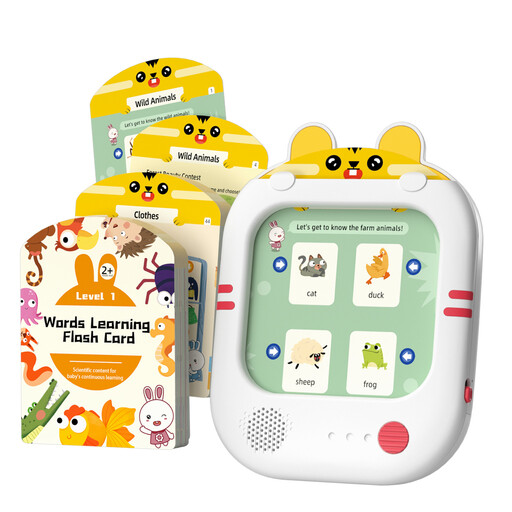
Why this product suits this profile: This screen-free learning system is designed for children aged 3 to 5 and combines card-based content with audio feedback.
The system uses 47 double-sided cards instead of a screen. The included lithium-ion battery is charged via USB-C; small parts require the warnings to be observed.
According to the product description, it contains over 180 words and more than 180 logic games; the stated operating time is up to six hours.
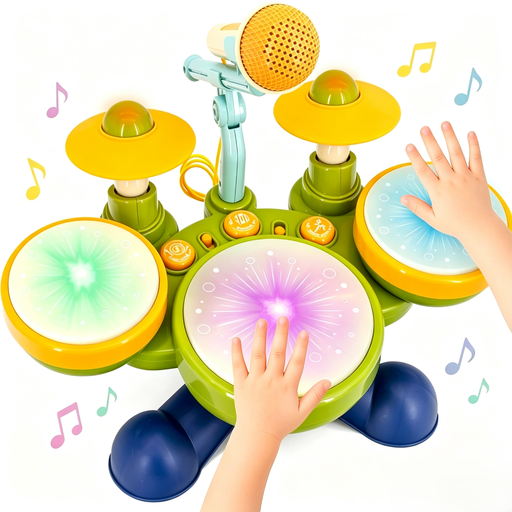
Why this product suits this profile: For families where music is played regularly, this set offers three illuminated drum pads, two cymbals and a microphone for role play.
A volume control helps you adjust the sound to suit your living space. The detachable stand also allows children to play on the floor.
Microphone included, height-adjustable cymbals and, according to the supplier, ABS plastic and rounded edges. Batteries are not included.
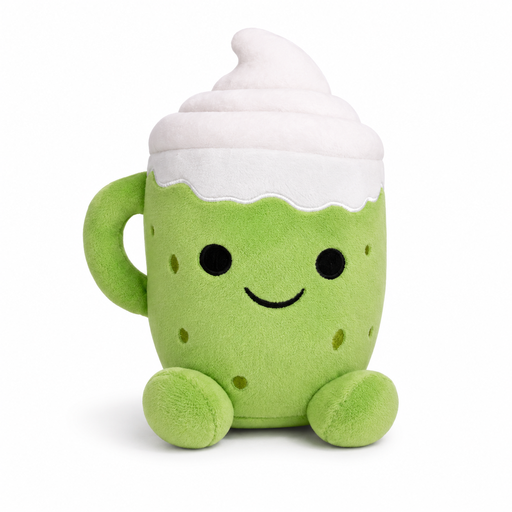
Why this product suits this profile: Measuring approximately 25 cm, this soft toy is suitable as a decorative gift, travel companion or cuddly toy for children aged 3 and over and adults.
The facial features are embroidered and the product is described as an integrated unit. According to the care notice, it must not be washed or soaked, but should only be wiped carefully.
Polyester filling, three colour options and a low weight; suitable for decoration, carrying in a rucksack and giving as a birthday or Christmas present.
We have put together a complete, regularly updated list of products that fully meet these strict selection criteria and the safety regulations applicable in the EU.
For babies from 6 months, options include an activity table positioned on the floor, a sensory toy with large buttons or a rolling penguin. With moving products, check that there is enough clear floor space.
Children between 1 and 3 years can benefit from a children’s piano, a simple children’s drum kit or an activity table with shape sorters. Montessori toys should not be bought solely because of the name: the key factors are the specific activity, the size of the elements and whether the child can use it independently.
From the age of 3, options include a Paw Patrol figure, a washable soft toy or a language-based educational game. Because of their small parts and random contents, Blind Boxes should generally be viewed as collector’s items for older children or adults. You do not know which figure is inside before buying.
Products with large, securely attached elements, rounded edges and a clear age recommendation are suitable. A baby toy from 6 months should be used under supervision, particularly if it contains batteries or light or sound functions. Loose small parts should be kept out of babies’ reach.
A general assessment is not possible without measuring the specific product. In practical terms, a volume control and mute mode are useful. Set the volume low, avoid prolonged use directly next to the ear and take regular breaks from playing.
Durability depends on the materials, construction, frequency of use and care. Check toys regularly for cracks, loose parts and damaged seams. Electronic models require suitable batteries or charging cycles, while soft toys should be cleaned according to the care instructions and stored in a dry place.