
Lieferung heute & morgen

Qualitätsgarantie

Willkommens-Angebote freischalten: KOSTENLOSE Lieferung | Bis zu 80 % RABATT | Kostenlose 30-Tage-JoyPlus-Testphase
App herunterladen
The right children’s vehicle should make exercise enjoyable, be safe and easy to handle, and suit your child’s stage of development for as long as possible. The choice ranges from a balance bike for toddlers and tricycles to a 3-wheel children’s scooter. However, eye-catching designs and a long list of promises do not automatically lead to a good purchasing decision.
Parents should watch out for three common pitfalls before buying:
Age is a useful guide, but it should not be the only selection criterion.
For younger children, models with a low seat position, a wide base and controlled steering are often suitable. A 5-in-1 tricycle with a parent push handle can cover different stages of use: initially as a push-along vehicle, and later as a tricycle or balance-bike-style model. A safety belt and correctly locked push handle are particularly important when the vehicle is being used by an adult.
From around the age of three, a classic tricycle, balance bike or children’s scooter may be suitable. A 3-wheel children’s scooter with lean-to-steer control responds to shifts in weight and may be easier for children to control than a two-wheeled scooter. Actual suitability depends on height, coordination and the manufacturer’s specifications.
For older children, an adjustable-height handlebar, a sufficiently wide deck and a weight limit suited to the child’s body weight are essential. A foldable children’s scooter can also be practical if it needs to be transported in the car, hallway or on public transport.
With a tricycle, your child’s feet should be able to reach the ground or pedals securely. The handlebar must not be too high or too low. On scooters, the handlebar should be adjusted so that the arms remain slightly bent. Adjustment ranges are only useful if the lowest and highest positions suit your child’s height.
A wide wheelbase can help improve stability in everyday use, but it does not replace supervision. Look for:
LED wheels mainly improve visibility and are an additional visual feature. They should not be considered safety lighting for use on the road. Children’s vehicles are generally not intended for use on public roads unless the manufacturer states otherwise.
The CE mark is a legally required conformity marking for certain product groups, but it is not an independent testing seal or a blanket assessment of quality. You should therefore read the complete product description and all warnings.
The following points are particularly important:
Before every ride, check the screws, folding mechanism, wheels, seat and push handle. Avoid hazardous areas such as stairs, sloping paths, bodies of water and roads.
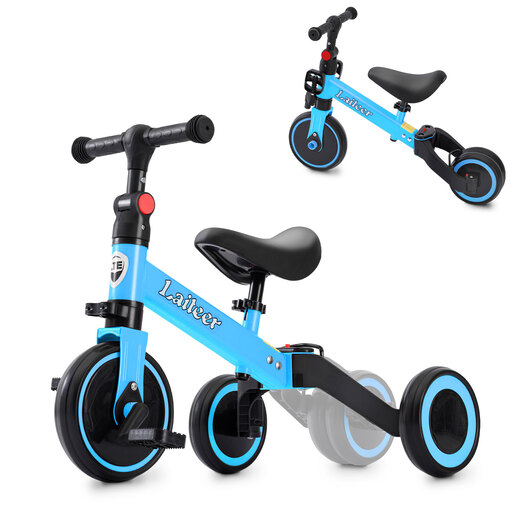
Why this product suits this profile: According to the specified age range of 2 to 5 years, this model combines balance bike and tricycle functions. It also features an adjustable seat and a removable pedal.
The 2-in-1 design reduces the need for two separate vehicles. Before buying, check the seat height, pedal installation and maximum load.
Adjustable seat, removable pedal and foldable design according to the product details.
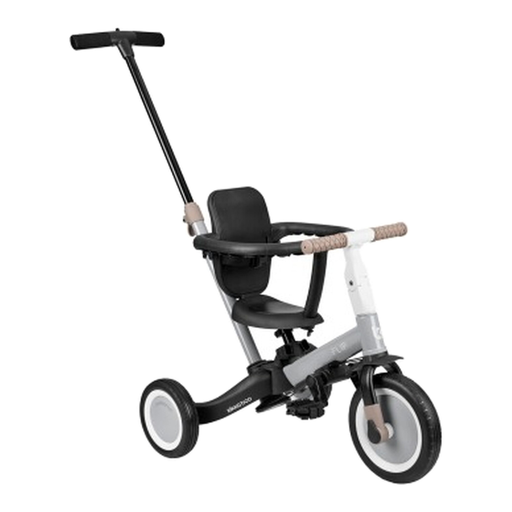
Why this product suits this profile: According to the supplier, the 5-in-1 tricycle is intended for children aged 1 to 5 years and can be converted from push-along mode to bicycle mode.
The multiple seat adjustments and parent push handle help prevent the product from being outgrown too quickly. The safety belt and locking mechanisms must be checked before every ride.
High-carbon-steel frame, height-adjustable seat, three-stage parent push handle and two-point belt according to the product details.
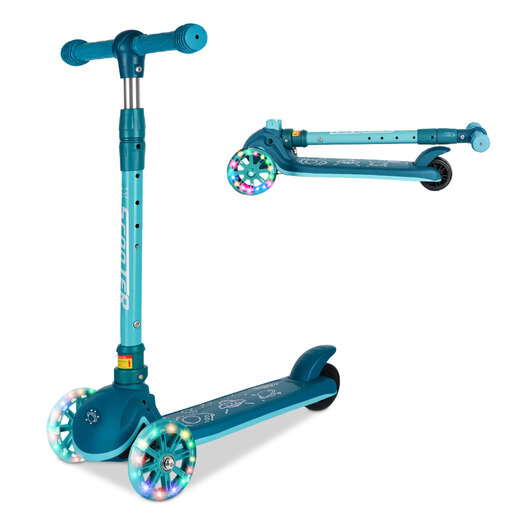
Why this product suits this profile: This three-wheeled scooter is specified for children aged 3 to 10 years and is designed for families looking for flexible transport and storage options.
The folding function makes storage easier. Before use, check that the folding mechanism is fully locked and that the handlebar is suitable for your child’s height.
Height-adjustable handlebar, anti-slip deck and light-up wheels according to the product details.
We have compiled a complete, regularly updated list of products that fully meet these strict selection criteria and the safety regulations applicable in the EU.
Before placing your order, it is worth running through this quick checklist:
This depends on height, balance and how the vehicle is intended to be used. A tricycle provides a seated riding position, a balance bike helps children practise their balance, and a 3-wheel children’s scooter is suitable for children who can already stand securely and push themselves along. The manufacturer’s specifications and constant supervision are essential.
The service life depends mainly on handlebar height, permitted weight, the condition of the materials and riding behaviour. A height-adjustable handlebar can extend the period of use. Wear parts such as wheels, grips and the folding mechanism should be checked regularly and replaced if damaged.
No. LED wheels are primarily a visible design feature. A sturdy frame, an anti-slip deck, fully functioning steering and a suitable weight limit are more important. A scooter with light-up wheels is not automatically suitable for use on public roads either.