
Lieferung heute & morgen

Qualitätsgarantie

Willkommens-Angebote freischalten: KOSTENLOSE Lieferung | Bis zu 80 % RABATT | Kostenlose 30-Tage-JoyPlus-Testphase
App herunterladen
A children's workbench is more than just a toy. It's a place where creativity and craftsmanship are playfully encouraged. But the selection is vast, and not every model lives up to its promises. Many parents invest in a toy workbench that ends up unused in a corner after just a short time. This is often due to avoidable flaws that quickly spoil the fun. This guide will help you navigate the typical pitfalls and make a decision that brings long-lasting joy.
Before we turn to the important features, let's look at the three most common reasons a children's workbench ends up gathering dust. Recognising these problems is the first step toward a successful purchase.
To avoid a bad purchase, you should check three crucial criteria. These will help you objectively assess the quality and suitability of a workbench for children.
The material is a key factor in determining durability and safety. The choice between plastic and wood depends on the child's age and your own priorities.
Regardless of the material, a GS mark (Geprüfte Sicherheit / Tested Safety) is a reliable indicator that the product meets the requirements of the German Product Safety Act.
A good toy workbench grows with the child's abilities. For beginners from 3 years old, large, easy-to-grip tools and simple screw connections are ideal. Older children (5-6 years) often want more realistic functions and smaller parts to build more complex "projects." The tools should be designed to actually work—screws should be able to be turned, and the hammer should be sturdy enough for light tapping sounds without breaking.
The height of the work surface is crucial for a comfortable and healthy posture during play. A workbench for ages 3 and up should have a working height of about 45-55 cm (18-22 inches). Measure your child's height and ensure they can stand upright and work comfortably at the bench without having to bend over or stretch too much. Some models offer height-adjustable feet, which allows for a longer period of use.
Instead of making a one-size-fits-all recommendation, we have matched products to different play styles and age groups.
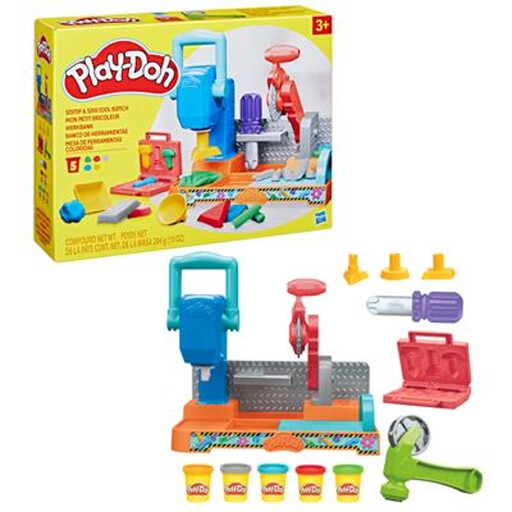
Why This Fits Their Persona: Ideal for children aged 3 and up whose focus is on sensory and creative play. Instead of realistic mechanics, the emphasis here is on shaping, cutting, and stamping modelling clay, which promotes fine motor skills in a different, very safe way.
It bypasses the "useless accessories" trap, as the tools are specifically designed for soft modelling clay and perfectly perform their function (cutting, stamping). There's no frustration from parts that don't work together.
Promotes creativity and fine motor skills without the complexity and potential small parts of a mechanical workbench. No batteries or assembly required.
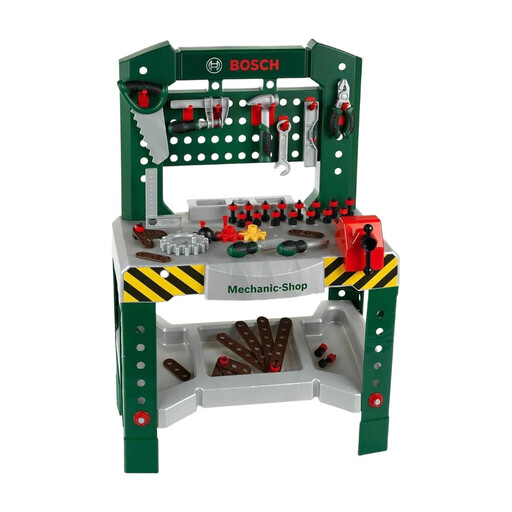
Why This Fits Their Persona: Perfect for children who want to imitate adults doing DIY projects. The well-known Bosch design creates high brand recognition, and the 77-piece set offers a wide range of realistic play opportunities.
As a product from a renowned toy manufacturer (Theo Klein), this model features a well-thought-out design and child-friendly, functional tools. It avoids the pitfalls of instability and useless accessories.
The extensive accessory set and the worktop with a learning function promote dexterity, creativity, and an understanding of tools. Offers long-lasting play value.
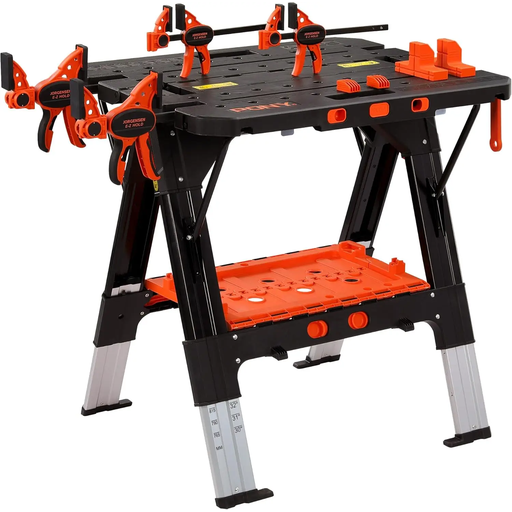
Why This Fits Their Persona: This product is intended for adults or for joint projects with teenagers under supervision. It is a real, heavy-duty workbench (up to 227 kg / 500 lbs) and not a toy.
This is a prime example of the "dangerous misjudgment" pitfall. It is not a toy workbench. Buying this for a young child would be a serious mistake due to pinching hazards and unsuitable materials.
For its intended purpose, it is an excellent product: a sturdy, foldable, and height-adjustable workbench for the garage or workshop. Ideal for DIY enthusiasts.
We have compiled a complete, up-to-date list of products that fully meet these strict selection criteria and German safety regulations.
1. At what age is a children's workbench a good idea? Generally, a workbench for ages 3 and up is recommended. At this age, fine motor skills are sufficiently developed to handle simple tools. For younger children, creative workbenches without small, swallowable parts are more suitable, where the focus is on shaping and sensory exploration.
2. What should I look for in a wooden children's workbench? For a wooden children's workbench, three points are crucial: First, a smooth, splinter-free finish on all surfaces. Second, the use of non-toxic paints and varnishes, often certified according to the European toy safety standard EN 71. Third, a solid and stable construction that won't tip over, even during enthusiastic hammering.
3. How do I safely assemble a children's workbench? Follow the manufacturer's assembly instructions exactly. Tighten all screws firmly and check for stability before letting your child play with it. Place the workbench on a level surface, ideally with its back against a wall to prevent it from tipping over backwards. Regularly check that all connections are still tight.