
Lieferung heute & morgen

Qualitätsgarantie

Willkommens-Angebote freischalten: KOSTENLOSE Lieferung | Bis zu 80 % RABATT | Kostenlose 30-Tage-JoyPlus-Testphase
App herunterladen
A children’s workbench brings pretend-play activities such as screwing, assembling and repairing to life. But workbenches for children vary considerably in size, accessories, stability and recommended age. A long list of accessories alone tells you little about whether a toy will be practical for everyday play.
Before buying, parents, grandparents and other relatives should take a closer look. The brand and appearance aren’t the only things that matter: consider whether it’s suitable for the child’s age, how small parts can be stored, and whether they’ll be able to play independently with the set.
A children’s workbench with lots of accessories may look impressive at first glance. But screws, nuts and tools are easily lost if they don’t have a designated place. A large number of parts can also overwhelm younger children.
A more practical choice is a set-up that suits the way the toy is designed to be used. For example, a workbench should have a screw surface, vice, storage areas or hooks. With a children’s tool set, a manageable selection of tools and a sturdy storage box are often more important.
Drills, jigsaws and angle grinders with lights and sound effects can add to pretend play. However, they need batteries, and their features can distract from the creative play itself.
If you’re looking for educational toys for aspiring craftspeople without ongoing costs, choose a manual workbench or a tool set that doesn’t need batteries. For electronic toys, check the battery type, what’s included and how batteries can be stored safely.
Most of the workshop toys mentioned here are intended for children aged 3 and over, but they include small parts such as screws, nuts and detachable accessories. An age recommendation is no substitute for assessing your individual child.
Small parts pose a choking hazard for children under 3. With older children, too, an adult should supervise their first time playing and explain that these are toy tools, not real working tools.
Check the official age recommendation and the manufacturer’s warnings. When choosing a toy workbench for children aged 3 and over, you should also check the following:
For example, the hauck Learn to Work tool set is stated to comply with EN 71. Always check this information for the specific product. It doesn’t replace checking the toy’s actual condition during play.
A large children’s workbench needs a permanent place to stand. Before buying, check the assembled workbench’s dimensions and the space available for moving around it. A 102 cm-high workbench may suit some children, while a compact tool case is more flexible to use and easier to put away.
Examples:
You should also check that the workbench stands securely once assembled, and that drawers, hooks and storage areas are within reach.
For longer play sessions, a vice, learning surface, screws and a range of tools can be useful. For shorter or portable pretend-play sessions, a tool case for children may be enough. A children’s DIY set with a specific craft project, meanwhile, is suited to children who prefer making things to free-form assembly.
Battery-powered tools need the right batteries. For example, the Theo Klein 8379 Bosch jigsaw toy requires 2 AA batteries, while the Theo Klein 8584 tool case requires 3 AA batteries. According to the product details, these batteries aren’t included.
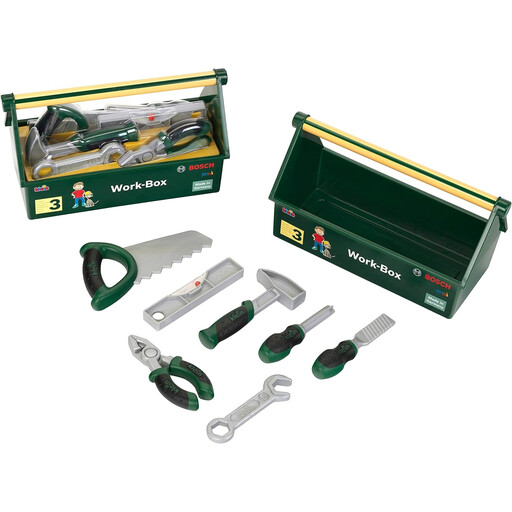
Why it suits this profile: This compact case contains seven tools and doesn’t need batteries. It’s a good choice for children who are starting to explore different kinds of pretend play.
The tools can be kept in a portable box. This keeps the set manageable and makes it easier to keep everything together.
Seven pieces, measures 30,25 × 17,25 × 14 cm and can be used manually without batteries.
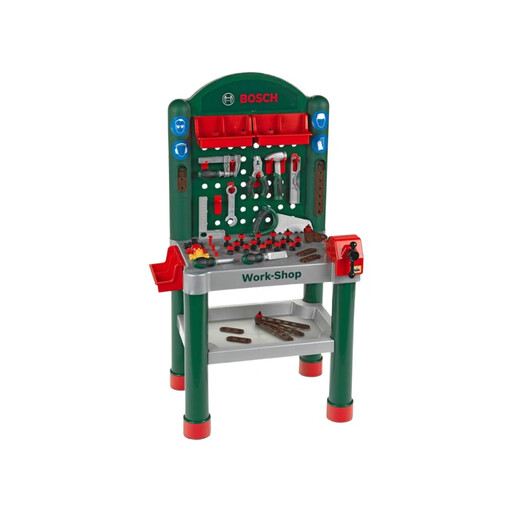
Why it suits this profile: This Bosch workbench for children combines a dedicated play station with 79 accessories and several storage options.
The set isn’t limited to a single toy tool. The vice, learning surface and storage areas support a variety of play scenarios.
79 pieces, vice, learning features and measures 50 × 37 × 102 cm.
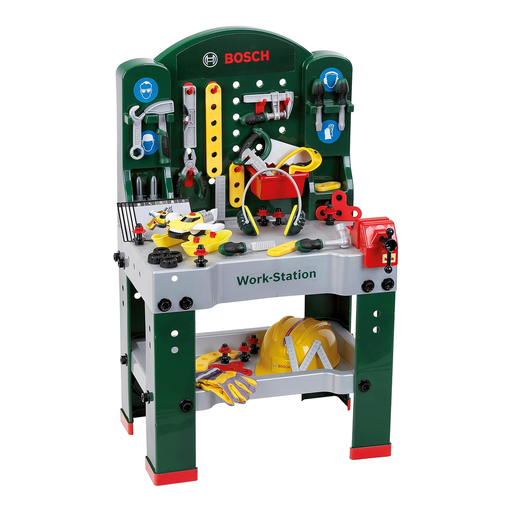
Why it suits this profile: This large work station is designed for children who regularly assemble and sort things, and enjoy creating different workshop-themed pretend-play scenarios.
Tools, screws and other fasteners, storage areas and a vehicle to assemble offer a range of ways to play, rather than just one effect.
Measures 61 × 44,5 × 101 cm, with a vice, storage box and a wide range of accessories. No batteries needed.
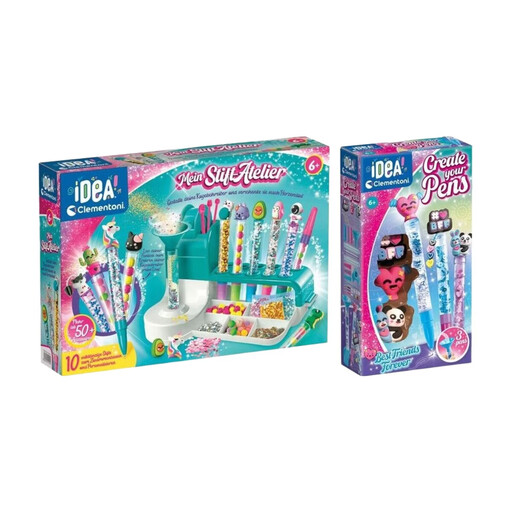
Why it suits this profile: This set is designed for children aged 6 and over who want a specific DIY project for creating and personalising their own designs.
It has a clearly defined project, rather than promising open-ended pretend play with no finished result.
A work station, tools and decorations for designing your own pens. No batteries needed.
We’ve put together a complete, regularly updated list of products that meet these strict selection criteria and fully comply with the safety regulations in force in the EU.
Choose a model with an official age recommendation of 3 and over and clear safety warnings. Also check its size, stability, small parts and whether it can be used under supervision. A compact children’s workbench or a tool set in a case may be easier to manage as a first set than a large station.
It depends on the model. Before buying, allow for space to stand and play as well as the product’s dimensions. A workbench around 100 cm high needs a permanent spot. A tool case for children, on the other hand, can be put away in a cupboard or on a shelf after playtime.
No. Manual workbenches, tool cases and wooden sets work without batteries. Depending on the model, toys with a drill, jigsaw or other light and sound effects need AA or AAA batteries. Check whether they’re included and follow the battery safety instructions.