
Lieferung heute & morgen

Qualitätsgarantie

Willkommens-Angebote freischalten: KOSTENLOSE Lieferung | Bis zu 80 % RABATT | Kostenlose 30-Tage-JoyPlus-Testphase
App herunterladen
A children’s electric motorbike can be an exciting way for families to give children their first experience of a motorised outdoor vehicle. However, models vary considerably in terms of speed, seat height, drive system, battery capacity and safety features. A low-cost purchase can prove impractical if the vehicle is not suitable for the child’s height or the intended terrain.
This buying guide explains what parents and gift buyers should look out for. Electric dirt bikes for children and realistic motorcycle models for collectors are also considered separately.
A recommendation such as “for ages 3 to 8” is only a rough guide. The key factors are seat height, inside leg measurement, handlebar position and permitted weight. A child may be within the recommended age range but still be unable to reach the ground safely with both feet. Before buying, compare the child’s measurements with those stated in the product description.
A 12V children’s motorbike is not automatically less suitable than a 36V children’s electric motorbike. Voltage affects factors including motor power and handling. A 36V model may be too fast or difficult for younger children to control. For beginners, controlled speed settings, an emergency stop switch and a suitable seat height are more important than maximum power.
The stated range depends on the rider’s weight, surface, temperature, gradient and selected riding mode. An electric dirt bike for children will usually achieve its maximum range in favourable conditions. If your child will regularly ride on grass, unpaved paths or light off-road terrain, you should also consider the tyre tread, suspension, brakes and charging time.
For children aged around 3 to 6, a smaller children’s cross motorbike with 12-inch wheels may be suitable. According to the product details, the RFN Warrior Kids SX-E250 is designed for children aged 3 to 6 and a height of approximately 90 to 110 cm. Its seat height is 460 mm.
The larger SX-E350 model has 14-inch wheels and a seat height of 490 mm. According to the product data, it is intended for children aged approximately 4 to 8 and a height of around 100 to 120 cm. These figures should be treated as a guide; being able to control the vehicle safely is the priority.
Several riding modes make it easier for children to get used to the vehicle gradually. According to the specifications, the SX-E250 has three modes at 8, 12 and 25 km/h. The SX-E350 offers three modes at 15, 22 and 30 km/h. For private property or designated off-road areas, select the lowest suitable setting.
The models are not automatically approved for use on public roads. Before using one in Germany, parents should check the manufacturer’s information, local regulations and whether the intended area permits this type of use. A helmet and suitable protective clothing are advisable regardless of the maximum speed.
Look out for:
A battery-powered children’s vehicle should only be charged using the supplied charger. During charging, the battery should be placed on a dry, non-flammable surface and stored in accordance with the manufacturer’s instructions.
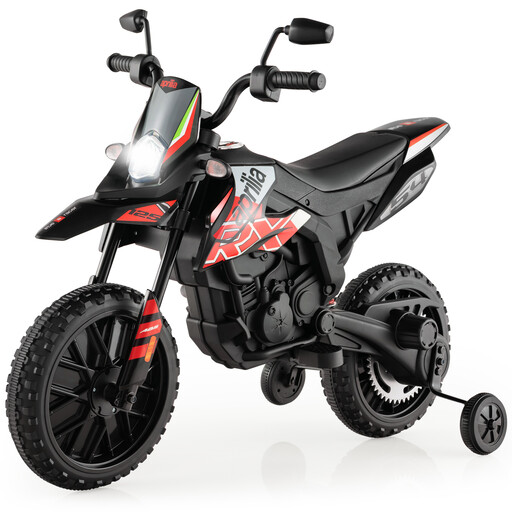
Why this product suits this profile: This 12V children’s motorbike with training wheels is aimed at buyers looking for a straightforward beginner’s vehicle with eye-catching styling.
The training wheels can provide extra balance when starting off slowly. Even so, check the seat height and specific speed figures before buying.
12V drive system, training wheels and licensed Aprilia design according to the product name.
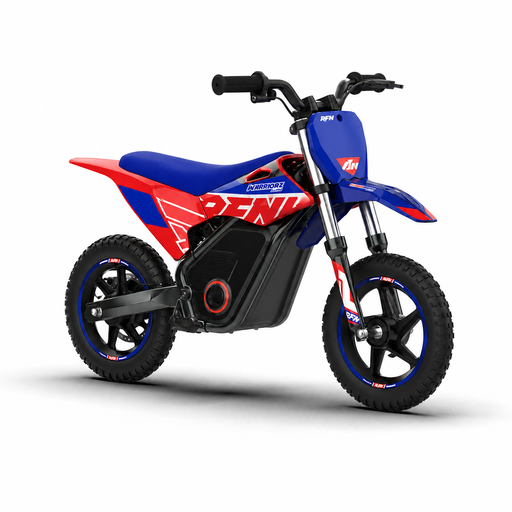
Why this product suits this profile: This children’s motocross bike combines three speed settings with a 36V battery, front-fork suspension and a rear disc brake.
The specifications clearly state the recommended age, height, seat height, range and riding modes. This makes it easier to assess the fit than relying on an age recommendation alone.
36V and 250W rating, three modes up to 25 km/h and an 18 km range according to the product data.
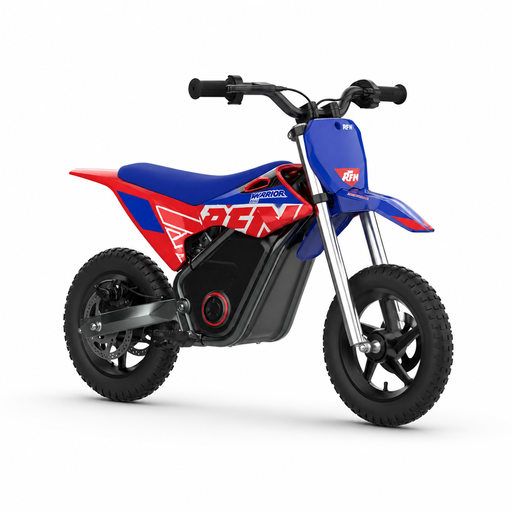
Why this product suits this profile: The 14-inch version is designed for taller children and regular use on suitable private off-road areas.
According to the product data, three riding modes and an emergency stop switch help ensure controlled use. However, the higher speed requires suitable protective equipment and supervision.
36V and 350W rating, 14-inch off-road tyres, front and rear brakes, and an 18 km range according to the specifications.
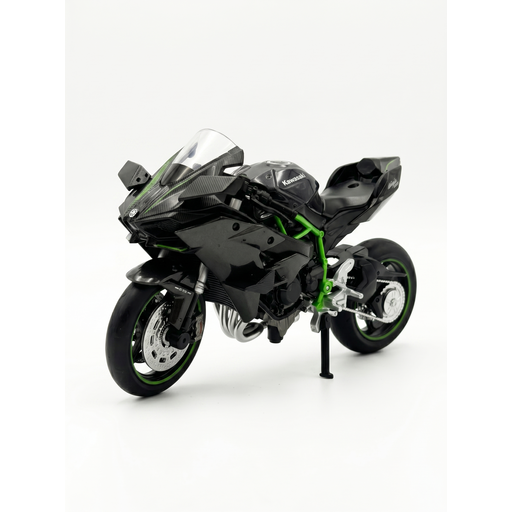
Why this product suits this profile: The Kawasaki Ninja H2R model is not an electric vehicle but a die-cast motorcycle model for display, gifting or adult motorcycle enthusiasts.
The 14+ age recommendation makes it clear that this should not be confused with a rideable children’s vehicle.
1:12 scale, movable front wheel, rolling wheels and simulated rear suspension according to the product description.
Fans of a Yamaha YZF-R1 model motorcycle can also choose from CCA versions in 1:18 scale. According to the specifications, the black model is made from zinc alloy and ABS, features a fold-out stand and simulated rear suspension, and is intended for ages 14 and over: View the Yamaha YZF-R1 Diecast Motorcycle Model. A yellow version with similar features is also available: CCA Yellow Yamaha YZF-R1 Model.
We have put together a complete, regularly updated list of products that fully meet these strict selection criteria and the safety regulations applicable in the EU.
This depends on more than age alone. The manufacturer’s recommendations, the child’s height, seat height, weight and experience all need to be considered together. For younger children, models with lower speeds and training wheels may be suitable. The first rides should take place in a clear, enclosed area under direct supervision.
The running time depends on battery capacity, riding mode, surface, temperature and load. The RFN models mentioned above have a stated range of around 18 km. This is a product figure, not a guarantee for every everyday situation. A spare battery can be useful for regular use, provided it is approved by the manufacturer.
Running costs mainly consist of electricity consumption, possible wear to the tyres or brakes, and replacing the battery at a later stage. The actual electricity cost can be calculated using the battery capacity and your local electricity tariff. It is also important to store the battery in a dry, frost-free place in accordance with the instructions.