
Lieferung heute & morgen

Qualitätsgarantie

Willkommens-Angebote freischalten: KOSTENLOSE Lieferung | Bis zu 80 % RABATT | Kostenlose 30-Tage-JoyPlus-Testphase
App herunterladen
A children’s e-scooter can provide a controlled introduction to electric mobility on private land. For parents, the priorities are less about colourful extra features and more about a suitable age range, limited speed, the right handlebar height and an easy-to-understand control system. However, product specifications vary considerably. Anyone who focuses only on range or motor power could end up buying a model that is too heavy, too fast or legally unsuitable for their child.
An e-scooter with General Operating Permit (ABE) can generally be approved for use on public roads, provided that further requirements are met. However, this does not mean that it is designed for children. A model with a top speed of 20 km/h, a 350 W motor and approval from the age of 16 is not suitable as an e-scooter for children aged 6 and over.
According to the product details, the Segway-Ninebot C2 Lite and C2 Pro E models are not approved for use on public roads. They should therefore only be used where this is legally permitted, such as on suitable private land. Before buying, parents should check the applicable German traffic regulations and the manufacturer’s instructions.
“Up to 17 km” or “up to 25–40 km” are laboratory or ideal-condition figures. They depend, among other things, on weight, temperature, gradient, riding mode and surface. For a child, charging time may also be more important than maximum range. The C2 Pro E, for example, states a range of up to 17 km and a charging time of around four hours; the C2 Lite is specified as offering up to 14 km and taking approximately 5.5 hours to charge.
An e-scooter with a Bluetooth speaker, RGB lighting or app connectivity may be appealing, but these features do not automatically make the scooter easier to use. What matters is a brake that can be reached easily, a non-slip deck, sufficient visibility and an adjustable handlebar. A foldable children’s e-scooter should also lock securely when folded and should not be able to unfold accidentally.
For younger children, a model with several limited settings is often easier to understand than a powerful e-scooter. The Segway-Ninebot C2 Pro E offers three riding modes:
With a stated top speed of 16 km/h, it falls into the 16 km/h children’s e-scooter category. The C2 Lite also has three riding modes and, according to the manufacturer’s information, is intended for children aged 6 to 10 with a height of approximately 115 to 145 cm. The stated age and height ranges should always be checked against the child’s actual development.
A children’s scooter must be suitable for the child’s body weight and height. The C2 Lite has a stated net weight of 7.8 kg and a maximum load capacity of 50 kg. The C2 Pro E weighs 10.7 kg and can also carry up to 50 kg. A heavier model may be more difficult to control when carrying, turning or putting it away.
An e-scooter with an adjustable handlebar may remain suitable for longer. Nevertheless, the lowest and highest settings should be checked. The child must be able to reach the handlebars securely without raising their shoulders significantly or fully extending their arms.
Low-maintenance or puncture-resistant tyres reduce everyday upkeep. The C2 Lite is specified with 7-inch solid tyres, while the C2 Pro E has 7-inch maintenance-free tyres. These tyres do not require conventional pressure checks, but they are not equally suitable for every surface.
A mechanical drum-brake mechanism is listed for both of the Segway-Ninebot models mentioned. Before the first ride, the child should practise controlled braking on level ground away from traffic. A protection rating such as IPX4 or IP54 only describes limited protection against splashing water. It is not approval for riding in the rain or through puddles, or for cleaning with a pressure washer.
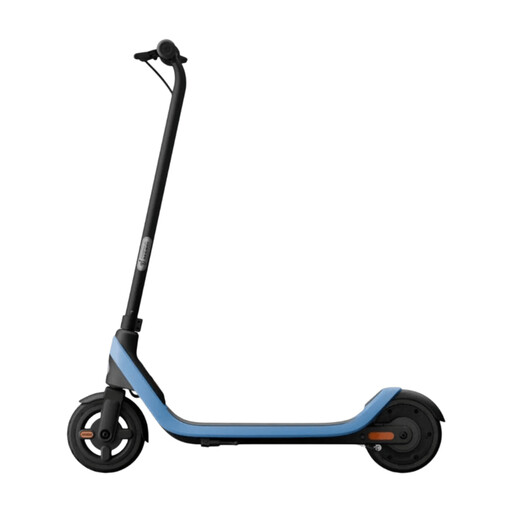
Why does it suit this profile? According to the product details, this model is intended for children aged 6 to 10 and measuring 115 to 145 cm. It is suitable for first rides on permitted private land.
Three riding modes and a top speed of 16 km/h make the choice easier to assess than an adult model with greater power.
7-inch solid tyres, drum brake, folding frame, IPX4 rating and a net weight of 7.8 kg.
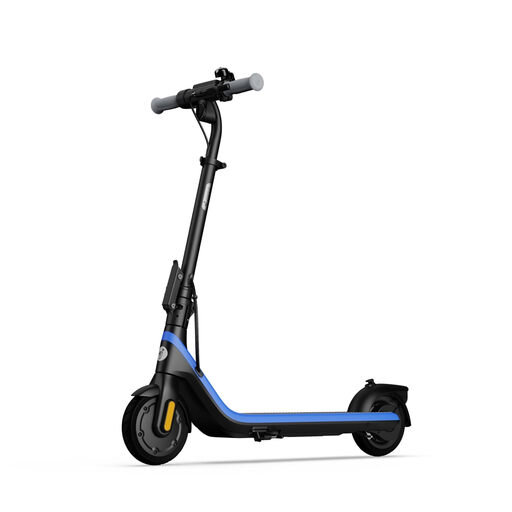
Why does it suit this profile? For children and teenagers aged 6 to 14, the adjustable handlebar height can provide a configuration that remains suitable for longer.
The age recommendation, 50 kg load capacity and three riding modes help prevent a large adult model from being mistaken for a children’s vehicle.
Top speed of 16 km/h, range of up to 17 km, folding aluminium frame and Bluetooth speaker.

Why does it suit this profile? For younger children who should first practise balancing, steering and braking without a battery or motor, this non-electric alternative is a relevant choice.
If motor assistance is not needed at first, you avoid unnecessary battery, charging and maintenance requirements.
Four wheels, adjustable height, lean-to-steer steering and a stated load capacity of up to 100 kg.
The full selection includes models with different features and intended uses. Before buying, continue to check the child’s age, load capacity, intended use and the applicable German regulations.
Models such as the TODIMART T3-ABE or an e-scooter with an ABE and 8.5-inch tyres are, according to the respective product details, intended for adults or users aged 16 and over. They are therefore not an obvious choice for an e-scooter for children and teenagers under 16, even if the speed can be technically limited.
Not every model. According to the product details provided, children’s e-scooters without the relevant approval may not be used on public roads. For approved models, you must check factors including age requirements, insurance and traffic regulations. An ABE alone does not replace a complete legal assessment.
Actual running time depends on the riding mode, weight, temperature, gradients and riding style. The stated range should therefore be treated as a guide. To maximise battery life, charge the battery according to the manufacturer’s instructions, do not modify it, and store the scooter in a dry place protected from extreme heat.
Solid or honeycomb tyres do not require regular pressure checks and are less susceptible to conventional punctures. However, you still need to inspect them for cracks, foreign objects, unusual wear and a secure fit. Puncture-resistant tyres do not automatically make a children’s e-scooter suitable for wet or uneven paths.