
Lieferung heute & morgen

Qualitätsgarantie

Willkommens-Angebote freischalten: KOSTENLOSE Lieferung | Bis zu 80 % RABATT | Kostenlose 30-Tage-JoyPlus-Testphase
App herunterladen
Children’s games from 4 years should combine easy-to-understand rules, suitable challenges and durable playing materials. However, choosing the right game is not always easy for parents, grandparents and families: many packages promise learning progress or particularly long-lasting fun, even though important details only become clear in the small print.
This buying guide explains what to look for in children’s board games, card games for children and family games for children. The selection takes account of recommended age, number of players, game mechanics, materials and practical use in everyday family life in Germany.
“From 4 years” does not automatically mean that every four-year-old can play a game without help. Some games already require reading, recognising number sequences or maintaining concentration for longer periods. Others use simple movements, pictures or colours, making them easier to access.
You should therefore check:
Children’s games from 3 years often have particularly simple rules. Children’s games from 5 years, on the other hand, may already include initial tactical decisions or more complex matching tasks.
Board games, dice games for children and card games often contain small playing pieces, cards or dice. According to the manufacturers’ information, the products in this selection are not suitable for children under 3 years where small parts pose a choking hazard. Depending on the game, adult supervision is recommended for children aged 4 to 5.
Look out for:
An educational game for children does not automatically have to teach school subjects. Depending on the game mechanics, the focus may be on number sequences, colour recognition, hand-eye coordination, reaction skills or social rules, for example. The important thing is that the learning objective matches the child’s development and interests.
The number of players determines whether a game is suitable for an only child, siblings or a larger family. There are many compact formats available for games for 2 to 4 players. Some products are also designed for 5 or 6 people.
A rough guide:
With strategy games for children, decisions should remain easy to understand. A gradual increase in difficulty is helpful when a game offers several rule variants. This allows the family to begin with a simplified version and introduce additional rules later.
With reaction games for children, you should also bear in mind that fast movements and auditory stimuli do not appeal to every child equally. Puzzles, sorting games or cooperative tasks can provide a calmer alternative.
Durable cardboard or plastic parts are practical for regular use. A metal case, integrated compartments or a compact travel box help keep all the pieces together. When travelling, the packed size and set-up time are also important.
For battery-operated games, check the following:
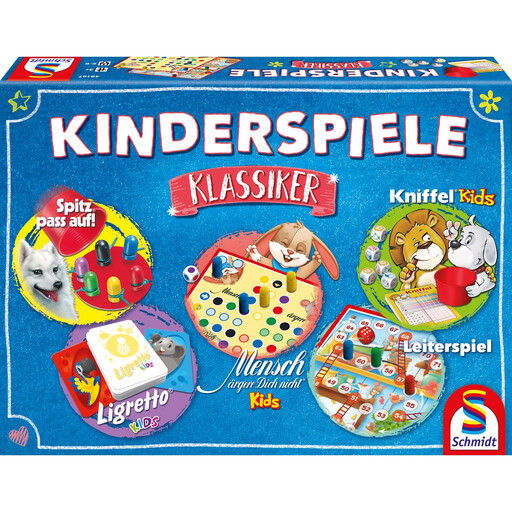
Why this product suits the profile: The collection contains five well-known game ideas and, according to the manufacturer, is intended for children from 3 years. It is suitable when one set needs to appeal to several age groups.
Several game types reduce the risk of a single game going unused because it is too difficult or too easy. Small parts should still be stored safely.
Five classic children’s games, suitable from 3 years, with no batteries required and ideal for playing together.
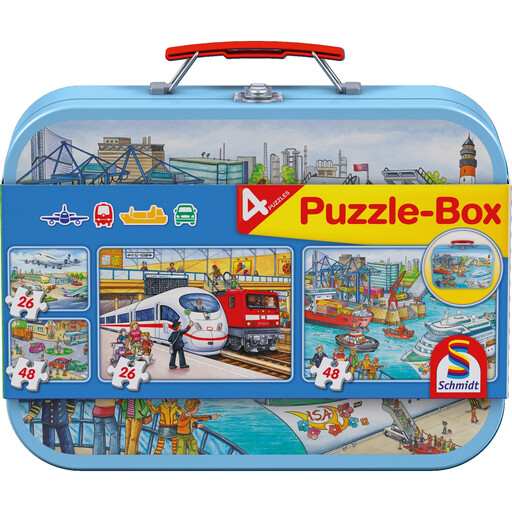
Why this product suits the profile: The puzzle box contains four designs with 26 or 48 pieces, as well as a metal case. The format is suitable for children who prefer focused, quieter activities.
The two piece counts allow the puzzle to be matched to the child’s current stage of development. Posters with cut lines help children get started.
Four vehicle designs, metal storage case, matt surface and a recommended age of 4 years and over.
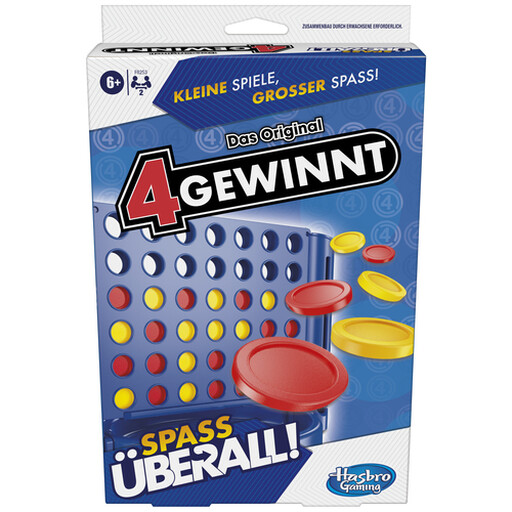
Why this product suits the profile: The compact version is designed for two players aged 6 and over and folds away neatly. This makes it ideal for travelling, waiting times and quick games at home.
The integrated storage compartment helps prevent the common problem of lost counters. The number of players is clearly limited to two.
Folding playing board, integrated storage, 42 playing chips and simple Connect 4 rules.
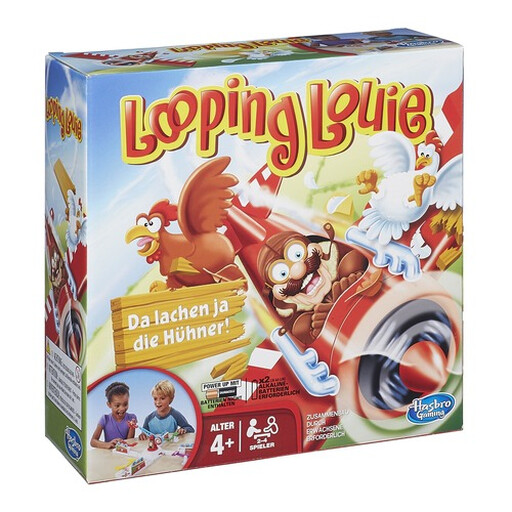
Why this product suits the profile: According to the product information, this 3D game is designed for 2 to 4 players aged 4 and over and uses a battery-powered flying mechanism. It is ideal for short, action-packed rounds and children’s birthday parties.
The number of players and approximate round length of 10 minutes are clearly stated. Before buying, check that you have batteries and enough space.
2 to 4 players, easy to use, short games and interactive plastic components.
We have put together a complete, regularly updated list of products that fully meet these strict selection criteria and the safety regulations applicable in the EU.
Games with short rules, a manageable playing time and a number of players that suits the family are suitable. Models for 2 to 4 players are ideal for parent-and-child games. For larger families, games with space for 5 or 6 players may be more practical.
That depends on the game mechanics and how the game is used. Puzzles can support matching skills and fine motor skills, while card games can help children recognise colours or numbers. Depending on how they are played, reaction and dice games can promote attention, understanding of rules and the ability to deal with winning and losing. No medical or therapeutic effect can be inferred from this.
Their lifespan depends on the materials, storage and frequency of use. Cards should be stored in a dry place, preferably in a box. Games with lots of small parts benefit from organised storage. Before each use, check for damaged pieces and replace them if necessary.