
Lieferung heute & morgen

Qualitätsgarantie

Willkommens-Angebote freischalten: KOSTENLOSE Lieferung | Bis zu 80 % RABATT | Kostenlose 30-Tage-JoyPlus-Testphase
App herunterladen
A Chinese cleaver can chop vegetables, mince herbs and, depending on the design, portion meat. Its broad blade is reminiscent of a kitchen cleaver, but that doesn’t mean it’s automatically suitable for every hard ingredient. If you focus only on a shiny finish or bold marketing claims, you could end up with a knife that doesn’t suit the way you like to chop.
A large kitchen cleaver looks robust. But blade thickness, steel type, grind and intended use all matter too. A Chinese kitchen knife with a thin edge is often better suited to slicing and chopping vegetables than cutting through hard bones. Using it incorrectly can damage the edge and blade faces.
The term stainless steel cleaver only tells you which broad material group the knife belongs to. On its own, it reveals little about hardness, corrosion resistance or how easy the knife is to sharpen. Carbon steel isn’t necessarily unsuitable either: it may need different care and should be dried straight after washing. Check that details about the steel, hardness and care are clearly stated before you buy.
A very sharp edge makes precise cuts easier, but it doesn’t make up for poor balance. A heavy kitchen cleaver can be useful for chopping, but it needs to be handled with control. A lighter model is often easier to manoeuvre for herbs, leeks and vegetables than a hefty meat cleaver. So it’s the intended use that matters, not just the weight highlighted in the product listing.
For many households, a blade length of around 170 to 210 mm is versatile enough for everyday use. A 190 mm model can offer plenty of space for vegetables and meat while usually being easier to manoeuvre than a much longer cleaver. A wider blade makes it easier to scoop up chopped ingredients, while a more compact shape can be more comfortable to use with a small chopping board.
Also pay attention to the blade grind:
When choosing a stainless steel knife, the specific steel grade and care instructions tell you more than the general term ‘rust-resistant’. According to the product details, the Japanese cleaver from COOKER KING is made from 7Cr17MoV stainless steel and has a stated hardness of 58 ± 2 HRC. This manufacturer’s specification provides a technical point of comparison, but it isn’t a general quality rating for all knives.
Carbon steel models can hold an edge well, but are more sensitive to moisture and acidic foods. Whatever the material:
The product information should clearly state whether a knife is dishwasher-safe. The product description for the ZWILLING Professional S Meat Knife recommends hand washing and rules out cleaning it in a dishwasher.
A safe handle should feel secure in your hand, even when your hands are dry. Wooden handles can feel comfortable, but need to be stored somewhere dry. According to the product details, Pakkawood is used as a moisture-resistant handle material on the COOKER KING model. A full-tang construction and multiple rivets can indicate a sturdy build, but you should still check the handle joint and overall finish.
Use a cleaver only on a stable chopping board. Hard glass or stone surfaces can blunt the edge more quickly. Keep unprotected knives out of children’s reach.

Why this product suits this profile: With a stated blade length of 190 mm, it’s a manageable, versatile option for everyday chopping tasks involving vegetables and meat.
The stated blade length makes it easier to choose the right knife, rather than relying solely on vague claims such as ‘extra robust’.
190 mm blade; designed as a Chinese kitchen knife for slicing and chopping at home.
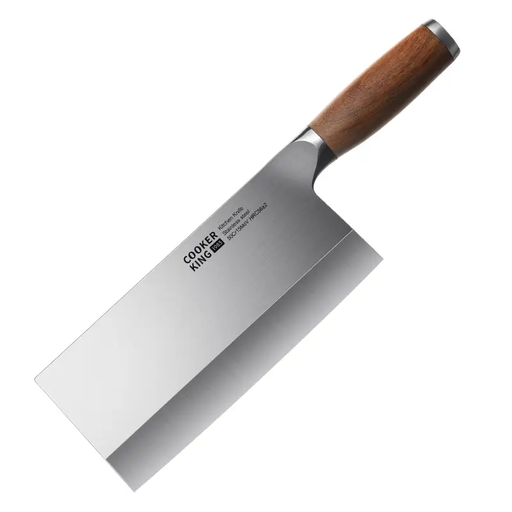
Why this product suits this profile: If you want to compare the material, hardness rating and handle construction before buying, this knife comes with several technical specifications.
The product details specify 7Cr17MoV, 58 ± 2 HRC and a 15-degree double bevel, rather than relying on vague claims about sharpness.
According to the product details, it features a full-tang construction with three rivets, a Pakkawood handle and a mirror-polished blade.
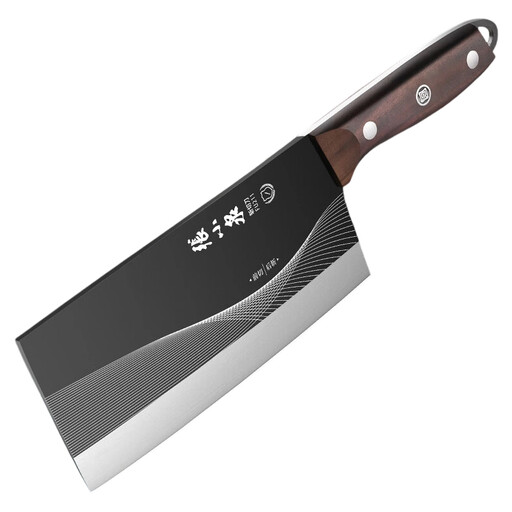
Why this product suits this profile: The stated length of 313 mm and its description as a bone-cutting knife make it suitable for specialist, heavier-duty chopping tasks.
Its specialist purpose is clear from the product name, making it easy to distinguish from a fine vegetable cleaver designed for precise everyday cuts.
313 mm model; described as a stainless steel bone-cutting knife. Designed for controlled use on a suitable surface.
The ongoing costs of owning a cleaver mainly come from care, occasional sharpening and, if needed, a protective storage solution. A knife block, magnetic strip or blade guard helps prevent the knife from coming into contact with other kitchen utensils. Sharpening should suit the existing grind; an unsuitable pull-through sharpener can alter the edge geometry.
Don’t use a chef’s knife for chopping frozen foods, metal surfaces or other hard objects unless the manufacturer specifically says it’s suitable. For bones, a Chinese bone cleaver designed for the task is a better choice. Stop using the knife if you notice any visible chips in the blade.
We’ve put together a complete, regularly updated list of products that meet these strict selection criteria and fully comply with the safety regulations in force in the EU.
Not every model. Many Chinese cleavers are designed primarily for vegetables, herbs and boneless meat. For harder bones, use a cleaver specifically designed for the job. Always follow the manufacturer’s specific instructions.
It depends on the steel, grind, cutting surface, how often you use it and how well you care for it. There’s no reliable one-size-fits-all estimate. Regular sharpening suited to the material, and drying the knife straight away, can help keep it in good working order.
Stainless steel is generally less sensitive to moisture in everyday use, but it still needs to be cleaned and dried. Carbon steel can react more quickly to acids and water. So check the care instructions for the specific product before you buy.