
Lieferung heute & morgen

Qualitätsgarantie

Willkommens-Angebote freischalten: KOSTENLOSE Lieferung | Bis zu 80 % RABATT | Kostenlose 30-Tage-JoyPlus-Testphase
App herunterladen
A Chinese cleaver can chop vegetables, rock herbs and – depending on its design – portion meat. However, many models look very similar at first glance. A wide blade does not automatically mean the knife is suitable for bones. Likewise, terms like "hand-forged" or "razor-sharp" alone tell you little about everyday usability, care and safety.
If you want to buy a Chinese kitchen knife or a Chinese cleaver, you should therefore avoid three typical pitfalls in particular:
For many kitchen tasks, Chinese cleavers typically have a blade length of around 17 to 21 cm. A 17 cm blade can be nimble, while 19 to 21 cm offers more surface area for larger ingredients. The right size depends on your chopping board, hand size and working style.
The distinction between a cleaver for meat and vegetables and a bone cleaver is important:
A wide blade also provides space for scooping up chopped ingredients. This makes it practical, but is not evidence of a specific cutting performance.
With a stainless steel kitchen knife, easy cleaning is usually the main focus. However, rust-resistant steel is not completely maintenance-free: salt, acids and prolonged exposure to moisture can affect the surface. After use, the blade should be rinsed and thoroughly dried.
Blades made from high-carbon steel can offer high hardness and good edge retention, but are more sensitive to moisture. With such models, immediate drying and occasional oiling are part of the care routine. A forged version can feel sturdy thanks to its one-piece construction; however, "forged" does not replace specific information about the steel, hardness or blade geometry.
Some models list technical values. The COOKER-KING model, for example, is described with 7Cr17MoV stainless steel and a hardness of 58 ± 2 HRC. The Zwilling PRO Set specifies FRIODUR and SIGMAFORGE processes as well as approximately 57 HRC. Such details are more helpful than generic advertising claims, but should always be cross-checked with the manufacturer's data for the specific item.
A cleaver with a wooden handle can feel comfortable in the hand, but requires extra attention after washing. Wood should not be left in water for long periods and is generally not dishwasher-safe. Plastic handles are usually easier to clean. High-quality series often feature full tang constructions and multiple rivets, which make the handle build more transparent.
Also pay attention to:
Dishwasher suitability is a manufacturer's specification, but hand washing can preserve the sharpness and surface for longer. The knife must be completely dry before being put away.
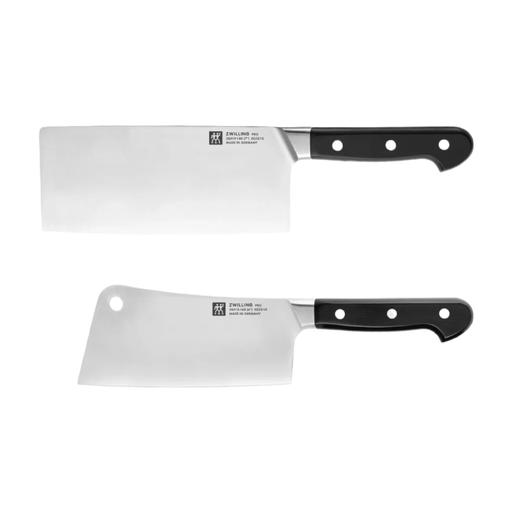
Why this product fits the profile: The two-piece set covers two different tasks: the Chinese chef's knife is intended for vegetables, fish, fruit and meat, while the cleaver is for meat and bones.
The separate areas of use help prevent a lightweight all-purpose knife from being used on bones. The blade lengths of 16 and 18 cm are clearly stated.
FRIODUR and SIGMAFORGE specifications, rust-resistant special steel and an ergonomic handle with three rivets.
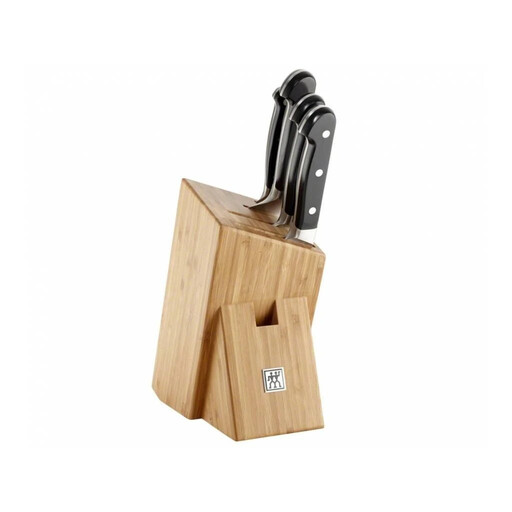
Why this product fits the profile: The set is aimed at households that want to store a Chinese kitchen knife, Santoku knife, paring knife and cleaver together.
The bamboo block provides fixed storage slots. The description states blade lengths of 10, 16 and 18 cm as well as a full tang construction.
Four knives, FRIODUR stainless steel, approximately 57 HRC and a handle with three rivets; hand washing is recommended.
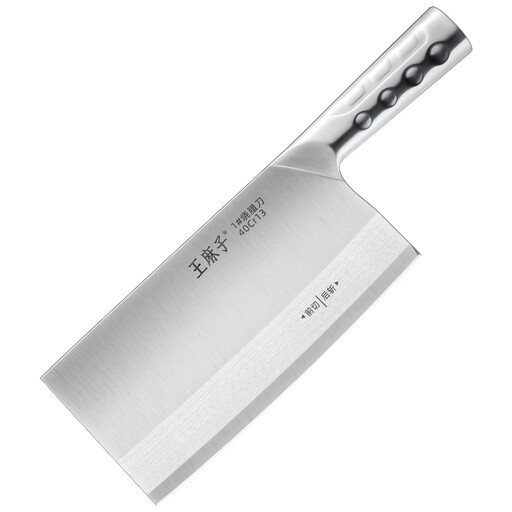
Why this product fits the profile: The 210 mm blade is of interest to users who regularly chop larger quantities of vegetables or prepare meat when cooking Asian dishes.
The product description indicates high-carbon steel. This makes it clear that careful drying is more important than with a stainless steel kitchen knife.
210 mm blade, wooden handle and design for slicing, dicing and chopping; follow care instructions for carbon steel.
Use a Chinese cleaver only on a stable chopping board. Cut with controlled movements and avoid twisting the blade sideways. A kitchen cleaver model intended for bones should not be used for fine rocking if its blade is too thick or heavy for that purpose.
Care includes:
We have compiled a complete, regularly updated list of products that fully meet these strict selection criteria and the safety regulations in force in the EU.
Only a cleaver expressly designed for the purpose should be used on bones. A Chinese chef's knife with a thin edge is intended for vegetables, herbs, fish and boneless meat. The product description and warning notices must state the intended use.
It is not possible to give a reliable fixed lifespan. It depends on the steel, edge angle, what you cut, your chopping board and care. Hard surfaces, dishwasher cleaning and lateral stress can dull the edge more quickly. Regular, material-appropriate sharpening helps maintain usability.
A kitchen knife set is practical if you need to cover several tasks and want to store the knives safely. However, if you mainly chop vegetables and herbs, a single Chinese chef's knife is often sufficient. When choosing, actual blade lengths and intended uses are more important than the sheer number of pieces.