
Lieferung heute & morgen

Qualitätsgarantie

Willkommens-Angebote freischalten: KOSTENLOSE Lieferung | Bis zu 80 % RABATT | Kostenlose 30-Tage-JoyPlus-Testphase
App herunterladen
A Chinese chef's knife, often called a Chinese Cleaver, is a versatile tool in Asian and international cuisine. Its characteristic rectangular blade functionally distinguishes it from European chef's knives. The Wang Ma Zi brand, with origins dating back to the 17th century, is renowned for crafting traditional, forged blades. This article analyses the technical specifications and selection criteria for a Wang Ma Zi Chinese Chef's Knife and presents two specific models.
The decision for a suitable Chinese chef's knife should be based on an analysis of objective parameters. The following technical aspects are relevant to your selection.
Most traditional Wang Ma Zi knives are crafted from carbon steel. Unlike stainless steel, carbon steel chef's knives have a higher carbon content.
A forged chef's knife is shaped from a single piece of steel under heat and pressure. This process compresses the steel's molecular structure, resulting in a denser, more stable blade. Stamped knives, by contrast, are cut from a sheet of steel. Forged blades, typical of Wang Ma Zi, generally offer greater durability and improved edge retention.
Chinese chef's knives are primarily divided into two categories, distinguished by the blade's thickness and geometry:
The choice between a slicer and a chopper depends directly on the intended application.
The handle's construction influences the knife's balance, control, and longevity. A full-tang construction is a hallmark of quality. In this design, the steel of the blade extends through the entire handle. This ensures optimal weight distribution between the blade and handle and significantly increases the knife's overall stability. Wooden handles offer a pleasant feel and grip but also require maintenance to prevent them from drying out.
Based on the technical criteria above, we present two models from Wang Ma Zi's Shenmu series.
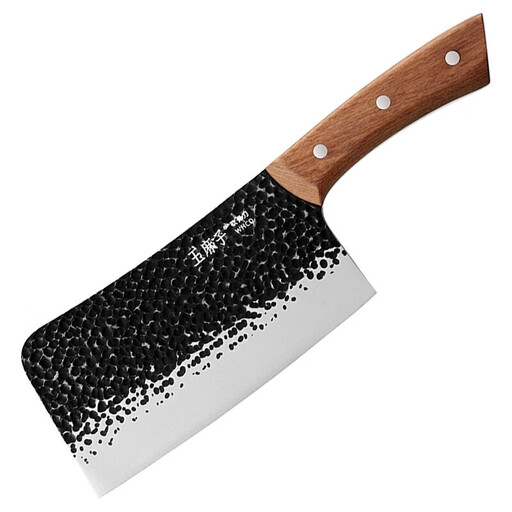
Why We Recommend This Product This model, with its 170 mm blade, is designed as a classic slicer. The carbon steel blade enables precise and effortless cuts when preparing vegetables, herbs, and boneless meat. Its full-tang construction ensures balanced handling and high durability. The star pattern finish on the blade's spine is a purely aesthetic detail that alludes to traditional forging techniques.
Pros:
Who It's For:
View Product: Wang Ma Zi Shenmu Series Star Shine - 170 mm

Why We Recommend This Product With its 190 mm blade, this model is designed as a robust chopper for demanding tasks. The blade is forged from wear-resistant steel and has the necessary thickness and weight to dice vegetables, break down meat, and even cut through bone. The full-tang construction provides the required stability and power transfer. Its Shenmu wood handle is ergonomically shaped and offers a non-slip grip, even when wet.
Pros:
Who It's For:
View Product: Wangmazi Shenmu Series Star Shine - 190 mm
The models featured represent specific use cases within the Wang Ma Zi range. However, the Chinese chef's knife segment includes a wide variety of blade lengths, weights, and materials optimised for different preferences and tasks. Those looking to buy a Chinese Cleaver and considering other designs will find a broader selection in our main category.
For a more comprehensive overview of different models, you can consult our Cleavers category.
1. What is the functional difference between a Chinese chef's knife and a European meat cleaver? A European meat cleaver is designed almost exclusively for hacking through thick bones and cartilage and has a very thick, heavy, and often wedge-shaped blade. While a Chinese cleaver (chopper) is also suitable for bones, its blade is generally thinner and more versatile. The slicer variant of the Chinese chef's knife, by contrast, is an all-purpose tool for vegetables and meat that can be handled with great precision despite its size.
2. How do you properly care for a carbon steel chef's knife? Proper care is crucial for its longevity. Follow these steps:
3. Are Wang Ma Zi knives suitable for use in professional kitchens? Yes, the materials and construction of many Wang Ma Zi knives meet the demands of professional kitchens. Features such as full-tang construction, the use of high-carbon forged steel, and ergonomic design are engineered for the high durability and sustained performance required in a professional culinary environment.