Shoppers with a specific sugar limit
If ‘sugar-free’ matters to you, check the stated sugar content per 100 g. A label such as ‘no added sugar’ doesn’t answer that question on its own.


For a chocolate snack at the cinema, an individually portioned bar is a practical choice if you want to decide in advance how much to take with you; a block is better if you prefer to portion it yourself. However, ‘no added sugar’ does not mean ‘sugar-free’: under EU Regulation (EC) No 1924/2006, a product must contain no more than 0.5 g of sugar per 100 g to be labelled ‘sugar-free’. So compare the nutrition information per 100 g and per portion, and read the ingredients and warnings about sweeteners and allergens.
If ‘sugar-free’ matters to you, check the stated sugar content per 100 g. A label such as ‘no added sugar’ doesn’t answer that question on its own.
Knowing the weight of each individual bar helps you decide how much to take with you. You’ll also need the nutrition information per 100 g to compare different bars.
When it comes to sweeteners, nuts, milk, soya or gluten-containing cereals, check the ingredients list, allergen information and any consumption advice.
First, decide whether you’re looking for a product labelled ‘sugar-free’ or simply a snack with no added sugar. Then consider the portion format and ingredients.
| Criteria | What to check | Who it matters to |
|---|---|---|
| Sugar information | Compare the ‘of which sugars’ figure per 100 g with the EU Regulation (EC) No 1924/2006 limit of no more than 0.5 g per 100 g for a ‘sugar-free’ claim. | I want to stick to a specific sugar limit and not rely solely on the front of the pack. Around 45% of shoppers put this check first. |
| Portion size | Check the weight of each bar and the nutrition information per portion and per 100 g. | For a trip to the cinema, I want to take one portion whose size I know in advance. Portion planning is the main consideration for around 33% of shoppers. |
| Ingredients and warnings | Read the information about sweeteners, highlighted allergens and consumption advice on the specific pack. | If certain ingredients or sweeteners matter to me, I need to check the labelling before buying. This is the priority for around 22% of shoppers. |
A product with no added sugar can still contain more than 0.5 g of sugar per 100 g. For example, the no-added-sugar dark chocolate listed by Lindt Deutschland contains 1.0 g of sugar per 100 g.
If you’re choosing a product labelled ‘sugar-free’, check the sugar line in the nutrition information per 100 g.
A small, individually portioned bar helps you control how much you snack on, but on its own it doesn’t show how two products compare per 100 g.
Use the figures per 100 g as a common basis for comparison, then check the information for the portion you actually want to take with you.
For the products described, polyols such as maltitol or sorbitol, and ingredients such as nuts, milk, soya or gluten-containing cereals, may affect your choice. Some products carry a warning that excessive consumption may have a laxative effect.
Read the full labelling on the relevant pack, especially if you need to avoid certain ingredients or take a consumption warning into account.
NEOH’s Peanut Chocolate Bar Zero is an individually portioned bar with no added sugar.
REWE describes ja!’s no-added-sugar chocolate muesli bars as a pack of eight 25 g bars.
Lindt’s no-added-sugar dark chocolate comes as a block rather than an individually portioned bar.
This selection includes individually portioned chocolate and cereal bars, as well as chocolate that you can portion yourself. Your choice will depend on the sugar information, the portion format you want and the ingredients listed on the pack.
 No image available
This 50 g bar is a good choice if you want an individual chocolate brownie bar of a specific weight for your trip to the cinema. Check the sugar content per 100 g and the information about sweeteners and allergens; the words ‘Sugar Free’ alone aren’t a substitute for checking these details.
 No image available
This pack of six 20 g cereal bars is handy if you want to plan a small bar-sized snack for your trip to the cinema. Compare the stated sugar content per 100 g: ‘no added sugar’ doesn’t mean ‘sugar-free’. Also check the allergen information.
 No image available
This white chocolate version is worth considering if you’d rather take a 20 g portion than a block; the pack contains six bars. Check the sugar content per 100 g and the ingredients on the specific pack before comparing it with other bars.
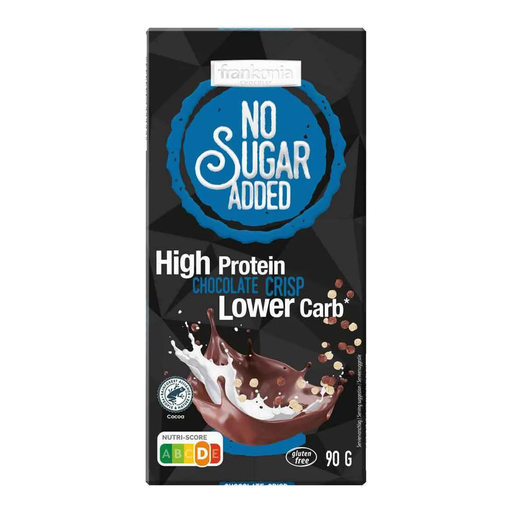 No image available
This 90 g chocolate is an option if you’d like to portion out how much you take to the cinema. Before buying, check the sugar content per 100 g, the ingredients and the packaging format; a recommended serving size doesn’t mean it comes individually wrapped.
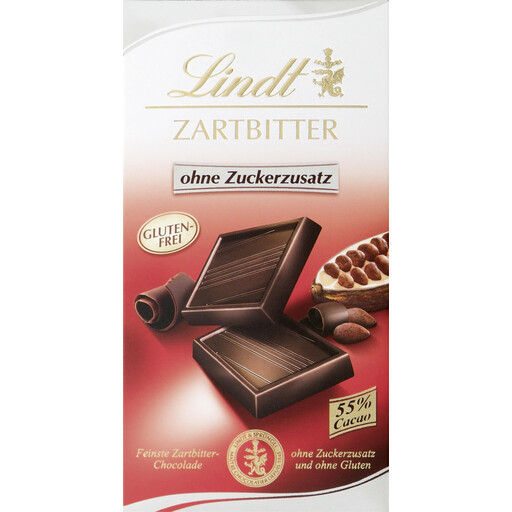 No image available
This 100 g block is a good choice if you prefer dark chocolate and want to decide on your own portion size. Lindt Deutschland states that its dark chocolate block contains 1.0 g of sugar per 100 g, which is above the EU limit for a ‘sugar-free’ claim. Also check the labelling for maltitol and allergens.
No. Under EU Regulation (EC) No 1924/2006, a product can only be labelled ‘sugar-free’ if it contains no more than 0.5 g of sugar per 100 g or 100 ml. For example, Lindt Deutschland states that its no-added-sugar dark chocolate contains 1.0 g of sugar per 100 g.
No. The ‘no added sugar’ claim doesn’t tell you how much energy a product contains. Compare the energy figures per 100 g across different bars, then use the figure per portion to assess the amount you plan to snack on.
Some products containing sweeteners such as maltitol or sorbitol carry a warning that excessive consumption may have a laxative effect. Read this warning on the specific pack and bear it in mind when choosing your portion.
Check the sugar and energy content per 100 g, the portion weight and, where available, the nutrition information per portion. Ingredients, highlighted allergens and consumption advice may also influence your choice. Check your cinema’s house rules to see whether you can bring your own snacks.