Enjoy a sweet breakfast and compare fibre
You want chocolate flavour at breakfast and compare the fibre content of specific products per 100 g, rather than relying solely on the front of the pack.


For a sweet breakfast with fibre in mind, comparing the nutritional information per 100 g is more useful than judging by the chocolate-themed packaging. Both chocolate muesli and crunchy chocolate cereal are options. The right choice also depends on the sugar content, ingredients, allergens and texture you prefer.
You want chocolate flavour at breakfast and compare the fibre content of specific products per 100 g, rather than relying solely on the front of the pack.
You’re looking for a chocolatey breakfast but also want to know the sugar content per 100 g. Fibre and sugar are listed separately in the nutritional information.
If certain ingredients aren’t suitable for you, check the labelling on the specific variety. In chocolate muesli and cereal, allergens to look out for may include gluten-containing cereals, milk, soya and nuts.
If texture is the deciding factor, first distinguish oat-based chocolate muesli from classic chocolate cereal. Then compare the nutritional values on the same per-100-g basis and check the ingredients for the variety you want.
A good fit if: You’re looking for a chocolate muesli mix that states its oat or wholegrain content.
Worth bearing in mind: Sugar levels and allergens vary between varieties here too; a wholegrain content claim doesn’t answer these questions.
A good fit if: You prefer crunchy cereal pieces to a muesli mix and check the fibre content of the variety.
Worth bearing in mind: Kellogg's lists 10 g of fibre and 20 g of sugar per 100 g for Pokémon Chocolate Flavour Cereal; these figures apply to this variety.
| Criteria | What to check when buying | Who it matters to |
|---|---|---|
| Fibre | Fibre per 100 g and the size of your portion. Under EU Regulation (EC) No 1924/2006, the claim ‘high in fibre’ requires at least 6 g per 100 g or 3 g per 100 kcal. | I mainly want to compare the fibre content of different products for a sweet breakfast. This is the main consideration when buying for around 42% of consumers. |
| Sugar | Sugar per 100 g; for claims such as ‘less sugar’, check the comparison basis stated. | I want chocolate flavour, but I don’t want to overlook the sugar content because of a fibre claim. Sugar is the main buying criterion for around 33% of consumers. |
| Ingredients and allergens | The ingredients list and allergen information on the specific pack, including for varieties described as gluten-free. | If I need to avoid certain ingredients, the labelling on the variety I choose determines what I can buy. This check takes priority for around 25% of consumers. |
These figures describe different things. Kellogg's lists both 10 g of fibre and 20 g of sugar per 100 g for Pokémon Chocolate Flavour Cereal.
Compare both figures on the same per-100-g basis and decide which matters most for your choice.
Nutritional values, wholegrain content and allergens apply to the specific variety named, not to every product from a brand.
Match the product name and pack size to the nutritional information and ingredients list of the item you want to buy.
A product description saying ‘gluten-free’ doesn’t tell you whether other ingredients or allergen information may be relevant to you.
Read the full labelling on the current pack, including highlighted allergens and any may-contain warnings.
Pokémon Chocolate Flavour Cereal is a crunchy chocolate cereal. Kellogg's lists 10 g of fibre and 20 g of sugar per 100 g for this product.
For its Chocolate Oat Muesli ‘30% Less Sugar’, REWE lists 71% wholegrain and, per 100 g, 9 g of fibre and 12 g of sugar.
REWE describes Bauck Mühle’s Chocolate Oat Muesli as a gluten-free mix and lists 8.4 g of fibre and 9.2 g of sugar per 100 g.
These three products are chocolate crunchy mueslis for shoppers looking for an oat- or wholegrain-based mix. To choose between them, compare the nutritional information and ingredients on each pack.
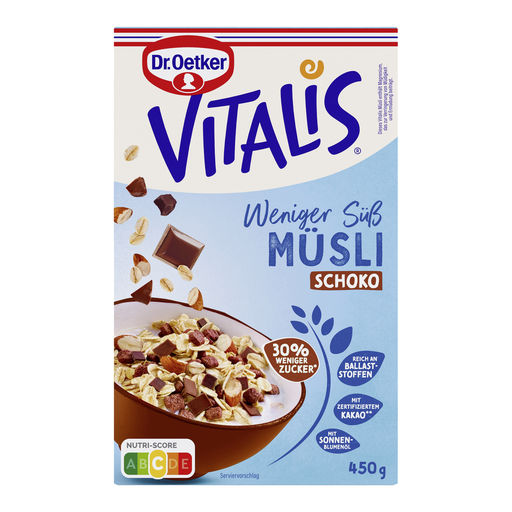 No image available
A chocolate crunchy muesli option if you’re looking for an oat-based mix. Check the fibre, sugar and allergen information on the specific pack.
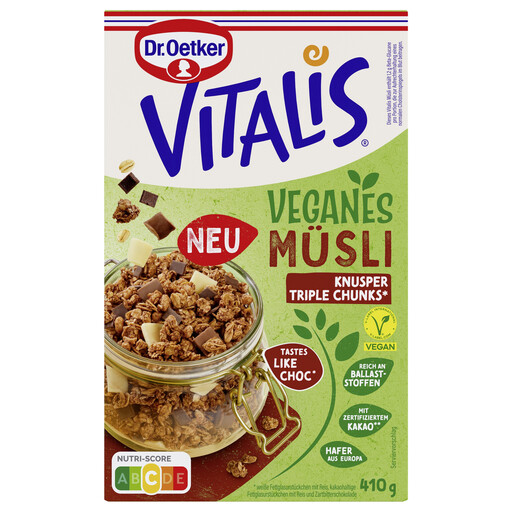 No image available
A crunchy chocolate muesli option if wholegrain oats are important to your choice. Before buying, check the sugar content and ingredients on the current pack. The product name alone doesn’t replace checking the nutritional and allergen information.
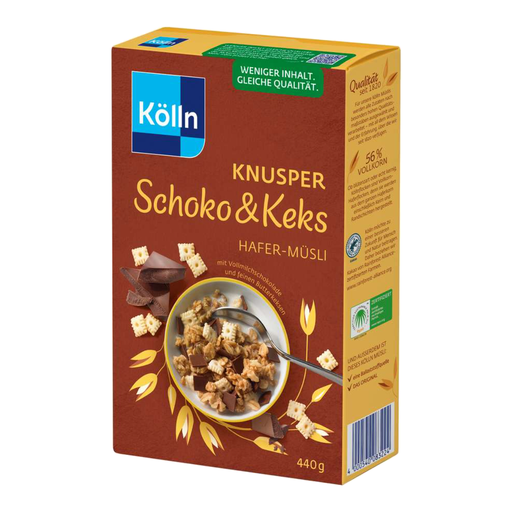 No image available
For shoppers looking for chocolate crunchy muesli with oats and biscuit pieces. Compare the sugar content per 100 g and check the allergen information on the pack you choose.
Under EU Regulation (EC) No 1924/2006, this claim requires at least 6 g of fibre per 100 g or 3 g per 100 kcal. On its own, it doesn’t tell you anything about sugar, allergens or the contribution of your portion.
The amount per portion depends on how much muesli or cereal you actually serve yourself. The German Nutrition Society recommends at least 30 g of fibre a day for adults; a breakfast portion is just one part of your total daily intake.
No. Sugar and fibre are listed separately in the nutritional information. Compare both per 100 g and, for ‘less sugar’ claims, check what the comparison is based on.
Read the ingredients list and allergen information on the specific pack. According to the Federal Office of Consumer Protection and Food Safety, the 14 main allergens must be listed and highlighted in the ingredients list; also check for any may-contain warnings.