Weekday breakfasts with a focus on fibre
You want a quick-to-serve chocolate muesli or chocolate cereal in the morning, and prefer to check its fibre content in the nutrition information rather than relying on a wholegrain claim alone.


If a high fibre content is your priority for a chocolate breakfast, check the figure in the nutrition table: under EU Regulation (EC) No 1924/2006, a ‘high fibre’ claim requires at least 6 g of fibre per 100 g or 3 g per 100 kcal. The examples from REWE and Nestlé Cereals—Vitalis Dark Chocolate Fine Muesli, NESQUIK Crunchy Breakfast and Clusters Chocolate—meet the threshold per 100 g. For everyday choices, you should also check the sugar content, ingredients, allergens and portion size.
You want a quick-to-serve chocolate muesli or chocolate cereal in the morning, and prefer to check its fibre content in the nutrition information rather than relying on a wholegrain claim alone.
You’re looking for a chocolate flavour but want to compare the sugar content of different products per 100 g. A lower sugar figure doesn’t tell you how much fibre a product contains.
You need to check the specific recipe for cereals, milk or nuts. Even if a product is labelled gluten-free or lactose-free, check its fibre content separately if that matters to your choice.
For a chocolate breakfast with a focus on fibre, check the fibre content first, then compare sugar and ingredients on the same basis. If you need to avoid certain ingredients, the information on the specific pack takes priority.
| Criterion | What to check when buying | Who it matters most to |
|---|---|---|
| Fibre | Check the fibre per 100 g in the nutrition information. Under EU Regulation (EC) No 1924/2006, a ‘high fibre’ claim requires at least 6 g per 100 g or 3 g per 100 kcal. | If I want my weekday breakfast to have a clearly high fibre content, a wholegrain claim isn’t enough for me. Around 42% of consumers would make fibre their top buying criterion. |
| Sugar | Compare the sugar and fibre figures per 100 g, using the same basis. | I want a chocolate flavour, but when choosing a regular breakfast cereal, I first check how much sugar the product contains. Around 33% of consumers would put sugar content first when making their choice. |
| Ingredients and allergens | Read the ingredients list, highlighted allergens and precautionary ‘may contain’ statements on the specific pack. | If I need to avoid certain ingredients, the recipe has to suit me before I weigh up sugar and fibre. This would be a priority for around 25% of consumers. |
A wholegrain content tells you about an ingredient; it doesn’t automatically tell you how much fibre is in the finished chocolate muesli.
Check the fibre figure in the nutrition information. EU Regulation (EC) No 1924/2006 sets a minimum of 6 g per 100 g or 3 g per 100 kcal for a ‘high fibre’ claim.
The chocolate products with at least 6 g of fibre per 100 g described by REWE and Nestlé Cereals have different sugar contents: 15 g, 22.1 g and 28.2 g per 100 g.
Compare both figures per 100 g and decide which difference matters most for your breakfast.
Chocolate cereals and chocolate mueslis can vary in the types of cereals they contain, as well as in milk, soya, almonds and other nuts. Similar names don’t mean the recipes are the same.
Check the ingredients and allergen information on the pack every time you buy, even if you’ve had the product before.
With Vitalis Dark Chocolate Fine Muesli, you can assess fibre and sugar together using the nutrition information provided by REWE.
NESQUIK Crunchy Breakfast and Clusters Chocolate offer different textures. Nestlé Cereals states that both contain 8.7 g of fibre per 100 g.
Less Sweet Chocolate Muesli is an option if you want to start by comparing the stated sugar content.
The organic chocolate muesli in this range is worth considering if you’re looking for gluten-free and lactose-free labelling.
Choco Krispies Original and Trésor Choco Nut are different chocolate cereals: Kellogg's describes one as toasted rice and the other as filled cereal pillows.
These Vitalis products are chocolate mueslis that let you compare different recipes and pack sizes for weekday breakfasts. Check the current nutrition information and ingredients on each individual pack; figures for other Vitalis varieties may not apply.
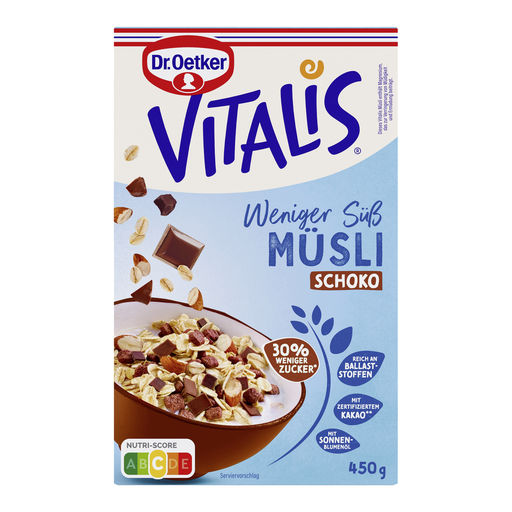 Image unavailable
A crunchy chocolate muesli option for weekday breakfasts. Compare fibre and sugar per 100 g, and check the allergen information on the pack. Pack size: 450 g.
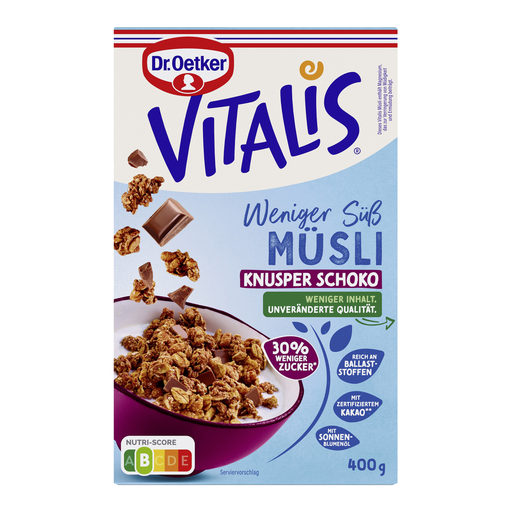 Image unavailable
Another crunchy chocolate muesli option for breakfast. Check its own fibre, sugar and allergen information rather than assuming it’s the same as other Less Sweet products. Pack size: 400 g.
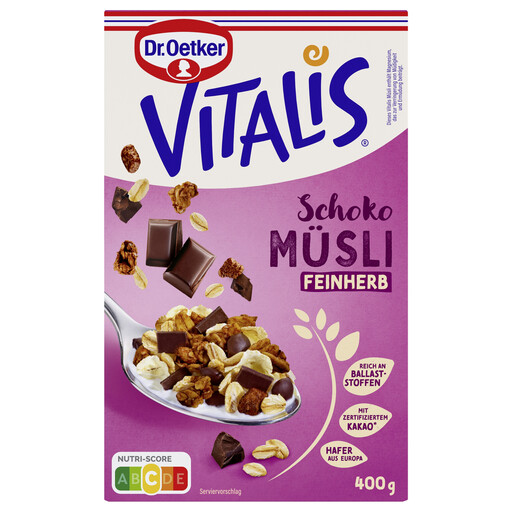 Image unavailable
A chocolate muesli described as Dark Chocolate Fine. For a fibre comparison, use the nutrition information for this specific variety, and check its ingredients and allergens too. Pack size: 400 g.
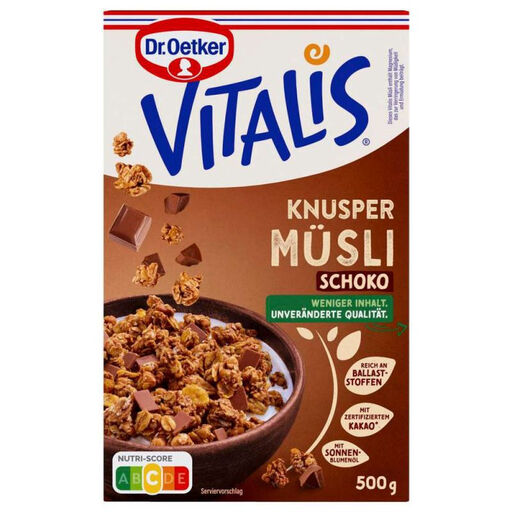 Image unavailable
A crunchy chocolate muesli in a 500 g pack. If you’re comparing it with a Less Sweet variety, check the fibre and sugar figures per 100 g for each product, as well as the allergen information.
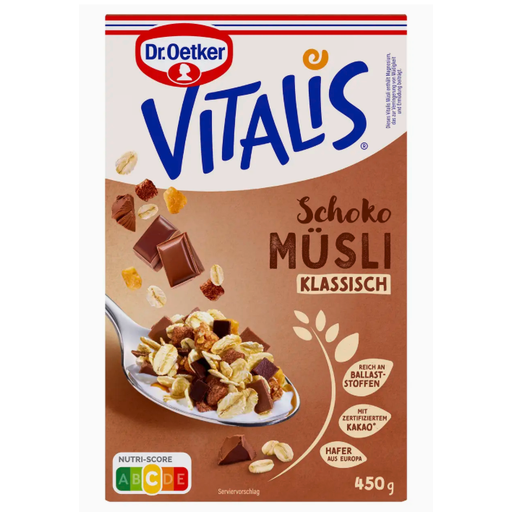 Image unavailable
A Classic chocolate muesli option for breakfast. Assess its fibre and sugar content using its own nutrition information, and check the labelling on the pack if you have any intolerances. Pack size: 450 g.
For a ‘high fibre’ claim, EU Regulation (EC) No 1924/2006 requires at least 6 g of fibre per 100 g or at least 3 g per 100 kcal. When comparing dry cereals, you can line up the stated figures per 100 g.
No. A wholegrain claim doesn’t replace the fibre figure for the finished product. Check the nutrition information for the specific chocolate muesli if a high fibre content is one of your buying criteria.
The suggested serving size on the pack can be a useful starting point. Include the amount you actually eat and any extras, such as milk, yoghurt or fruit, when considering your breakfast portion. Store opened muesli in a cool, dry place in a tightly sealed container.
Read the ingredients list, highlighted allergens and any precautionary ‘may contain’ statements on the specific pack you’re buying. The Federal Ministry of Agriculture, Food and Home Affairs explains ingredient and allergen labelling for prepacked foods. If you buy the product again, check the current pack, as recipes can change.