Hoteliers focusing on fibre
You want to offer a chocolate cereal whose declared fibre content meets the condition for a ‘high in fibre’ claim. Wholegrain content alone won’t tell you whether it does.


For a chocolate cereal to be described as ‘high in fibre’ on a German hotel buffet, its declared fibre content is key: EU Regulation (EC) No 1924/2006 sets at least 6 g per 100 g as one of the conditions for this claim. Nestlé declares 8.7 g per 100 g for both Clusters Schoko and Nesquik Knusperfrühstück; Kellogg’s declares 6.0 g per 100 g for Choco Krispies Chocos. For buffet service, also check the allergens on the pack you receive and decide whether open containers or individual portions are better suited to your operation.
You want to offer a chocolate cereal whose declared fibre content meets the condition for a ‘high in fibre’ claim. Wholegrain content alone won’t tell you whether it does.
If you serve cereals loose, you need to make the information on the relevant pack available to guests. Depending on the product, allergens such as cereals containing gluten, milk, soya or almonds may be relevant.
You want to serve cereals in individual portions and make replenishing them straightforward. Check the product’s nutritional information to confirm whether a chocolate cereal also meets your fibre requirement.
First, check the nutritional information for the specific chocolate cereal. Then consider the ingredients, allergen information and serving format to decide how the product will work on your buffet.
| Criteria | What to check when buying | Who it matters to most |
|---|---|---|
| Fibre content | For a ‘high in fibre’ claim, compare the figure per 100 g with the EU condition of at least 6 g. The nutritional information on the pack you receive is what counts. | If I specifically want to offer a chocolate cereal with this nutritional claim, I need to see the right figure on the pack, not just a mention of wholegrain. Around 42% of consumers are likely to put this evidence first. |
| Serving format | Consider whether open containers or individual portions suit your operation’s replenishment process and guest information requirements. If choosing portions, check the fibre content of the specific product separately. | If we replenish the buffet frequently, I want a serving format that fits our routine. For around 33% of consumers, buffet service is likely to be their main reason for buying. |
| Allergen information | Check the ingredients and allergen advice on the current packaging for each variant, and make this information available to guests when serving cereals loose. | If we decant cereals into open dispensers, guests need to be able to see which allergens each product contains. Around 25% of consumers are likely to prioritise this information. |
Wholegrain content is no substitute for the fibre figure. Nestlé declares 42.6% wholemeal wheat flour in Cini Minis Churros, but 5.3 g of fibre per 100 g. This product is therefore below the EU condition of 6 g per 100 g.
For every chocolate cereal carrying this claim, check the fibre figure per 100 g on the pack.
According to the Federal Ministry of Agriculture, Food and Home Affairs, allergen information is also required for unpackaged goods. At an open buffet, it must remain clearly linked to the cereal being served.
Keep the latest product and allergen information to hand for each container, and update it whenever the product or recipe changes.
Individual portions can be practical for buffet service, but they don’t prove that a product meets a particular nutritional claim. CaterPoint lists HELLMA Bio-Schoko-Müsli in 45 g portions for hotel breakfast buffets.
Before ordering, check the nutritional information for that specific portioned product if you plan to serve it as ‘high in fibre’.
Nestlé notes that when recipes change, packs with the old and new recipes may be available in shops at the same time. For buffet labelling, the version you actually receive is what matters.
When your delivery arrives, check the ingredients, allergens and fibre information on the packaging.
Nestlé declares 8.7 g of fibre per 100 g for both Clusters Schoko and Nesquik Knusperfrühstück.
Kellogg’s declares 6.0 g of fibre per 100 g for Choco Krispies Chocos.
CaterPoint lists HELLMA Bio-Schoko-Müsli in 45 g individual portions for hotel breakfast buffets.
A chocolate rice cereal in a 420 g pack is listed here. It is not the same product as Kellogg’s Choco Krispies Chocos, for which a fibre figure is given above. Before planning to include the Joybuy product in a buffet selection with a specific fibre claim, check the figure and allergen information on the pack you receive.
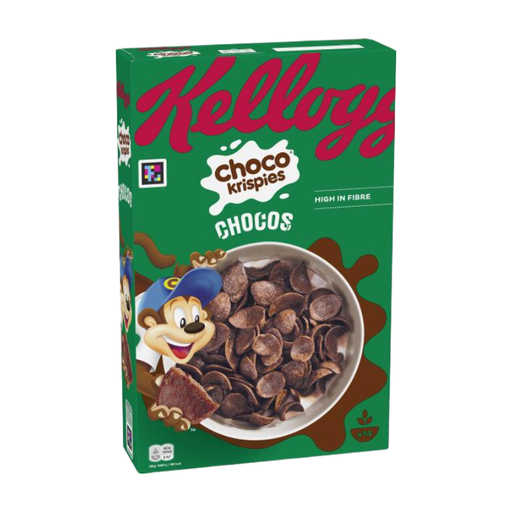 No image available
This product could work as a chocolate cereal for the breakfast buffet if the information on the pack you receive meets your fibre requirements and allergen information needs.
The product name describes it as chocolate rice cereal in a 420 g pack.
Under EU Regulation (EC) No 1924/2006, at least 6 g of fibre per 100 g is one of the conditions for this claim. Check the declared fibre content of the specific product; wholegrain content alone isn’t enough to support the claim.
Nestlé declares 8.7 g per 100 g for both Clusters Schoko and Nesquik Knusperfrühstück; Kellogg’s declares 6.0 g per 100 g for Choco Krispies Chocos. These figures apply to the variants named, not to similarly named products.
Yes. According to the Federal Ministry of Agriculture, Food and Home Affairs, allergen information must also be available for unpackaged goods. Link the information from the current packaging to the relevant buffet container.
Not necessarily. Individual portions can make serving and replenishment easier, but the right choice depends on how your buffet operates. The format also doesn’t tell you whether the specific chocolate product meets your fibre requirement.
No. If the product you serve or its recipe changes, the information must match the goods actually being served. Nestlé notes that old and new recipes may be on sale at the same time for a while, so check the packaging you receive.