Parents keeping an eye on sugar
If you’re planning to serve chocolate-flavoured cereal for breakfast, the sugar content matters just as much as the fibre. Gesund ins Leben recommends limiting sugar and sweets for toddlers.


When choosing breakfast cereal for a toddler, don’t base your decision on fibre alone. Check the sugar content, ingredients and allergen information on the specific pack too. Under Regulation (EC) No 1924/2006, published on EUR-Lex, the claim ‘high fibre’ requires at least 6 g of fibre per 100 g or 3 g per 100 kcal. Gesund ins Leben recommends limiting sugar and sweets for toddlers.
If you’re planning to serve chocolate-flavoured cereal for breakfast, the sugar content matters just as much as the fibre. Gesund ins Leben recommends limiting sugar and sweets for toddlers.
If you’re looking for a clear picture of the cereal base, check the wholegrain ingredients and fibre information on the pack. A wholegrain claim doesn’t replace the fibre figure per 100 g.
If you have allergies or intolerances, the ingredients and allergen information on the specific pack take priority over flavour or brand. Lebensmittelklarheit lists wheat, barley and oats among cereals containing gluten.
Start by comparing sugar and fibre using the same measure. Then check the ingredients and allergen information on the product you’re actually buying.
| Criterion | What to check when buying | Who it matters most to |
|---|---|---|
| Sugar and fibre | Compare ‘of which sugars’ and fibre per 100 g; also read the ingredients list. | I want to offer a chocolate flavour without overlooking the sugar content behind a fibre claim. For around 50% of consumers, keeping sugar as low as possible is likely to be the main priority when buying. |
| Wholegrain and fibre content | Check the wholegrain ingredients and the stated fibre content. Under Regulation (EC) No 1924/2006, published on EUR-Lex, the claim ‘high fibre’ requires at least 6 g per 100 g or 3 g per 100 kcal. | If a clear wholegrain base matters more to me, I want to see the fibre content directly on the pack. Around 30% of consumers are likely to put this evidence first. |
| Ingredients and allergens | Read the current ingredients list and highlighted allergen information. Check again if the recipe changes. | If I have an allergy or intolerance, I need to check whether the specific pack is suitable before serving it. For around 20% of consumers, this check is likely to take priority. |
The fibre figure doesn’t tell you how much sugar a product contains. Nestlé Cereals Deutschland gives the cinnamon cereal CINI MINIS as containing 6.4 g of fibre and 24 g of sugar per 100 g; it isn’t a chocolate cereal.
Check both nutritional values together and compare products using the same measure.
A product name alone doesn’t tell you how much fibre that particular variety contains. A claim such as ‘less sugar’ doesn’t replace checking the sugar content either.
Check the nutritional information and ingredients on the current pack rather than judging varieties by their names alone.
Cereal ingredients and other allergen information vary between products. For example, Nestlé Cereals Deutschland lists wheat and barley malt extract in the ingredients for CINI MINIS.
Check the pack again every time you buy, especially if allergies or intolerances are a concern.
A fibre figure alone doesn’t prove that a cereal provides sustained energy or makes a complete breakfast. Gesund ins Leben emphasises a varied diet for toddlers.
Assess the cereal as part of the whole meal, rather than judging it by a single nutritional value.
CINI MINIS is a cinnamon cereal, so it isn’t a direct alternative to chocolate cereal.
EDEKA24 lists several Kölln chocolate oat mueslis as possible products to compare by pack.
EDEKA24 lists ‘Knusper Triple Choc Müsli’ under its EDEKA Herzstücke own-label range.
According to a Lidl announcement from January 2024, Crownfield is an own-label brand in its cereal range.
This selection features two chocolate mueslis. For a toddler’s breakfast, check the sugar, fibre, ingredients and allergens for each variety on the current pack.
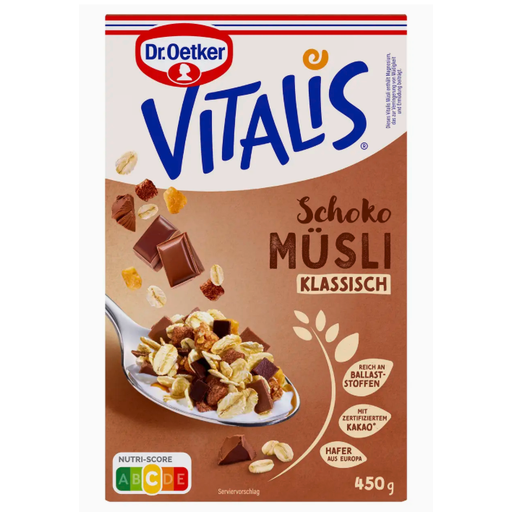 No image available
If you’re considering a chocolate muesli for breakfast, compare the sugar and fibre content per 100 g for this variety. Before serving, check the ingredients and allergen information on the pack.
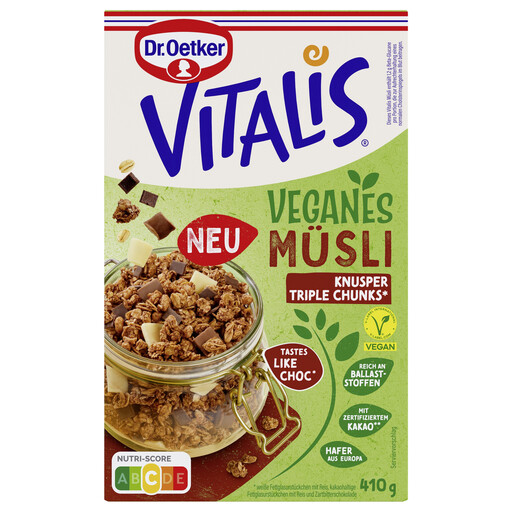 No image available
If you’d like to compare a Triple Choc muesli, the sugar content on the current pack is key. Check the fibre content, ingredients and allergen information too before including it in a toddler’s breakfast.
Under Regulation (EC) No 1924/2006, published on EUR-Lex, this claim requires at least 6 g of fibre per 100 g or 3 g per 100 kcal. On its own, it says nothing about the sugar content or whether the product is suitable for a toddler’s breakfast.
There’s no one-size-fits-all answer for chocolate cereal: it depends on the specific product and the meal as a whole. Gesund ins Leben recommends plenty of plant-based foods, including cereals and wholegrains, as part of a toddler’s diet, while limiting sugar and sweets.
Read the ingredients list and highlighted allergen information on the current pack. Lebensmittelklarheit lists wheat, rye, barley and oats among cereals containing gluten. A brand name is no substitute for checking the individual product.
No. According to the recommendations from Gesund ins Leben, healthy toddlers can have a balanced diet without products specifically marketed at children. Instead, check the ingredients and nutritional information for the specific product as part of the rest of the breakfast.