What should you look for when buying?
Start by comparing fibre and sugar per 100 g across similar products. Then consider the ingredients and pack size to find an option that suits your household and how much you plan to use during the week.
| Criteria |
What to check when buying |
Who it matters to |
| Fibre |
Check the fibre per 100 g in the nutritional information. Under EU Regulation (EC) No 1924/2006, ‘high in fibre’ means at least 6 g per 100 g or 3 g per 100 kcal. |
If you want a chocolatey taste but make the fibre threshold your main buying criterion, you’ll need to check the value for the specific variety. This is the main concern for around 36% of consumers. |
| Sugar |
Compare sugar per 100 g in similar chocolate muesli or chocolate cereals. For ‘less sugar’ claims, check what the product is being compared with. |
If you’re looking for a less sweet variety, you’ll want to understand the stated sugar content rather than rely on the claim on the pack alone. Around 29% of consumers put this ahead of other buying criteria. |
| Ingredients and allergens |
Check the ingredients list, highlighted allergens and, where relevant, any ‘may contain’ warnings on the pack. |
If anyone in your household has specific allergen requirements, the variety needs to be suitable for everyone who will be eating it. For around 14% of consumers, suitability is the main factor when choosing. |
| Pack size |
Check the pack size against how much you plan to use during the week and the space you have for storage. |
If you’re buying for several breakfasts, you’ll want to avoid buying too little or choosing a pack that doesn’t suit your household’s needs. Around 21% of consumers make this their top priority. |
Chocolate muesli for your weekly shop
The following Joybuy products are chocolate muesli in a range of varieties and pack sizes. Choose a variety based on its nutritional information and ingredients, and a pack size that suits your weekly needs.
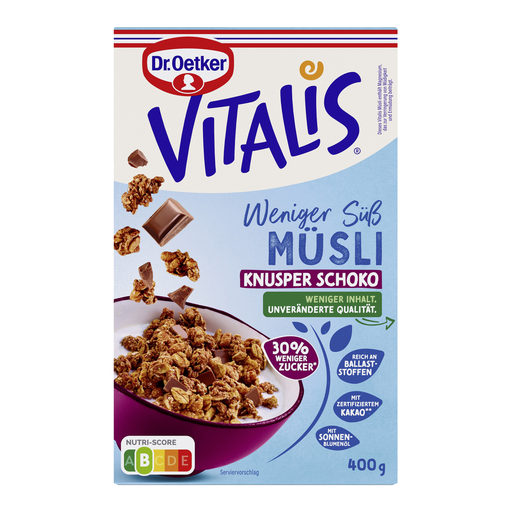 Image unavailable
Dr. Oetker Vitalis Less Sweet Crunchy Chocolate Müsli, 400 g
A 400 g pack of chocolate muesli, if this size suits your weekly needs. Before choosing, compare the nutritional information and check the ingredients for any relevant allergens.
View on Joybuy
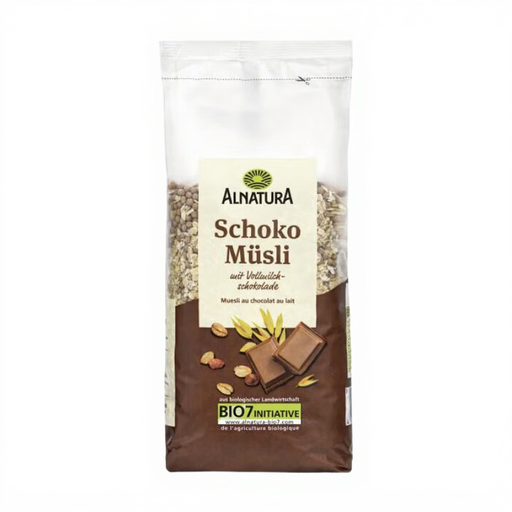 Image unavailable
Alnatura Organic Chocolate Müsli, 750 g
The 750 g pack may suit you if your household is likely to use this amount and has space to store it. Check the fibre, sugar and ingredients on the specific pack.
View on Joybuy
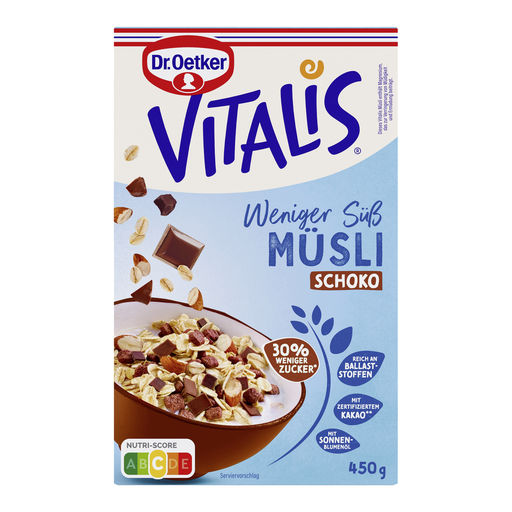 Image unavailable
Dr. Oetker Vitalis Less Sweet Chocolate Crunchy Müsli, 450 g
A 450 g option for shoppers who want to compare chocolate muesli varieties using the values per 100 g. Compare fibre and sugar separately, and check the ingredients list too.
View on Joybuy
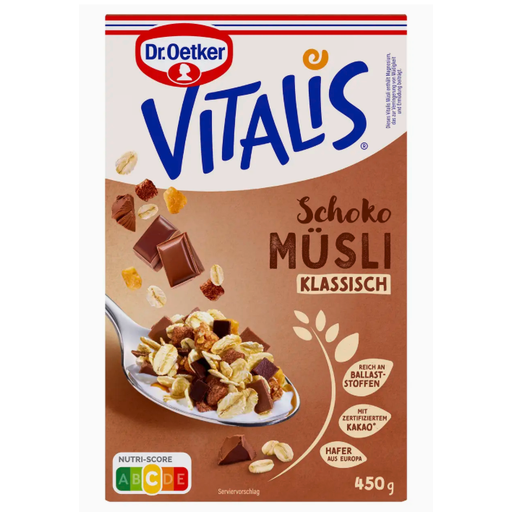 Image unavailable
Dr. Oetker Vitalis Classic Chocolate Müsli, 450 g
The Classic Chocolate variety comes in a 450 g pack. If you’re choosing between this and a Less Sweet variety, compare the nutritional information on each pack rather than assuming the values from the variety name.
View on Joybuy
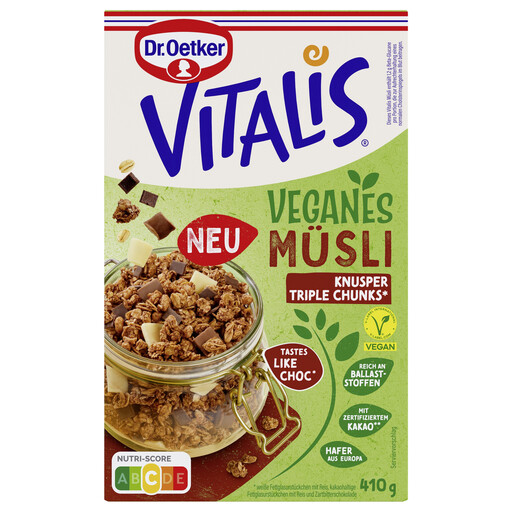 Image unavailable
Dr. Oetker Vitalis Vegan Crunchy Triple Choc Müsli, 410 g
A 410 g chocolate muesli option to compare with the other pack sizes. Check the nutritional information and ingredients on the specific pack; the variety name alone doesn’t mean it is allergen-free.
View on Joybuy
Frequently asked questions
When is chocolate muesli considered high in fibre?
For the nutrition claim ‘high in fibre’, EU Regulation (EC) No 1924/2006 requires at least 6 g of fibre per 100 g or 3 g per 100 kcal. Check the value for the specific variety; a mention of oats or wholegrains is no substitute.
Does ‘30% less sugar’ also mean ‘low sugar’?
No. Comparing a product with others doesn’t mean that the chocolate muesli is low in sugar. Check the absolute sugar content per 100 g and assess fibre separately.
How do I check for allergens in chocolate muesli?
Read the ingredients list and highlighted allergens on each specific pack. Depending on the variety, gluten-containing cereals, milk or nuts may be among the ingredients. Check for any ‘may contain’ warnings too, if needed.
What pack size should I choose for my weekly shop?
Choose a pack size that suits your household’s planned use and storage space. When comparing different varieties, also check the nutritional information per 100 g, so the pack size doesn’t distract you from the recipe.
Is the Nutri-Score enough to compare fibre content?
No, the Nutri-Score doesn’t replace the fibre value in the nutritional information. The Verbraucherzentrale recommends using it only to compare products within a similar category. For this buying criterion, you’ll need to check the fibre content of the variety separately.


