Bakers making small, spontaneous batches
You want to bake a few cookies without having to arrange use of the shared oven, and you have a safe place to put a mini oven.


Start by using the shared oven if it’s available and has trays that suit the number of cookies you want to bake. A mini oven of your own is worth considering if you want to bake smaller batches independently and have a safe place to put it. Before buying, check whether you’re allowed to keep your own appliance in the shared kitchen.
You want to bake a few cookies without having to arrange use of the shared oven, and you have a safe place to put a mini oven.
You want to bake enough dough for several people in as few batches as possible, so you compare tray size with the oven time available.
You need to weigh up the space required for the appliance, its door opening and the recommended clearance against the batch size you want to bake.
Best if: You can arrange a time to bake and there are trays that suit the number of cookies you want to make. Bosch’s chocolate chip cookie recipe calls for conventional top and bottom heat at 190 °C for 9 to 11 minutes.
The trade-off: You don’t need extra space, but you’re dependent on the shared appliance being available, in good condition and easy to use.
Best if: You usually bake a few cookies independently of the shared oven and can set up the appliance safely in line with its manual. The Steba KB M19 is one example, with a 19 l capacity, a baking tray and switchable fan-assisted cooking.
The trade-off: The appliance takes up worktop space and needs a suitable socket; a small cooking cavity may mean baking more batches.
Best if: A larger tray matters more for your batches than having the smallest possible appliance. Rommelsbacher lists trays measuring 32.5 × 28.5 cm for the BG 1550 and BGE 1580/E, and 38.5 × 31.5 cm for the BG 1805/E.
The trade-off: Larger trays need more space, but they don’t guarantee a particular number of cookies or baking batches.
Best if: You plan to cook other small oven dishes as well as cookies, and the specific heating mode and a suitable tray are available for your recipe.
The trade-off: Extra heating modes are no substitute for the right tray size or the cooking mode specified in the recipe.
First, work out whether the shared oven is available when you want to bake. If you’re buying an appliance of your own, compare tray size, heating mode and a safe place to put it rather than focusing only on cooking capacity or rated power.
| What matters | What to check before buying | Who is it important to? |
|---|---|---|
| Number of cookies and tray size | Compare the tray dimensions and what’s included with your planned batch size and the spacing needed between cookies. | If I’m baking for several flatmates, I want to fit as many cookies as possible on one tray while leaving enough space between them. Around 33% of consumers say batch size is their main concern. |
| Space and independent use | Check the external dimensions, door opening and the clearances specified in the manual for the particular model. | If our shared worktop space is limited, I want to know whether there’s room to use the appliance safely. Around 27% of consumers give top priority to where the appliance will go. |
| Heating mode to suit the recipe | Check whether the specific model offers the heating mode you want and whether its temperature range suits the recipe. | If I’m following a recipe that calls for conventional top and bottom heat, I want to be able to select that mode. Around 20% of consumers say the heating mode specified in the recipe is their main concern. |
| Cleaning and ease of use | Check the crumb tray and cleaning instructions; let the appliance cool down before cleaning it. | In a shared kitchen, I want to be able to clear away crumbs easily and understand the operating and safety instructions. Around 20% of consumers say cleaning and ease of use matter most to them. |
The capacity in litres doesn’t tell you how much room a tray actually offers for cookies. Rommelsbacher lists different tray sizes for its various models.
Check the dimensions of the tray supplied with the full model details and compare them with the batch size you have in mind.
The Severin TO 2058 has four rack positions, but that doesn’t mean two cookie trays are guaranteed to bake evenly at the same time.
Check the manual for the specific model for clear instructions on using more than one rack. Otherwise, plan to bake your batches one after another.
The Steba KB M19 manual specifies a 10 cm gap between the back of the appliance and the kitchen wall, as well as unobstructed ventilation slots.
Before buying, check the external dimensions, door opening, socket location and all the setup instructions in the manual for the exact model.
Rated power isn’t the same as measured electricity use over your baking time. The Verbraucherzentrale recommends considering an oven’s actual electricity consumption and cooking capacity when comparing models.
Only compare consumption figures measured on the same basis; don’t use wattage and recipe time to calculate exact costs.
Mini ovens with a range of tray sizes, including 30-l and 42-l models.
The TO 2058 is a freestanding 42 l oven for baking and toasting.
The KB M19 is a compact 19-l oven for smaller portions and limited space.
The TO 26 SilverStyle is a freestanding 26-l oven, sitting between smaller and larger countertop models.
An existing built-in oven could be an option in a shared kitchen.
These freestanding mini ovens range from compact to larger models. For each one, compare the tray size, heating mode and space required with your needs.
 No image available
This 32-l model may suit larger batches, but its capacity alone doesn’t tell you how many cookies will fit on the tray.
32 l; 1.600 W; temperature range from 100 to 250 °C; timer; baking tray and removable crumb tray.
The stated external dimensions are 52.3 × 36 × 32.2 cm.
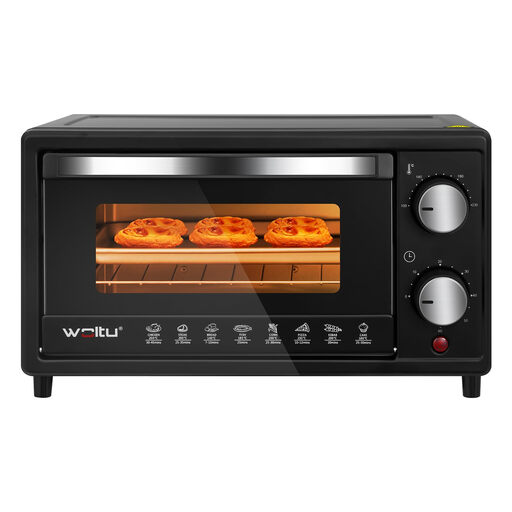 No image available
Its compact size may suit smaller baking jobs when space is tight, but still check the clearances in the manual against the spot where you plan to use it.
10 l; conventional top and bottom heat; temperature range from 100 to 230 °C; baking tray and wire rack.
The stated dimensions are 37 × 26.5 × 21 cm.
 No image available
If you’re planning to cook a range of small oven dishes, the product details list several heating modes. This doesn’t mean you can bake on more than one rack at the same time.
28 l; three heating modes and three rack positions; conventional top and bottom heat; temperature range from 100 to 230 °C; baking tray.
Bosch Home Appliances recommends conventional top and bottom heat at 190 °C for 9 to 11 minutes for its recipe. These are recipe timings, not a guaranteed baking time for every appliance or dough.
Not based on the number of rack positions alone. Check the manual for the exact model for explicit approval and instructions on using more than one rack. Otherwise, plan to bake your batches one after another.
Follow the manual for the specific appliance. For the Steba KB M19, for example, it specifies a 10 cm gap between the back of the appliance and the kitchen wall, an accessible, properly earthed socket and unobstructed ventilation slots. Don’t leave the appliance unattended while it’s in use, and let hot surfaces cool before cleaning.
No. The Verbraucherzentrale explains that statutory consumer rights are set out in law, while a guarantee is an additional voluntary promise. Check the specific offer to see who the seller is and what guarantee terms apply.
For new electrical equipment covered by the 1. ProdSV and designed for 50 to 1.000 volts AC, the manufacturer must issue an EU declaration of conformity and apply the CE marking after successfully completing the conformity assessment procedure. The German Federal Ministry of Justice lists these requirements in the 1. ProdSV. Check the details for the specific product; the marking doesn’t assess how well an oven bakes cookies.