Shoppers who look for organic products
You’re looking for a chocolatey cookie to keep in the cupboard or enjoy with a coffee, and want to check its organic certification rather than relying solely on wording in the product description.


If you’re looking for a chocolate-coated cookie for an organic or speciality food shop, check the product format first, then consider your main requirement: a vegan recipe, clearly labelled as gluten-free or lactose-free, or milk chocolate. An organic claim is no substitute for checking the organic certification and the ingredients and allergens; chocolate chips in the dough are not a chocolate coating.
You’re looking for a chocolatey cookie to keep in the cupboard or enjoy with a coffee, and want to check its organic certification rather than relying solely on wording in the product description.
You want a cookie with a chocolate coating and no animal-derived ingredients. The labelling and ingredients list for the specific variety matter here; the type of chocolate alone isn’t a reliable guide.
You need a variety that’s explicitly labelled accordingly. You can’t assume a product is gluten-free or lactose-free just because it’s described as “organic”, “vegan” or “dark chocolate”.
First, decide which feature is essential for you. Then compare the type of chocolate and the product format, so you don’t accidentally choose a cookie with chocolate chips instead of a chocolate-coated one.
| Criteria | What to check when buying | Who it matters most to |
|---|---|---|
| Organic certification | Look for the EU organic logo and control body code on the current packaging. Also check whether the chocolate actually forms a coating. | When I’m shopping for organic and speciality foods, I want to be able to verify the certification and find the chocolate cookie I’m after. Around 33% of shoppers put this first. |
| Vegan recipe | Check for an explicit vegan label and review the ingredients. If you have relevant allergies, check the allergen and trace warnings too. | If I want to avoid animal-derived ingredients, a dark chocolate coating alone isn’t enough to go on. A vegan recipe is the main priority for around 25% of shoppers. |
| Gluten-free and lactose-free | Check for the relevant free-from label, as well as the ingredients and allergen information on the specific pack. | I need to avoid gluten or lactose and don’t want to rely on a product being labelled “organic” or “vegan”. This is the main requirement for around 25% of shoppers. |
| Type of chocolate and product format | Check whether it’s milk or dark chocolate, and whether the product is described as coated, chocolate-bottomed, made with chocolate chips or filled. | If I don’t have a more pressing dietary requirement, I mainly want to choose the right type of chocolate and a genuine coating. Taste and product format are the priority for around 17% of shoppers. |
Organic certification doesn’t tell you whether a cookie contains milk, gluten-containing cereals or other allergens. For example, the organic oat cookies described by EDEKA contain oats and wheat.
Check organic status separately from the ingredients, highlighted allergens and trace warnings.
REWE states that its vegan organic oat cookies may contain traces of milk and soya. A trace warning doesn’t mean these ingredients are definitely present, but it doesn’t rule out accidental cross-contamination either.
If you have an allergy, the information on the current packaging is what matters. Don’t rely on the vegan label alone.
Bahlsen describes Chokini as shortbread-style biscuits with chocolate chips. That’s a different product format from chocolate-coated biscuits, such as the dark chocolate organic oat cookies described by REWE.
Read the product description carefully and look for the difference between “coated”, “with chocolate chips” and “filled”.
EDEKA notes that packaging information may differ from what’s shown online, and that products may not be available in every store.
Before buying, check the information on the packaging and availability at your chosen shopping location.
REWE Bio describes vegan oat cookies coated in dark chocolate. REWE frei von also offers Bio Chocolate Cookies explicitly labelled gluten-free and lactose-free.
EDEKA describes organic oat cookies with dark or milk chocolate. The dark chocolate variety is described as vegan.
ALDI SÜD offers oat cookies with milk and dark chocolate under its ALDI BIO range.
Gullón describes its Cacao Chips Cookies as an option for shoppers specifically looking for a recipe that’s free from gluten, nuts and eggs.
Bahlsen describes Chokini as shortbread-style biscuits with rich dark chocolate chips and a hint of orange.
Lidl lists biscuits as part of its vegan Vemondo range.
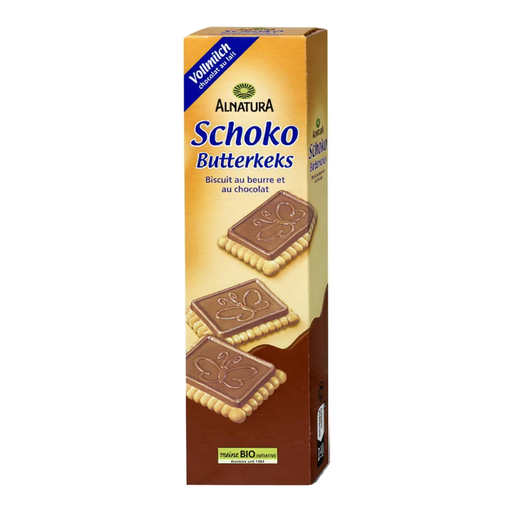
This selection features a butter biscuit coated in milk chocolate. If organic certification is important for your shop, also check for the EU organic logo and control body code on the packaging.
 No image available
For shoppers looking for butter biscuits coated in milk chocolate. The product contains milk and gluten-containing cereals; possible traces of egg, almonds, hazelnuts and sesame are also listed. If you’re shopping by organic certification, check the logo and control body code on the current packaging.
For packaged organic products on the EU market, look for the EU organic logo and the name or code of the organic control body. The brand name alone isn’t a substitute for checking the certification.
No. A vegan cookie may contain gluten-containing cereals or soya, for example, and may carry a warning about traces of milk. Check the ingredients, highlighted allergens and trace warnings on the current packaging.
The packaging gives you the information for the specific product you’re buying. EDEKA notes on its product pages that information shown online may differ from the details on the packaging.
Availability depends on where you shop. EDEKA notes that the oat cookies described may not be available in every store, so check with your chosen branch or delivery address.