Hosts with a strict sugar-free requirement
If the pack must actually say “sugar-free”, “no added sugar” isn’t an acceptable substitute. Check the product description and the “of which sugars” figure per 100 g on the specific pack.


For a meeting, first establish whether the chocolate must explicitly be labelled “sugar-free” or whether “no added sugar” is enough: these claims don’t mean the same thing. Then consider how you’ll serve it – as a shareable bar or individually wrapped portions – and check the ingredients and allergen information on the specific pack.
If the pack must actually say “sugar-free”, “no added sugar” isn’t an acceptable substitute. Check the product description and the “of which sugars” figure per 100 g on the specific pack.
If you want to share chocolate around the table and “no added sugar” is sufficient, a bar could be a good option. Lindt Germany describes its corresponding dark chocolate as a 100 g bar, with 1.0 g of sugar per 100 g.
If everyone should have their own cocoa snack, an individually wrapped oat bar could be suitable. REWE describes the CORNY Haferkraft Kakao Zero Vegan as a vegan oat bar with no added sugar – not a chocolate bar. As always, check the ingredients and allergen information on the specific pack.
For your meeting, first decide which sugar claim you need, then how you’ll serve the portions and finally whether the ingredient information suits your attendees.
| Criteria | What to check when shopping | Who it matters most to |
|---|---|---|
| Sugar claim | Don’t treat “sugar-free” and “no added sugar” as equivalent claims; check the “of which sugars” figure per 100 g. | If the catering must explicitly be “sugar-free”, I don’t want to accidentally serve a bar with no added sugar as though it met that requirement. This distinction is a priority for around 40% of consumers. |
| Portioning | Check the bar size or snack bar weight, as well as whether it’s individually wrapped and what type of product it is. | If everyone needs their own portion, an individually served snack matters more to me than a bar to share; around 30% of consumers prioritise this. |
| Ingredients and allergens | Check the information about sweeteners, allergens and possible traces on each specific pack. | If I need to cater for attendees’ requirements, I need clear ingredient information before serving anything. This check is a priority for around 30% of consumers. |
A product can still contain sugar even if no sugar has been added. Lindt Germany states that its milk chocolate bar with no added sugar contains 9.0 g of sugar per 100 g.
If “sugar-free” is a firm requirement, check the relevant claim and the sugar content per 100 g on the pack rather than assuming that no added sugar means it’s sugar-free.
The Verbraucherzentrale (German consumer advice centre) notes that consuming large amounts of sugar alcohols can have a laxative effect. If bars are left out for people to help themselves, or each person can take several, the amount eaten isn’t controlled.
Make sure the packaging, including the ingredients and any product-specific warnings, is available to read, and consider portion size when putting the snacks out.
Depending on the variety, the products described contain ingredients such as milk, soya or hazelnuts; other nuts may also be listed as possible traces. “Vegan” labelling doesn’t replace checking the allergen information.
Check for any relevant requirements before serving and, if needed, provide separate alternatives with a clear ingredients list.
An oat or protein bar is a different type of product from a traditional chocolate bar. This can affect both how you want to serve it and what people expect from a meeting snack.
Before you shop, decide whether you need chocolate to share or an individually wrapped cocoa snack.
Lindt Germany offers, among other products, milk and dark chocolate bars with no added sugar.
Xucker’s Crispy Chocolate is a 40 g protein bar containing chocolate, not a traditional chocolate bar.
Frankonia offers chocolate bars with no added sugar, including a hazelnut variety.
This selection features a shareable dark chocolate bar with no added sugar, for meetings where “sugar-free” isn’t a firm requirement. Make sure the ingredients and allergen information are suitable before serving it to attendees.
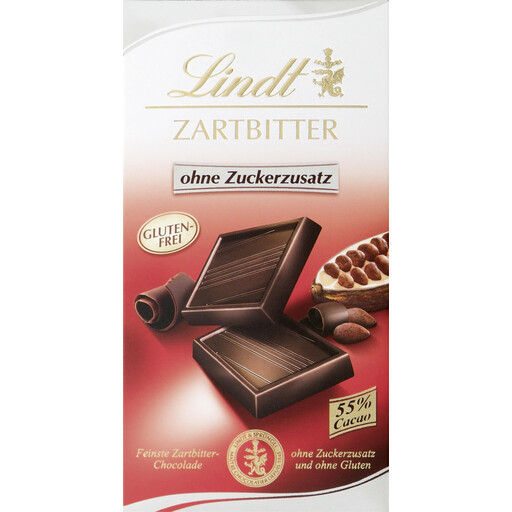 Image unavailable
A bar to share when chocolate with no added sugar is suitable for your meeting.
According to Lindt Germany, this dark chocolate variety contains at least 55% cocoa and 1.0 g of sugar per 100 g; it’s sweetened with maltitol. It contains milk and soya and may contain hazelnuts, almonds and other nuts. Excessive consumption may have a laxative effect.
No. “No added sugar” doesn’t rule out naturally occurring sugars, while “sugar-free” is a different claim. If this distinction matters for your catering, check both the product description and the “of which sugars” figure per 100 g on the specific pack.
Check the sugar content, ingredients, allergens, possible traces and warnings on every pack. Depending on the variety, the products described here may contain milk, soya and nuts, and information about maltitol or xylitol may also be relevant.
Yes, if you need individually served snacks and an oat or protein bar is acceptable instead of a chocolate bar. Before choosing one for your meeting, check the product type, portion size and ingredients of the specific variety.
No. The “no added sugar” claim doesn’t tell you the energy content of the whole product. Check the nutritional information per 100 g and, if provided, per portion.