If you need chocolate muesli for your holiday let to be genuinely sugar-free, the “of which sugars” figure per 100 g is key: Lebensmittelklarheit sets the limit at 0.5 g or less. According to the manufacturer, Dr. Oetker Vitalis No Added Sugar contains 1.3 g of sugar per 100 g, while Kölln says its Chocolate 30% Less Sugar muesli contains 13 g per 100 g. Neither is therefore sugar-free. If products containing sugar are also an option, you should consider sweeteners, allergens and the pack size you need.
Who needs to know the difference?
People with a strict sugar-free requirement
For you, the sugar content per 100 g matters more than similar-sounding claims on the front of the pack. According to the threshold explained by Lebensmittelklarheit, a product can only be called “sugar-free” if it contains no more than 0.5 g of sugar per 100 g.
Self-caterers with questions about sweeteners
You want to provide chocolate muesli for several people at your holiday let and check in advance whether its sweeteners are suitable for everyone. For Vitalis No Added Sugar muesli, this means checking the maltitol syrup and maltitol, as well as the consumption advice.
People who want to avoid sugar substitutes
You’re happy for the product to contain sugar, but want to choose a chocolate muesli without sugar substitutes. Kölln describes its Chocolate 30% Less Sugar oat muesli as having this feature, although its nutritional information still lists 13 g of sugar per 100 g.
What to look for when buying
First, decide whether “sugar-free” is an absolute requirement. If it isn’t, compare the sugar content per 100 g, then check the ingredients and whether the pack is suitable for everyone travelling with you.
| Criterion | What to check | Who it matters to |
|---|
| Sugar content |
Check the “of which sugars” figure per 100 g: Lebensmittelklarheit sets the limit for “sugar-free” at no more than 0.5 g per 100 g. “No added sugar” and “less sugar” mean something different. |
If I need a sugar-free product, I need to check the actual figure rather than rely on a similar-sounding claim. Around 42% of consumers put this strict requirement first. |
| Sweeteners |
Check the ingredients and product description for sweeteners. For Dr. Oetker Vitalis No Added Sugar, REWE also includes a warning that excessive consumption may have a laxative effect. |
If several people are having breakfast, I want to know in advance what the muesli is sweetened with and whether it’s suitable for everyone. This is the main concern for around 33% of consumers. |
| Travel group and supplies |
Check the allergens and may-contain warnings on the specific pack, along with its weight and any storage instructions for after opening. |
For everyone to share at a holiday let, the pack needs to suit the group’s dietary requirements and the length of your stay. This takes priority for around 25% of consumers. |
Common comparison mistakes
-
Assuming “no added sugar” means “sugar-free”
The two claims don’t mean the same thing. Dr. Oetker lists 1.3 g of sugar per 100 g for Vitalis No Added Sugar, which is above the sugar-free threshold explained by Lebensmittelklarheit.
If you need a sugar-free product, check the “of which sugars” figure per 100 g on the specific pack.
-
Assuming a percentage reduction means a low sugar content
“30% less sugar” describes a comparison, not the absolute sugar content. Kölln lists 13 g of sugar per 100 g for its Chocolate 30% Less Sugar muesli.
Compare the sugar content per 100 g on the packs you’re actually considering buying.
-
Overlooking sweeteners and consumption advice
Dr. Oetker Vitalis No Added Sugar is sweetened with maltitol syrup and maltitol. REWE warns that excessive consumption may have a laxative effect.
Check the ingredients and advice before buying, especially if several people will be sharing the same pack.
-
Leaving allergen checks until you arrive
Depending on the product, the chocolate mueslis we’ve looked at may contain gluten-containing cereals or milk, and may carry warnings about traces of other allergens.
Before you travel, compare the ingredients and may-contain warnings on the specific pack with the requirements of everyone in your group.
Brands and product ranges to consider
Dr. Oetker Vitalis
The range includes a variety of chocolate crunchy mueslis. For Vitalis No Added Sugar, Dr. Oetker lists 1.3 g of sugar and 11 g of fibre per 100 g.
- The no-added-sugar variety provides specific nutritional figures for comparing products per 100 g.
- It isn’t sugar-free. You should also check the maltitol syrup, maltitol, allergen information and warning about excessive consumption.
Kölln
Kölln describes its Chocolate 30% Less Sugar oat muesli as a variety without sugar substitutes. According to Kölln, it contains 13 g of sugar per 100 g.
- If you want to avoid sugar substitutes, you can check this product feature alongside the ingredients list.
- The relative sugar reduction doesn’t make the muesli sugar-free. Consider the cereals, milk and possible traces of nuts when choosing.
Nestlé Cereals
NESQUIK crunchy breakfast cereal is a chocolatey cereal option to compare with muesli. Nestlé Cereals lists 22.1 g of sugar per 100 g.
- The stated sugar content makes it possible to compare nutritional information per 100 g.
- Nestlé Cereals’ claims about sugar reduction across its range don’t prove that this individual product is sugar-free.
Chocolate muesli at Joybuy
These two packs may suit people looking to compare chocolate muesli with a reduced-sugar claim for their holiday let. If you need a strictly sugar-free product, check the nutritional information on the specific pack.
 No image available
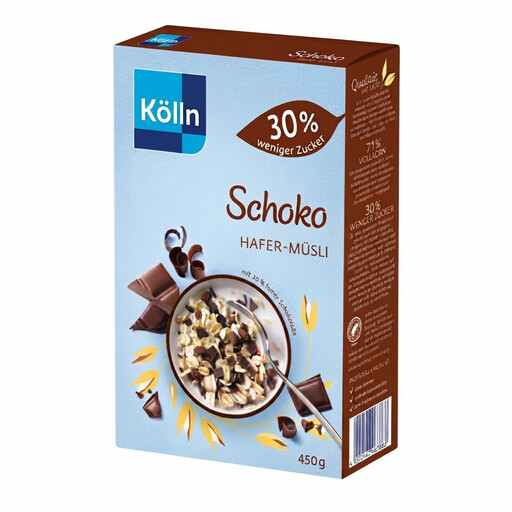
Kölln Chocolate 30% Less Sugar oat muesli, 450 g
An option for breakfast at your holiday let if you’d like a variety without sugar substitutes but are happy for the muesli to contain sugar.
The pack contains 450 g. Kölln lists 13 g of sugar per 100 g for this muesli, so it isn’t sugar-free.
If you have allergen requirements, check the ingredients and may-contain warnings on the specific pack.
View at Joybuy
 No image available
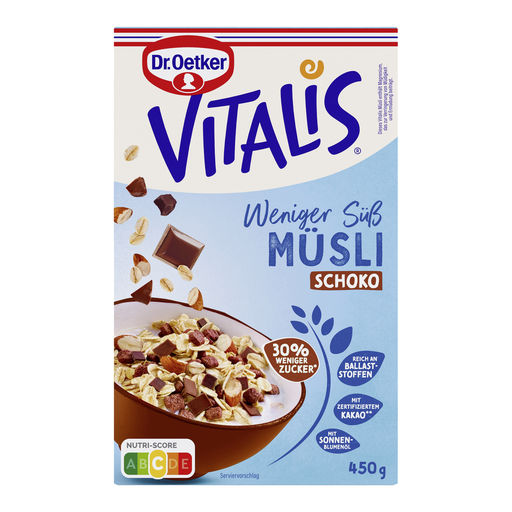
Dr. Oetker Vitalis Less Sweet Chocolate Crunchy Muesli, 450 g
Another chocolate muesli option for your holiday let if you’re looking for less sugar than in the product you’re comparing it with, but don’t need a strictly sugar-free option.
The pack contains 450 g. The “less sweet” claim doesn’t replace checking the “of which sugars” figure per 100 g.
Before buying, compare the ingredients and allergen and may-contain warnings on the specific pack with the requirements of everyone travelling with you.
View at Joybuy
Frequently asked questions
Does “no added sugar” mean the same as “sugar-free” for chocolate muesli?
No. Lebensmittelklarheit explains that “sugar-free” means no more than 0.5 g of sugar per 100 g. “No added sugar” doesn’t mean the total sugar content is below this limit. Dr. Oetker lists 1.3 g of sugar per 100 g for Vitalis No Added Sugar.
How can I tell if chocolate muesli contains sweeteners?
Check the product description and ingredients list on the specific pack. Lebensmittelklarheit explains the labelling statement “with sweetener(s)”. For Dr. Oetker Vitalis No Added Sugar, maltitol syrup and maltitol are relevant to your buying decision.
How should I store opened chocolate muesli at a holiday let?
Follow the storage instructions on the pack and reseal the inner packaging carefully after opening. For Vitalis No Added Sugar, Dr. Oetker specifically recommends sealing the inner bag well after opening.
What should I check before sharing breakfast with someone who has allergies?
Compare the current ingredients list and may-contain warnings on each pack with the requirements of everyone who will be eating it. Depending on the product, the mueslis we’ve looked at may contain gluten-containing cereals, milk, soya or nuts.
Where can I check for food recalls before I set off?
The German public portal lebensmittelwarnung.de publishes notices on behalf of the federal states and the Federal Office of Consumer Protection and Food Safety. If you’ve already bought a pack, check the product and batch against any relevant notice.


