Families with a strict sugar limit
It’s important not to confuse “sugar-free” with “no added sugar”. The nutritional information tells you how much sugar the specific product contains.


A chocolate snack with no added sugar isn’t automatically sugar-free for a lunchbox: what matters is the exact wording on the pack and the nutritional information. A small bar can be an addition to a packed lunch. When choosing one, also consider the portion size, ingredients, allergens and the rules at your child’s school.
It’s important not to confuse “sugar-free” with “no added sugar”. The nutritional information tells you how much sugar the specific product contains.
They’re looking for a small portion that’s easy to measure out and can be added to a packed lunch, rather than a chocolate snack to replace the whole meal.
If your child has allergies or is sensitive to sweeteners, check the ingredients list, allergen labelling and warnings for the specific variety.
First, check whether you need a product that’s “sugar-free” or whether “no added sugar” is enough. Then consider the portion size, ingredients and the type of snack you want.
| What to consider | What to check | Who it matters to |
|---|---|---|
| Sugar claim | Compare the wording on the pack with the sugar content per 100 g and per portion. Under EU Regulation (EC) No 1924/2006, “sugar-free” can only be used for solid foods containing no more than 0.5 g of sugar per 100 g. | If there’s a strict sugar limit for school breaks, I don’t want to mistake a product with no added sugar for a sugar-free one. Around 36% of consumers say this distinction is their main concern. |
| Lunchbox portion | Check the portion size and how the pack is divided up; plan for the snack to be an addition to a packed lunch. | I want to fit a small portion of chocolate in my child’s lunchbox without replacing their sandwich. For around 29% of consumers, portion size is the main consideration. |
| Ingredients and suitability | Read the sweeteners, warnings, declared allergens and precautionary traces information on the current pack. | If certain ingredients aren’t suitable for my child, I need to check the specific variety rather than rely on the brand name. This is the top priority for around 21% of consumers. |
| Flavour and texture | Choose between a chocolate bar, cereal bar or chocolate crisp, depending on the type of product you want; “no added sugar” doesn’t tell you what it will taste like. | I’m looking for a variety my child will enjoy, both in flavour and texture. This is the main consideration for around 14% of consumers. |
A product with no added sugar can still contain sugar. Lindt Germany states that its milk chocolate with no added sugar contains 9 g of sugar per 100 g. That’s above the limit for using the “sugar-free” claim under EU Regulation (EC) No 1924/2006.
If the sugar-free claim matters to you, check the wording and the sugar line in the nutritional information on the specific pack.
Products with no added sugar may contain sweeteners such as maltitol or xylitol. The Verbraucherzentrale (German Consumer Advice Centre) points out that many sugar substitutes can have a laxative effect if consumed in excess.
Read the ingredients list and product-specific information, especially if you’re planning to pack several sweet snacks for one day.
Less or no added sugar doesn’t turn a chocolate bar or cereal bar into a complete packed lunch. The German Nutrition Society recommends that sweet snacks shouldn’t replace a balanced meal.
If appropriate, pack a small portion alongside a sandwich, fruit or vegetables and water.
Ingredients and possible traces vary between varieties. So the labelling on a different chocolate or a bar you bought previously isn’t a reliable guide to what you’re choosing now.
If allergies are a concern, check the ingredients and allergen information on the pack of the variety you want.
The details below refer to the specific products mentioned, not to each brand’s entire range.
The milk chocolate with no added sugar is a chocolate bar for families who want to portion out a piece for a lunchbox themselves.
The chocolate and coconut bar with no added sugar is a bar option if you’d prefer something other than a large chocolate bar.
The Crispy Chocolate bar is for consumers specifically looking for a protein bar with chocolate.
Corny Free Schoko is a muesli bar with no added sugar, suitable as a small addition to a lunchbox.
This selection includes a cereal bar for smaller snack portions, a dark chocolate bar you can portion yourself and a chocolate crisp. All three product names say “no added sugar”; if you need to stick to a strict sugar limit, it’s also important to check the nutritional information for the specific variety.
 No image available
The 20 g bars make it easy to measure out a small addition to a lunchbox. “No added sugar” doesn’t mean “sugar-free”; check the sugar content, ingredients and allergens on the current pack.
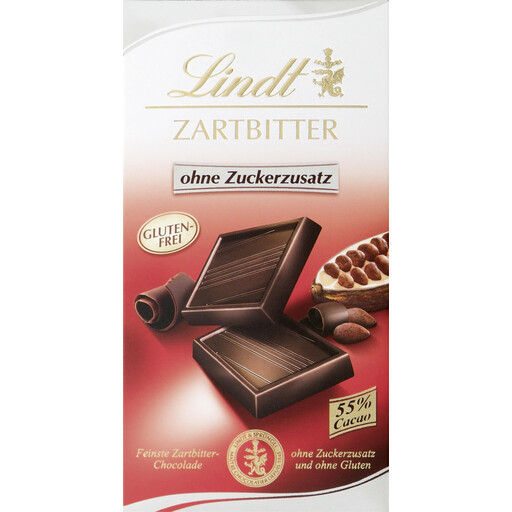 No image available
This dark chocolate bar could be a good choice if you want to portion out the amount for a lunchbox yourself. Compare the sugar content on its pack with your requirements; the nutritional information for a Lindt milk chocolate bar doesn’t apply to this dark variety.
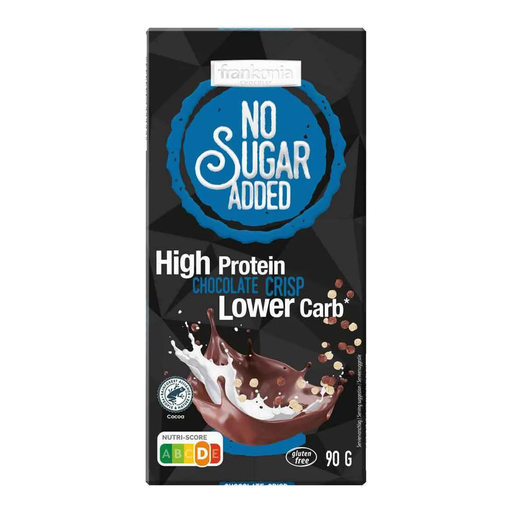 No image available
The chocolate crisp is an alternative for anyone who prefers this type of snack to a chocolate bar or cereal bar. For a lunchbox, check the sugar content per 100 g and per portion, as well as the ingredients, allergens and sweetener warnings.
No. Under EU Regulation (EC) No 1924/2006, solid foods must contain no more than 0.5 g of sugar per 100 g to be labelled “sugar-free”; “no added sugar” doesn’t rule out sugar being present. For example, Lindt Germany states that its milk chocolate with no added sugar contains 9 g of sugar per 100 g.
A chocolate bar shouldn’t be planned as a complete packed lunch. The German Nutrition Society highlights the importance of a balanced diet and water for children and teenagers; a small bar can only be an addition.
Follow the storage instructions for the specific product and keep chocolate away from heat. The manufacturer recommends storing the Xucker Crispy Chocolate bar in a cool, dry place. Check the rules at your child’s school to find out whether sweets are allowed at breaktime.