What should you consider when choosing?
First check the heating function specified in the recipe and whether your tart tin will fit. The number of usable shelf levels only becomes a key consideration if you plan to bake several suitable treats at once.
| Buying criterion |
What to check before buying |
Who it matters most to |
| Heating function specified in the recipe |
Check whether conventional top and bottom heat and fan cooking can be selected separately, and follow the setting given in the recipe you’re using. |
If I’m following a particular chocolate tart recipe, I want to be able to use its specified heating function. Around 33% of consumers prioritise the heating function specified in the recipe. |
| Oven space and shelf levels |
Compare your tin’s dimensions with the usable internal dimensions and the number of levels specified for the particular appliance. |
If I’m preparing several suitable bakes for a buffet, I want to fit the right tins in the oven together. Around 27% of consumers pay particular attention to oven space and shelf use. |
| Fit in your kitchen |
For a built-in oven, check the model’s housing and connection specifications. For a countertop model, also check its internal dimensions and the space it will occupy. |
If there’s no free oven housing in my kitchen, or I need to account for the existing housing, the fit in my kitchen will help determine my choice. Around 27% of consumers make this their top priority. |
| Energy use and cleaning |
For labelled domestic ovens, compare the kWh per standard cycle for the same heating function and check the cleaning method offered by the specific model. |
If I use my oven regularly and want to factor in the cleaning involved, energy use and care matter to me. Around 13% of consumers prioritise these ongoing aspects of use. |
The Verbraucherzentrale explains how to compare electricity consumption per standard cycle for different heating functions. According to the European Commission, small and portable ovens are not covered by the energy labelling requirements assessed for domestic ovens.
Suitable ovens at Joybuy
This selection includes built-in ovens for suitable housings, as well as a freestanding compact oven. Before buying, check that the appliance and tart tin are right for your kitchen and recipe.
 No product image available
Bosch HBA571BB4 Series 2 built-in oven
For a suitable built-in housing and buffets where you want to bake several suitable treats at once.
71 l cavity; conventional top and bottom heat and 3D hotair; according to the manufacturer, 3D hotair is designed for use on up to three levels.
View at Joybuy
 No product image available
Comfee built-in oven, 60 cm, 70 l
For a kitchen with a suitable built-in housing, if you’re considering a built-in oven for fan cooking.
60 cm; 70 l cavity; 3 kW according to the product name. The description lists fan-assisted hot air and multi-level baking.
View at Joybuy
 No product image available
Bosch HBG578ES3 Series 6 built-in oven
For a suitable built-in housing if you’re interested in additional oven functions as well as baking.
60 cm wide; 3D hotair and AirFry are listed in the product name. Check the housing dimensions for the specific model before installation.
View at Joybuy
 No product image available
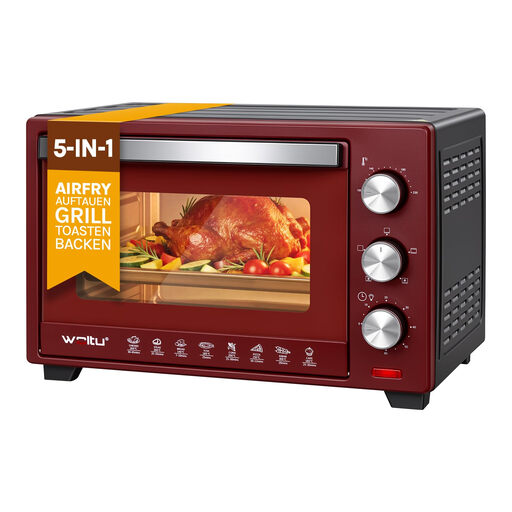
Woltu mini fan oven, 28 l
A freestanding option that doesn’t need a built-in housing, provided your tart tin fits in the usable internal space.
The product name lists a 28 l stated capacity and temperature control. Capacity alone doesn’t confirm that a particular tin will fit.
View at Joybuy
 No product image available
Siemens HB978GMB1 studioLine iQ700 built-in oven
For a suitable built-in housing if you want to use different heating functions for different recipes.
60 × 60 cm according to the product name. Check the housing dimensions and connection requirements for the specific model.
View at Joybuy
Frequently asked questions
Which setting should I use for a chocolate tart?
Follow the recipe you’re using. Dr. Oetker’s chocolate tart recipe specifies around 180 °C with conventional top and bottom heat or 160 °C with fan cooking, on the middle shelf, for around 40 minutes. These settings are for a tin measuring 26 or 28 cm in diameter. Don’t apply them to other fillings or tins without checking first.
How can I check that an oven will fit before installing it?
Compare your housing dimensions with the installation diagram and connection specifications for the specific model. For example, Bosch specifies a housing width of 560 to 568 mm for the HBA571BB4; this doesn’t automatically apply to other models.
How should I store a tart with a perishable filling before serving it at a buffet?
Keep perishable foods properly chilled until they’re ready to serve. The German Federal Institute for Risk Assessment explains that chilling slows or stops the growth of most bacteria. How best to handle the tart depends on the recipe and ingredients, not the oven function.
Does a small countertop oven automatically break the law if it doesn’t have an EU energy label?
No. The European Commission excludes small and portable ovens from the scope of the energy labelling requirements for domestic ovens assessed here. For covered appliances, the label includes information such as cavity volume and energy consumption per cycle.
Who should I contact if my new oven is faulty?
In Germany, the seller is generally responsible for statutory warranty claims when a product is faulty. The Verbraucherzentrale distinguishes these rights from a voluntary manufacturer’s guarantee.


