If you already have a suitable built-in oven, you don’t need to buy a second appliance just for one chocolate tart to go in your lunchbox. If you don’t have space for a built-in model, a countertop oven could be a good option. First compare your tin’s external dimensions with an explicit compatibility statement or the usable cooking space, then check the oven settings and placement requirements. Dr. Oetker’s example recipe specifies 26 or 28 cm springform tins and gives different settings for conventional heat and fan oven cooking; for other tarts, follow the instructions for the recipe you’re using.
Which oven is right for you?
Tart makers without space for a built-in oven
If you don’t have space for a built-in oven, you’ll need to consider where you can place the appliance and the external dimensions of your tin. Dr. Oetker’s example recipe specifies a 26 or 28 cm springform tin.
Homeowners with a built-in oven cavity
If you’re replacing a built-in oven or cooking larger quantities, the cavity dimensions and connection must be suitable for the specific model. Also check that it has the oven settings you need.
Anyone prepping a lunchbox
If your filling is perishable, you’ll also need to plan how to cool, store and transport your tart. The German Federal Institute for Risk Assessment recommends keeping perishable foods chilled when you’re out and about.
What to look for when buying
Dr. Oetker’s example recipe calls for a 26 or 28 cm springform tin and gives different settings for conventional heat and fan oven cooking. So check that your tin will fit first, then consider the oven settings, where you’ll put the appliance and the ongoing costs.
| Priority |
What to check before buying |
Who it matters to |
| Tin fit |
Check the tin’s external diameter, including the rim, as well as the manufacturer’s compatibility information, shelf, shelf height and door clearance. |
If I want my springform tin, including its rim, to fit comfortably, its size is my top priority. Around 36% of consumers say tin fit is their most important buying consideration. |
| Oven setting for the recipe |
Compare the available oven settings and temperature options with the requirements of your recipe. |
If I want to use the temperature and oven setting specified in my tart recipe, I pay particular attention to the available modes. For around 29% of consumers, the oven setting required by the recipe is the top priority. |
| Placement and installation |
For a countertop appliance, check the space available and the instructions in the manual. For a built-in model, compare the cavity and connection details. |
If I don’t have a suitable built-in space or have limited worktop space, the appliance needs to fit in my kitchen. Around 21% of consumers put placement first. |
| Energy use and running costs |
For built-in ovens with energy information, compare the consumption per standard baking cycle. Check repair services and accessories for the specific model only. |
If I want to weigh up energy use and future costs as well as the purchase price, clear information about the model matters. Around 14% of consumers put running and follow-on costs first. |
Energy-use figures per standard cycle are based on set test conditions and don’t show the actual electricity needed to bake this particular tart. The European Commission excludes portable ovens from the scope of its energy labelling rules for domestic ovens.
Common buying mistakes
-
Assuming the capacity or pizza stone confirms your tin will fit
The oven’s capacity or the diameter of a pizza stone doesn’t tell you whether a tart tin will fit. Dr. Oetker’s example recipe specifies a 26 or 28 cm tin, but your tin’s external dimensions may differ.
Measure your tin, including the rim, and check the manufacturer’s explicit compatibility information or the usable internal dimensions, as well as the shelf, shelf height and door clearance.
-
Checking only the appliance’s external dimensions when choosing where to put it
A countertop oven also needs to meet the clearance and placement requirements in its manual. A built-in oven needs a suitable cavity and connection.
Before buying, check the planned location against the manual for the specific countertop model. For a built-in model, compare the cavity and connection details with your kitchen.
-
Assuming your choice of oven determines how long a lunchbox tart will keep
Your choice of appliance doesn’t determine how to store a tart with a perishable filling. Dr. Oetker’s example recipe contains cream and egg; the German Federal Institute for Risk Assessment recommends keeping perishable foods chilled when you’re out and about. For fridge storage, it recommends a temperature of 2 °C to no more than 7 °C.
Plan chilling and transport separately from your choice of oven, and follow the guidance for the finished tart.
Brands and model examples
Rommelsbacher
Countertop ovens with specific information about tin size: for the BG 1550 and BGE 1580/E, the manufacturer specifies baking tins up to 29 cm in diameter.
- Rommelsbacher lists conventional heat and fan-assisted cooking for the BG 1550. The BGE 1580/E lets you select top and bottom heat separately, with fan-assisted cooking as an additional option.
- The model specifications don’t prove that it will produce better tarts. You’ll still need to check there’s enough room for the rim of your tin, the shelf and the door.
Severin
Severin describes the TO 2058 as a countertop oven with a 42 l capacity and four shelf levels.
- Severin lists fan-assisted cooking and a repair service for this model.
- The 29 cm pizza stone supplied with the oven doesn’t explicitly confirm that a tart tin of the same size will fit.
Steba
Steba publishes the internal dimensions of the KB 27 U.2, so you can compare them with the dimensions of your tin.
- Steba specifies a 20 l capacity, internal dimensions of 22 × 30 × 31 cm (H × W × D) and conventional heat.
- According to Steba, this model uses continuous fan-assisted cooking. Bear this in mind if you want to bake without a fan.
Bosch
The HBA572BB4 is a 71-l built-in oven designed to fit a suitable built-in cavity.
- Bosch lists six oven settings, including fan-assisted cooking and conventional heat.
- The cavity dimensions and connection need to suit your kitchen. Advertised heat distribution across several levels doesn’t prove an advantage when baking a single tart.
Siemens
The HB517ABS0 is a built-in oven with information on the required cavity, connection and oven settings.
- Siemens lists conventional heat and fan-assisted cooking for this model.
- The published cavity width is 560 to 568 mm, and the cavity depth is 550 mm. Compare these measurements and the connection details with your kitchen.
Countertop ovens at Joybuy
The Joybuy products below are countertop ovens for compact kitchens. Before buying, check the usable dimensions, placement requirements and oven settings for the model to make sure it suits your tart tin and recipe.
 No image available
Woltu BF12sz mini oven, 32 l, 1.600 W
This could be an option if you don’t want a built-in oven. Check whether your tart tin will fit in the usable cooking space.
The product title lists a 32 l capacity, 1.600 W, a timer, a crumb tray and a temperature range of 100 to 250 °C. Baking and grilling are listed as possible uses.
View at Joybuy
 No image available
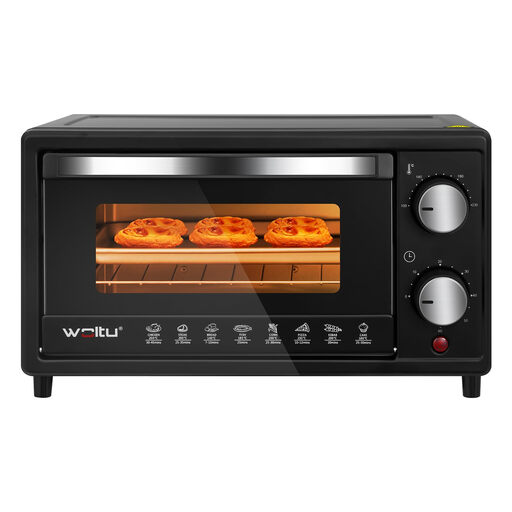
Woltu mini oven with pizza function, 10 l
This could be an option if you’re looking for a compact countertop oven rather than a built-in model. Compare your tin’s dimensions with the cooking space first.
The product title lists a 10 l capacity, a pizza function and a temperature range of 100 to 230 °C.
View at Joybuy
 No image available
Woltu mini convection oven, 28 l
This countertop model is worth considering if you’re not looking for a built-in oven. Check that your tin will fit by comparing its dimensions with the usable cooking space.
The product title lists a 28 l capacity, a temperature control and a timer.
View at Joybuy
Frequently asked questions
Do I always need to preheat the oven for a chocolate tart?
No, not necessarily. The Dr. Oetker recipe we checked calls for preheating; the European Commission recommends doing so if the recipe or appliance manual says to. Follow the recipe for your tart and the instructions for your specific oven.
Can I transport a cream-filled tart in my lunchbox without keeping it chilled?
Oven specifications don’t tell you how long it’s safe to transport. The German Federal Institute for Risk Assessment recommends keeping perishable foods chilled when you’re out and about; for fridge storage, it recommends a temperature of 2 °C to no more than 7 °C. So plan how to store and transport the finished tart separately from your choice of oven.
Does a higher wattage automatically mean higher costs per tart?
No. Wattage indicates power, not the measured energy used for this recipe. The EU energy label for ovens within its scope gives consumption in kWh per standardised baking cycle; the time, oven setting and quantity you bake for your tart may differ.
Do EU energy labelling rules also apply to a portable countertop oven?
According to the European Commission’s scope overview, portable ovens are excluded from the energy labelling rules for domestic ovens. That doesn’t mean every appliance described as a mini oven automatically falls within or outside the rules; it depends on the design of the specific appliance.


