First, measure your tart tin and the available space, including the clearances specified in the instructions. A small countertop oven takes up less worktop space, but limits the size of tin you can use. For a larger tart, consider a bigger countertop oven or, if you have a suitable space for it, a compact built-in oven. The capacity in litres alone won’t tell you whether your tin will fit or whether the oven can be positioned safely.
Which type of oven is right for you?
Tart bakers with a tin they already own
If you want to keep using your tart tin, check its overall diameter, including the rim, and its height against the stated tin size limit or usable internal dimensions of the specific oven. Rommelsbacher lists different tin diameters for different models; Steba provides internal dimensions for the KB M19.
Bakers short on worktop space
As well as the oven’s external dimensions, check how far the door opens and the clearances specified for that model. The instructions for the Steba KB M19 require a 10 cm gap between the back of the appliance and the kitchen wall; this figure does not automatically apply to other models.
Bakers who try different recipes
If you want to bake things other than tarts, compare the heating modes and controls you need with the extra space the oven will take up. Features vary by model.
What to consider when choosing
Start by measuring your tin and the space available for the oven. Then check whether the heating modes and running costs also matter for the other things you bake.
| What to consider |
What to look for |
Who it matters most to |
| Will the tart tin fit? |
Measure the overall diameter, including the rim, and the height of the tin. Rommelsbacher lists maximum tin diameters of 20 cm for the BG 950, 25 cm for the BG 1055/E and 29 cm for the BGE 1580/E. |
If I want to keep my tin, I’ll check its rim and height too; the right tin is the top buying priority for around 34% of consumers. |
| Can the oven be positioned safely in the available space? |
Check the external dimensions, door clearance and instructions. For the KB M19, Steba requires a 10 cm gap between the back of the appliance and the kitchen wall. |
If I have limited worktop space, I need a spot with enough room for both the appliance and its door; around 33% of consumers put a safe position first. |
| Are the heating modes and controls suitable? |
Compare your recipe’s requirements with the heating modes, temperature settings and timer functions of the specific model. |
If I bake from a variety of recipes, I want to be able to choose the right settings; around 17% of consumers say suitability for different recipes is their top priority. |
| Which ongoing costs should I consider? |
Compare energy consumption figures only for similar baking tasks; the wattage alone does not tell you the cost of baking a tart. The Verbraucherzentrale highlights the appliance’s actual electricity consumption. |
If I use the oven regularly, I want to consider energy use and what happens if it breaks; around 16% of consumers rank ongoing and future costs as a top buying priority. |
Common buying mistakes
-
Assuming the oven’s capacity tells you what size tin will fit
A capacity in litres doesn’t tell you whether a particular tin will fit, including its rim and height. The stated tin size limits vary from model to model.
Measure your tin before buying and compare it with the specifications for the specific oven.
Depending on the internal dimensions, you may need a smaller tin or have to bake in several batches.
-
Checking only the oven’s external dimensions when planning where to put it
You may need extra space for the door to open and to meet the required clearances. The instructions for the Steba KB M19 require a 10 cm gap between the appliance and the kitchen wall behind it.
Check the full positioning requirements for the exact model and allow for the door opening.
You may need to find a different place for the oven.
-
Assuming a lower wattage or smaller capacity means lower electricity costs
The rated power alone doesn’t show how much electricity it takes to bake a tart. For a meaningful comparison, the baking task and basis of measurement need to be the same.
Compare available energy consumption figures only under similar conditions, and don’t assume a particular saving based on the size of the appliance.
Brands to consider
Rommelsbacher
You can compare the mini oven models listed here using the manufacturer’s specifications for round baking tins.
- The manufacturer lists maximum tin diameters of 20, 25 and 29 cm for the BG 950, BG 1055/E and BGE 1580/E respectively.
- The larger BGE 1580/E takes up more space. The stated tin sizes are not the result of independent baking tests.
Steba
The KB M19 is a countertop oven option for anyone who wants to check the internal dimensions and heating modes against their tin.
- Steba says the oven has a 19 l capacity and internal dimensions of 23,5 × 31 × 25,5 cm (H × W × D); convection can be switched on.
- The instructions require a 10 cm gap between the appliance and the kitchen wall behind it. You’ll still need to check that your tin fits.
Severin
The TO 2068 is a countertop oven with top and bottom heat, as well as convection.
- The manufacturer lists a 20 l capacity and external dimensions of 44 × 39 cm (W × D).
- The supplied 29 cm pizza stone doesn’t prove that every tart tin of that size will fit.
Bosch
The CBG7341B1 is a built-in alternative if you have a suitable space for installation rather than free worktop space.
- Bosch lists appliance dimensions of 455 × 594 × 548 mm, a usable capacity of 47 l and top/bottom heat.
- The appliance dimensions don’t replace checking the installation space and installation instructions.
Joybuy products for countertop and built-in options
This selection includes countertop ovens for smaller worktops, as well as built-in ovens for suitable installation spaces. Check the tin size, external dimensions and positioning or installation requirements against your needs.
 No image available
Bosch HBA571BB4 Series 2 built-in oven
For baking if you have a suitable installation space; the product description recommends installation by a qualified professional.
71 l capacity, five heating modes and a temperature range of 30–275 °C. The description lists top/bottom heat and 3D hot air.
View at Joybuy
 No image available
Comfee 60 cm built-in oven, 70 l
A built-in oven option if you have a suitable space for installation.
The title lists a 70 l capacity and 10 functions; the description mentions convection, a grill, a pizza function and a timer.
View at Joybuy
 No image available
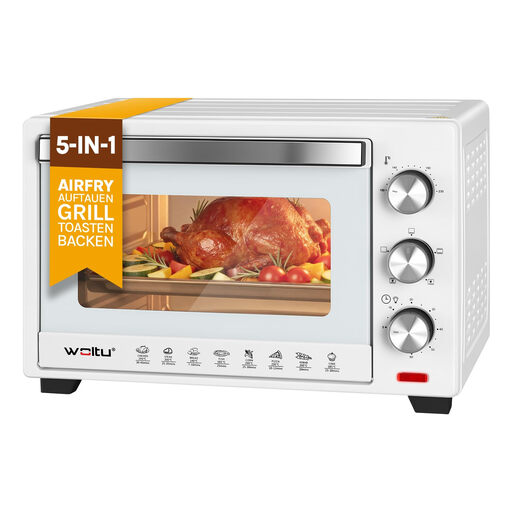
Woltu BF12sz mini oven, 32 l
A countertop appliance for baking and grilling; check the tin dimensions against the usable oven space before buying.
32 l, 1.600 W, a timer and a temperature range of 100 to 250 °C, according to the product details.
View at Joybuy
 No image available
Woltu mini oven, 10 l
A compact countertop oven for smaller worktops; check that your tart tin will fit inside.
10 l; dimensions of 37 × 26,5 × 21 cm according to the description. It lists top/bottom heat, temperature control from 100 to 230 °C and a 60-minute timer.
View at Joybuy
 No image available
Woltu mini convection oven, 28 l
A countertop oven with several heating modes; check your recipe’s requirements against the appliance’s settings.
The description lists top heat, bottom heat and combined heat, a temperature range of 100 to 230 °C and a mechanical 60-minute timer.
View at Joybuy
Frequently asked questions
Can I choose the oven size based on its capacity in litres alone?
No. Check the overall diameter, including the rim, and the height of your tart tin against the stated tin size limit or usable internal dimensions of the specific oven model.
Can a countertop oven go right next to the kitchen wall?
It depends on the instructions for the particular model. The Steba KB M19 requires a 10 cm gap between the back of the appliance and the kitchen wall; don’t assume the same applies to other ovens.
Do I have to use convection for a chocolate tart?
Not necessarily: it depends on your recipe and the settings available on your oven. For example, a published recipe for chocolate tartlets specifies 180 °C in the oven, but doesn’t say that convection is always required.
How do I compare the electricity consumption of small ovens?
Compare actual consumption figures for similar baking tasks; you can’t work out the saving per tart from the wattage or oven capacity alone. The Verbraucherzentrale points out that the appliance’s actual electricity consumption is what matters.
Which marking is relevant for an electric oven in Germany?
Electrical equipment covered by the EU Low Voltage Directive, including appliances rated for 50 to 1.000 V AC, must meet the relevant safety and conformity requirements, including CE marking. The EU explains that the manufacturer uses the CE mark to declare that the product complies with the relevant product rules; it is not an independent quality mark.


