People with a strict sugar limit
If you specifically want a bar labelled “sugar-free” for your coffee get-together, check the sugar content per 100 g. “No added sugar” does not answer that question.


For a coffee get-together, it’s worth first distinguishing between “sugar-free” and “no added sugar”. EU Regulation (EC) No 1924/2006 sets a maximum of 0.5 g of sugar per 100 g for a product to be labelled “sugar-free” — a limit exceeded by the no-added-sugar bars described here. If you don’t need a bar that is legally classed as sugar-free, you can choose according to your preferred flavour profile and the stated sugar content. For bars containing maltitol or xylitol, ingredients, allergens and consumption advice should also inform your decision.
If you specifically want a bar labelled “sugar-free” for your coffee get-together, check the sugar content per 100 g. “No added sugar” does not answer that question.
When choosing chocolate to enjoy with coffee, you can weigh up dark and milk chocolate bars. According to Lindt Deutschland, the two Lindt bars described here also differ in cocoa content and stated sugar content.
Xucker’s dark chocolate bar, which the brand describes as vegan, is one option. Make sure its ingredients, sweetener and precautionary allergen information suit your guests.
For chocolate to share over coffee, the sugar content per 100 g is the first thing to check if you’re looking for a “sugar-free” option. You can then consider the flavour, ingredients and pack size for sharing.
| Criterion | What to check | Who it matters most to |
|---|---|---|
| Sugar claim | Compare the sugar content per 100 g with the limit you need to meet. EU Regulation (EC) No 1924/2006 sets a maximum of 0.5 g per 100 g for “sugar-free”; “no added sugar” is a different claim. | If I specifically need a sugar-free bar, its stated sugar content must be within this limit. This is the top priority for around 40% of consumers. |
| Flavour with coffee | Compare the cocoa and sugar content of the specific variety. Lindt Deutschland states that its no-added-sugar dark chocolate contains at least 55% cocoa and 1.0 g of sugar per 100 g, while its no-added-sugar milk chocolate contains at least 35% cocoa and 9.0 g. | For coffee, I want to decide whether dark or milk chocolate would suit the gathering better. Around 30% of consumers put flavour first. |
| Sweeteners and ingredients | Check for maltitol or xylitol, allergens and consumption advice. According to the Verbraucherzentrale, large amounts of sugar substitutes can have a laxative effect. | If guests avoid different ingredients or might want to try several pieces, the information on the pack is especially important to me. This is the main concern for around 20% of consumers. |
| Sharing and portioning | Check the net weight and nutrition information per 100 g; if needed, also consider the sugar content in the portion on offer. | For a get-together, I want to be able to divide the bar easily and know how much I’m serving. This is the priority for around 10% of consumers. |
The two claims do not mean the same thing. Lindt Deutschland states that its no-added-sugar dark chocolate contains 1.0 g of sugar per 100 g and its milk chocolate contains 9.0 g per 100 g. Both are above the EU Regulation (EC) No 1924/2006 limit for “sugar-free”.
Before buying, check the sugar line in the nutrition information per 100 g rather than relying on the claim on the front of the pack.
The bars described contain maltitol or xylitol. The Verbraucherzentrale notes that sugar substitutes can have a laxative effect in large amounts.
At a coffee get-together, keep the packaging with its ingredients and advice to hand, and offer small pieces to start with.
Allergen and precautionary statements can vary between varieties. The product information for the Lindt dark chocolate bar described here lists milk and soya, and may also contain nuts.
If any guests have allergies, check the labelling on the exact pack you’re serving.
This claim does not describe the total sugar content: Lindt Deutschland states that EXCELLENCE Cacao Pur contains 13 g of sugar per 100 g, despite being made without refined sugar.
If the sugar content matters, compare the nutrition information for the bar you choose.
Lindt Deutschland describes no-added-sugar milk and dark chocolate bars sweetened with maltitol.
Xucker offers, among other products, a dark chocolate bar with xylitol that it describes as vegan.
In 2021, Ritter Sport introduced Cacao y Nada, a limited-edition bar made with cocoa fruit pulp.
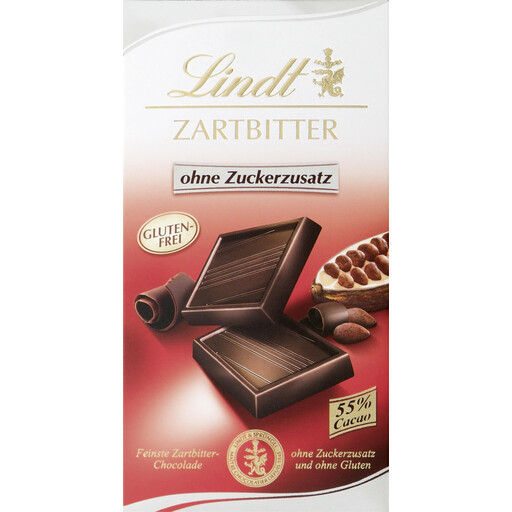
This dark chocolate bar is a pick for coffee get-togethers where you’re looking for chocolate with no added sugar — not for anyone who needs it to be “sugar-free”.
 No image available
A dark chocolate bar for your coffee get-together if “no added sugar” suits your needs and you don’t require chocolate that is legally classed as sugar-free.
According to Lindt Deutschland, it contains at least 55% cocoa, 1.0 g of sugar per 100 g and maltitol as a sweetener. Its sugar content is therefore above the EU limit of 0.5 g per 100 g for a “sugar-free” claim.
The product information lists milk and soya, and may also contain nuts. Maltitol can have a laxative effect if consumed in excess. Check the labelling on the specific pack you’re serving to guests.
Under EU Regulation (EC) No 1924/2006, a product can only carry the claim “sugar-free” if it contains no more than 0.5 g of sugar per 100 g. “No added sugar” does not mean the chocolate meets this limit.
Yes. Chocolate with no added sugar can be made with sweeteners. Lebensmittelklarheit explains that their use must be labelled accordingly; the ingredients list tells you which ingredients a bar contains.
As the Verbraucherzentrale explains, sugar substitutes can have a laxative effect when consumed in large amounts. The bars described here contain maltitol or xylitol and carry relevant consumption advice, which is worth bearing in mind if you’re serving several pieces.
No. Lindt Deutschland describes EXCELLENCE Cacao Pur as a bar made without refined sugar, but states that it contains 13 g of sugar per 100 g. So when choosing, check the stated total sugar content.
Keep chocolate sweetened with xylitol out of your dog’s reach, and don’t leave it unattended during your coffee get-together. Xucker specifically advises keeping its dark chocolate bar away from animals.