People who prioritise wholegrains
You want to identify wholegrain cereals as an ingredient in a sweet breakfast and check whether the proportion is stated. The fibre content per 100 g also helps you assess the ingredients list.


If wholegrains matter to you at breakfast, choose chocolate cereal or chocolate muesli by checking the ingredients list and any stated wholegrain content, rather than relying on the front of the pack alone. Where possible, compare sugar and fibre per 100 g within similar product categories. If you have allergies, always check the labelling on the specific pack.
You want to identify wholegrain cereals as an ingredient in a sweet breakfast and check whether the proportion is stated. The fibre content per 100 g also helps you assess the ingredients list.
You want to choose chocolate muesli or chocolate cereal by checking the sugar content per 100 g, rather than judging a claim such as “less sugar” on its own.
The ingredients and allergen information for each variety are key. You can’t tell from the product format alone whether it contains milk, gluten-containing cereals, almonds or possible traces.
First decide whether you want crunchy chocolate cereal, crunchy muesli or flaked muesli. Then compare the wholegrain ingredients and nutritional information of similar products.
| Criterion | What to check when buying | Who it matters most to |
|---|---|---|
| Wholegrains | Wholegrain cereals in the ingredients list and, if stated, their proportion; also check fibre per 100 g. | I want a chocolate flavour, but also want wholegrains to be a clearly identifiable part of my breakfast. This would be the top reason for buying for around 36% of consumers. |
| Sugar | Sugar per 100 g in similar products; if the pack says “less sugar”, check what it is being compared with. | I still want my sweet breakfast to taste of chocolate, but the amount of sugar is a deciding factor in my choice. Around 29% of consumers would prioritise this. |
| Allergens and ingredients | The current ingredients list, highlighted allergens and precautionary “may contain” warnings on the specific pack. | If I need to avoid certain ingredients, I only decide after checking the labelling for that variety. This would be the most important criterion for around 21% of consumers. |
| Product format | Whether it is cereal, baked crunchy muesli or flaked muesli. | For us, a familiar crunchy texture makes breakfast easy. Around 14% of consumers would put this first. |
A stated wholegrain proportion tells you about the cereal ingredients, not the sugar content. Chocolate cereal made with wholegrains can still be high in sugar.
Check the wholegrain information, sugar and fibre per 100 g together.
“Less sugar” is a relative claim. On its own, it doesn’t tell you how many grams of sugar the product contains per 100 g.
Check the nutritional information and see what the product is being compared with.
Chocolate cereal and chocolate muesli can contain different cereals and chocolate ingredients, depending on the variety. The product name alone won’t tell you whether it contains milk or almonds, for example.
Check the ingredients, highlighted allergens and precautionary “may contain” warnings on the specific pack.
Flaked muesli, crunchy muesli and shaped cereal differ in their ingredients and texture. According to the German consumer advice centre, the Nutri-Score is also most useful when comparing products within the same category or with the same intended use.
First choose the type of product you want, then compare similar varieties by their ingredients and nutritional information.
NESQUIK Knusper-Frühstück is a shaped chocolate cereal with stated wholegrain content.
This variety is an option for anyone looking for shaped chocolate cereal.
EDEKA Bio Schoko Müsli is a flake-based alternative to shaped chocolate cereal.
Schoko-Müsli weniger süß is aimed at people who want to check the sugar content of products in the muesli category.
Vitalis Schoko Müsli feinherb combines wholegrain flakes with chocolate pieces.
This selection includes chocolate muesli and chocolate crunchy muesli for people who pay attention to cereal ingredients and product format when choosing a sweet breakfast. Compare the varieties using the information on the current pack, particularly if sugar levels or allergens are important to your decision.
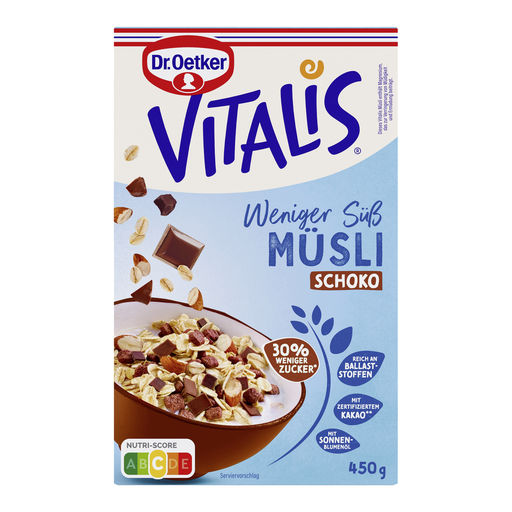 Image unavailable
For anyone looking for chocolatey crunchy muesli. The name “Less Sweet” doesn’t replace checking the sugar content per 100 g; also check the allergens on the current pack.
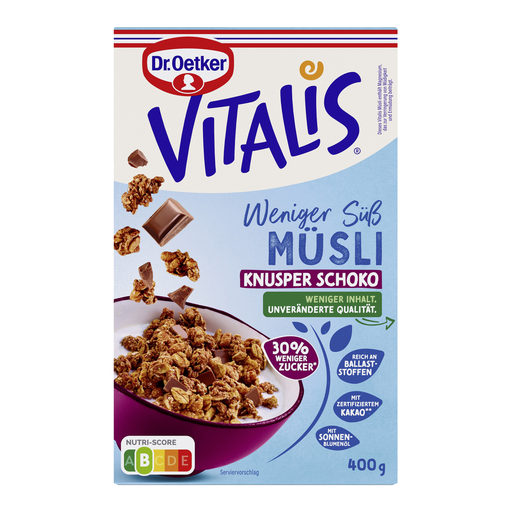 Image unavailable
Another chocolatey crunchy option for breakfast, here in a 400 g pack. Compare wholegrain ingredients and sugar per 100 g with the alternative you have in mind, and check the allergen information on the pack.
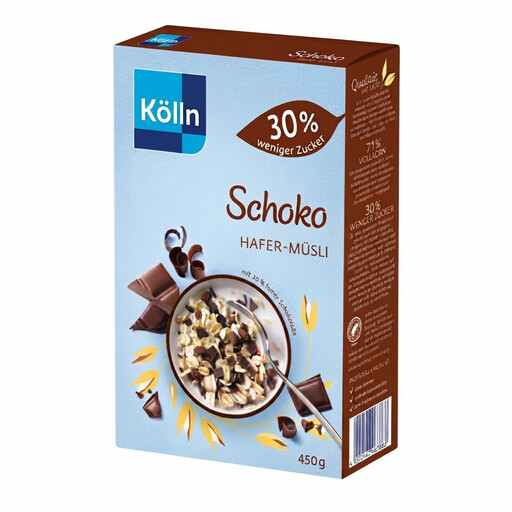 Image unavailable
For anyone who would prefer chocolate oat muesli to shaped cereal. “30% Less Sugar” describes a relative comparison; the sugar content per 100 g on the pack is also important when choosing.
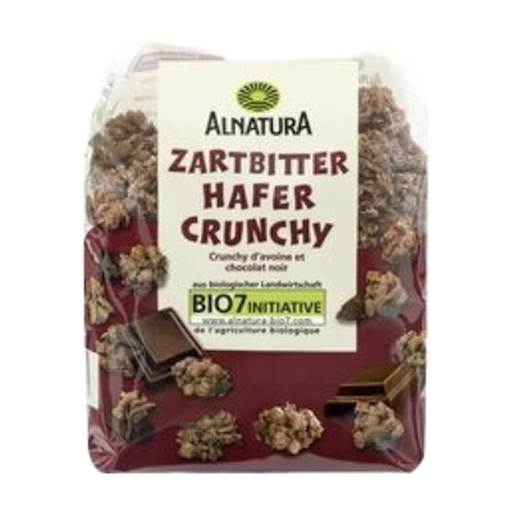 Image unavailable
For anyone who prefers oat crunchy muesli with dark chocolate. The type of chocolate doesn’t indicate the sugar content; compare the nutritional information per 100 g and check the allergens.
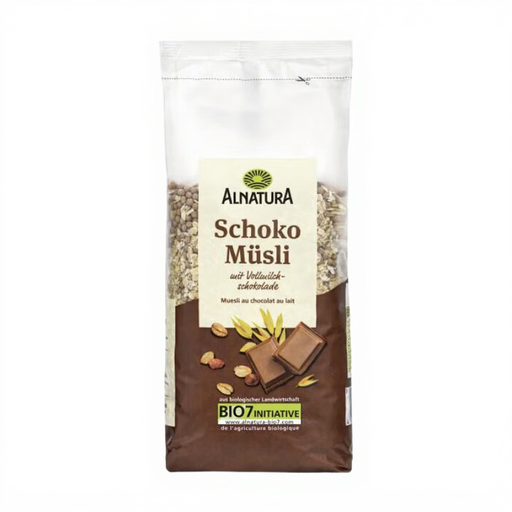 Image unavailable
A chocolate muesli option for anyone looking for a 750 g pack. Check the wholegrain ingredients of the specific variety and compare sugar and fibre per 100 g with other mueslis.
Look for cereal ingredients specifically labelled as wholegrain in the ingredients list, or for a stated wholegrain proportion. The general term “cereals” or a dark colour doesn’t prove that a product contains wholegrains; the ingredient’s position in the list can also help you assess it.
No. This describes a relative comparison, not the absolute amount of sugar. Check the “of which sugars” value per 100 g and find out which comparison product the claim refers to.
The Nutri-Score can be useful as an additional guide when comparing foods in the same category or with the same intended use. The German consumer advice centre recommends this approach; the ingredients list and nutritional information are still important for checking wholegrains, sugar and allergens separately.
Yes. Always use the labelling on the specific pack to make your choice. Check the current ingredients list, highlighted allergens and precautionary “may contain” warnings, even if you already know the variety.