Sugar-conscious shoppers
You’d like something chocolatey in the morning and compare sugar per 100 g as well as per portion, rather than relying solely on ‘no added sugar’.


For a sweet breakfast, ‘no added sugar’ doesn’t mean sugar-free: check the stated sugar per 100 g and the ingredients for the specific variety. A chocolate bar is easy to compare using this figure, while a cereal bar provides a set individual portion. For bars labelled vegan, the ingredients and may-contain information are still key.
You’d like something chocolatey in the morning and compare sugar per 100 g as well as per portion, rather than relying solely on ‘no added sugar’.
You’re looking for a pre-portioned chocolatey snack and consider the grain content and sweeteners as well as the portion size.
You check for vegan labelling or want to avoid certain ingredients. In either case, the ingredients and may-contain information for the specific variety must meet your needs.
First decide whether you’d prefer a chocolate bar or a single-portion cereal bar. Then compare the sugar content and check the sweeteners and ingredients for the specific variety.
| What to consider | What to check when buying | Who it matters to |
|---|---|---|
| Sugar content | Distinguish the wording on the pack from the sugar content per 100 g; for bars, also check the portion size. | Anyone specifically looking for a low stated sugar content shouldn’t rely solely on ‘no added sugar’. This comparison is the top priority for around 36% of consumers. |
| Portion and format | Compare the weight and nutritional values per bar with the amount of chocolate you plan to eat. | If you want a small chocolatey addition to breakfast on the go, a set individual portion makes it easier to plan. This is the main consideration for around 29% of consumers. |
| Sweeteners | Check the ingredients list for maltitol and other polyols, and follow any guidance on consumption. | If you’re sensitive to polyols or plan to eat several pieces, pay particular attention to the ingredients and quantity. Tolerance is the top priority for around 21% of consumers. |
| Ingredients and traces | Check the vegan labelling, ingredients list and any warnings about milk, peanuts or tree nuts for the specific variety. | If you need to avoid animal-derived ingredients or certain allergens, you can’t rely on the words ‘dark’ or ‘vegan’ alone. This check is the top priority for around 14% of consumers. |
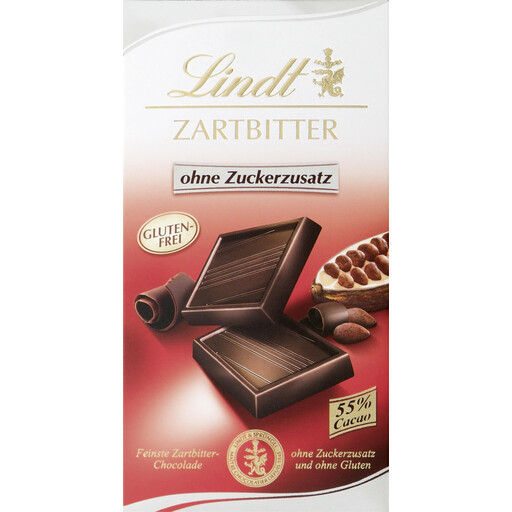
Chocolate labelled this way can still contain sugar. Lindt Germany states that its milk chocolate bar with no added sugar contains 9.0 g of sugar and 510 kcal per 100 g.
Compare the sugar and energy figures in the nutritional information, and take into account how much you actually plan to eat.
The German consumer advice centre notes that polyols can have a laxative effect when consumed in large quantities. Several grams of polyols are already listed for some individual cereal bars.
Check the portion size, the polyol content and any warnings on the pack.
NEOH Peanut Zero, labelled vegan by REWE, contains peanuts and may contain traces of milk and tree nuts. Dark chocolate can also contain milk ingredients.
If you need to avoid particular allergens, check the ingredients and may-contain information on the specific pack, rather than relying on the product category.
Lindt Germany states that its EXCELLENCE Edelbitter Mild with at least 85% cocoa contains 14.0 g of sugar per 100 g, while its dark chocolate bar with no added sugar contains 1.0 g per 100 g.
Don’t use the cocoa content as a substitute for comparing sugar figures and ingredients.
Lindt Germany offers chocolate bars with different sugar-related claims. The exact variety is what matters when choosing.
CORNY Free Schoko is a portioned cereal bar with chocolate, for shoppers who prefer a bar format.
NEOH Peanut Zero may suit shoppers looking for a peanut-based chocolate bar labelled vegan.
The ja! Müsli-Riegel Schoko ohne Zuckerzusatz offers another 25-g bar portion to compare.
This selection includes a dark chocolate bar, a cereal bar with white chocolate and two other chocolatey bars. Compare the format and nutritional information for each, rather than assuming that the sugar claims mean the same thing.
 No image available
For anyone who’d prefer a chocolate bar to a pre-portioned breakfast bar. The 100-g variety is labelled ‘no added sugar’. Check the sugar content for the portion you plan to eat, as well as the ingredients and sweeteners.
 No image available
For a individually portioned chocolatey snack on the go. The pack contains six 20-g bars and is labelled ‘no added sugar’. Check the ingredients for this white chocolate variety: information for CORNY Free Schoko with milk chocolate doesn’t necessarily apply to it.
 No image available
For shoppers looking for an individual chocolatey bar rather than a chocolate bar. This variety weighs 50 g. Don’t take ‘Sugar Free’ in the product name as a substitute for checking the sugar content in the nutritional information, and check the ingredients too.
 No image available
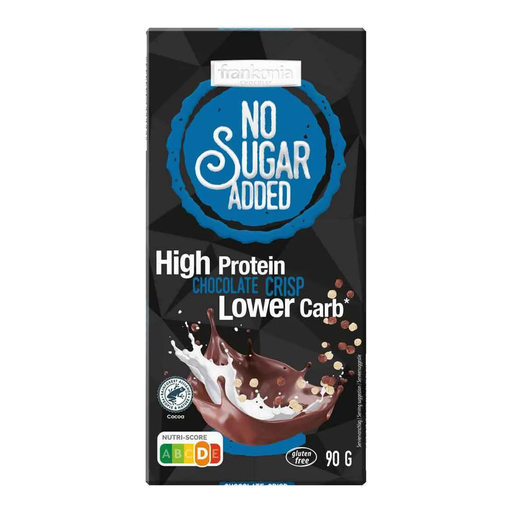
For shoppers considering a crisp-style chocolate bar. The 90-g pack is labelled ‘No Sugar Added’. For a useful comparison, focus on the sugar per 100 g, the ingredients and the portion you’ll actually eat.
No, the two claims don’t mean the same thing. The German consumer advice centre makes a clear distinction between them; for example, Lindt Germany states that its dark chocolate bar with no added sugar contains 1.0 g of sugar per 100 g. So always check the nutritional information too.
The sweetness may come from polyols, among other things. The cereal bars mentioned here, for example, contain maltitol syrup or isomalt. Check the ingredients list to see what’s in a particular variety.
Check the portion size and any warnings about excessive consumption. The German consumer advice centre notes that large amounts of polyols may have a laxative effect; some products carry an explicit warning.
No. According to Lindt Germany, Lindt dark chocolate with no added sugar contains whole milk powder. If you need to avoid milk or other ingredients, check the ingredients and may-contain information for the specific bar.
A chocolate bar is a good choice if you want to choose your own portion and compare varieties using the figures per 100 g; a cereal bar provides a set individual portion for when you’re out and about. For either option, compare the nutritional values for the amount you plan to eat and check the ingredients, rather than assuming the format tells you how much sugar it contains.