Commuters prioritising fibre
You can prepare a dry portion in the morning and mainly compare the fibre content per 100 g. Brand and crunchiness are less important to you.


If fibre is your priority when grabbing breakfast on the go, compare chocolate muesli with classic chocolate cereal using the nutritional information per 100 g, rather than relying on the product name. The oat mueslis featured here have more fibre than the Choco Krispies Chocos featured here. For your commute to work or school, consider whether you can prepare a dry portion in advance. Also check the sugar content and the ingredients and allergen information on the pack you buy.
You can prepare a dry portion in the morning and mainly compare the fibre content per 100 g. Brand and crunchiness are less important to you.
You fancy chocolate muesli but also keep an eye on the sugar content. An oat or wholegrain base alone won’t answer that question.
You need a format you can take with you and eat without any preparation. If you choose a bar, check its fibre content separately rather than assuming its handy format tells you anything about its nutritional value.
First, check whether the fibre content meets your requirements. Then decide how you want to eat your portion on the go, and compare sugar and ingredients across the products that suit you.
| Criterion | What to check | Who it matters most to |
|---|---|---|
| Fibre | Fibre per 100 g. To use the claim ‘high in fibre’, the EU Regulation (EC) No 1924/2006 requires at least 6 g per 100 g or 3 g per 100 kcal. | If fibre content matters more to me than the brand or format, I want to be able to work out the amount in the portion I plan to eat. Around 36% of consumers put fibre first when making this choice. |
| Taking it with you | Whether you can portion out the dry cereal in advance and whether you’ll need to take milk or yoghurt separately. | For my journey, I need a breakfast I can transport easily; a container might matter more than the pack size. Around 29% of consumers prioritise convenience when taking breakfast with them. |
| Sugar | Sugar per 100 g and, if a reduction claim is made, the product used for comparison. | I want a chocolate flavour, but I also want to compare the sugar content of different recipes carefully. Around 21% of consumers make this their first consideration. |
| Ingredients and allergens | The current ingredients and allergen information on the pack. Only assume a product meets a requirement, such as being gluten-free, if this is stated on the label. | If I need to avoid certain ingredients, the specific recipe on the pack determines whether the product is suitable for me. Around 14% of consumers make this their top priority. |
The type of grain doesn’t replace checking the nutritional information for the finished product. Kölln lists 9.5 g of fibre per 100 g for Knusper Schoko Feinherb 30 % less fat; Kellogg's lists 6.0 g per 100 g for Choco Krispies Chocos.
Compare the fibre content per 100 g on the specific packs. To use the claim ‘high in fibre’, the EU Regulation (EC) No 1924/2006 requires at least 6 g per 100 g or 3 g per 100 kcal.
A bar you can eat on its own solves the problem of taking breakfast with you, but it doesn’t automatically meet your fibre needs. Nestlé lists 5 g of fibre per 100 g for the Cini Minis bar, so it doesn’t meet the 6 g per 100 g requirement.
If fibre content is a deciding factor, check the nutritional information on bars too. You can only assess the alternative requirement of 3 g per 100 kcal using the relevant product values.
A sugar-reduction claim is based on a comparison and doesn’t automatically tell you the sugar or fibre content of other products. For example, Kölln offers a chocolate oat muesli labelled ‘30 % less sugar’.
Read the comparison information, then check the sugar and fibre content per 100 g for the same product variant.
‘Oat’ or ‘chocolate’ doesn’t tell you what other ingredients and allergens a particular recipe contains. EDEKA notes that online product information may differ from the packaging.
If you need to avoid ingredients for medical reasons, follow the current ingredients and allergen information on the pack you buy.
Chocolate oat mueslis with different recipes. When choosing between them, it’s the nutritional values of each variant that matter, not just the brand name.
Schoko Hafer Müsli is an option for shoppers specifically looking for chocolate muesli labelled gluten-free.
Choco Krispies Chocos are a classic, crunchy chocolate cereal alternative to chocolate muesli.
The Cini Minis bar is a different format for eating on the go, not the same type of product as chocolate muesli or loose cereal.
These crunchy chocolate mueslis could suit a breakfast where you portion out the dry muesli before setting off. Before buying, compare the nutritional information and label on each pack, particularly if fibre or specific ingredients are important to your choice.
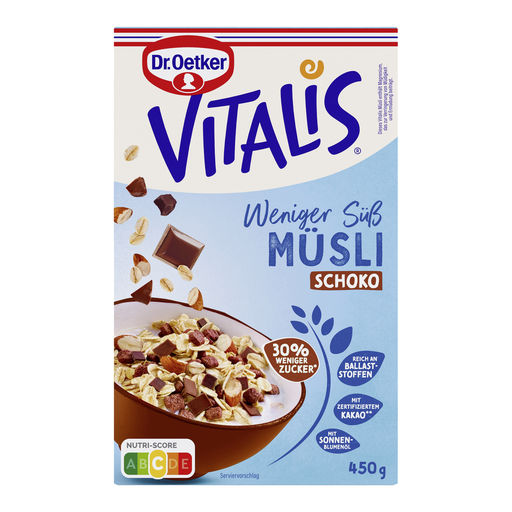 No image available
For preparing a dry portion of muesli to take with you; transport milk or yoghurt separately if you need it.
Pack size as stated in the product name: 450 g. Check the fibre content per 100 g and the ingredients and allergens on the pack you buy.
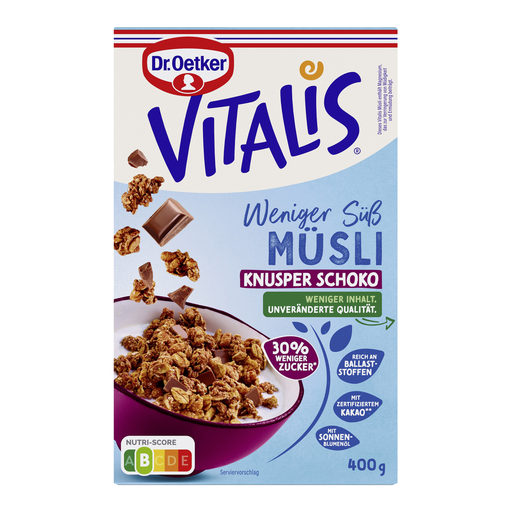 No image available
For anyone who wants to portion out crunchy chocolate muesli in the morning and take it along dry.
Pack size as stated in the product name: 400 g. Compare fibre and sugar per 100 g, and check the current allergen information.
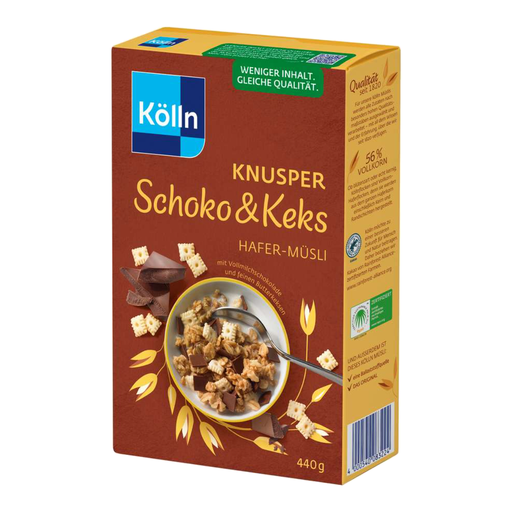 No image available
Oat muesli with chocolate and biscuit for a breakfast portion you can prepare in advance.
Pack size as stated in the product name: 440 g. Check the fibre content for this variant, along with the ingredients and allergen information on the pack.
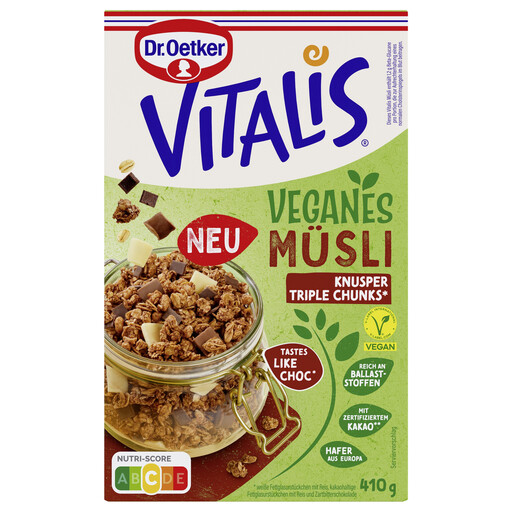 No image available
Crunchy chocolate muesli for a dry portion you can prepare before setting off for work or school.
Pack size as stated in the product name: 410 g. If a particular diet or fibre content is important to you, check the relevant information on this pack.
Under EU Regulation (EC) No 1924/2006, this nutrition claim requires at least 6 g of fibre per 100 g or at least 3 g per 100 kcal. The stated value per 100 g gives you a common basis for comparing packs, although your actual portion may be smaller.
You can’t tell from the fibre content alone. It describes one nutritional value of the product, not the make-up of the whole meal. Consider the portion you actually eat and anything you have with it.
Measure out a dry portion in advance and put it in a well-sealed container. If you want milk or yoghurt with it, take them separately and follow their storage and refrigeration instructions. Mix them together when you’re ready to eat.
If you need to avoid certain ingredients, check the label on the pack you buy. EDEKA notes that the product information shown online may differ from the packaging, so the recipe on the pack in front of you is what matters when making your choice.