For a choir recording using exactly two microphones, you need two microphone preamps that can be used at the same time. If you want to use extra microphones or mic up an accompaniment, you’ll need more inputs. What matters is how many sources you want to record separately and simultaneously – more channels won’t improve poor microphone placement or room acoustics.
Who should consider this?
Choir directors making stereo rehearsal recordings
If you want to record the overall sound with two microphones and listen back afterwards, start by checking their placement and how many microphone preamps can be used at the same time. Shure describes the aim of choir recording as capturing a balanced sound across the whole choir.
Multitrack recordists with an accompaniment
If you want to record additional microphones or a mic’d-up accompaniment alongside the choir, each on its own track, work out how many microphone channels you’ll need before buying. Audient, Steinberg, Focusrite and Behringer all offer models with multiple built-in microphone preamps.
Recording in a challenging rehearsal room
If you’re dealing with distracting room echo, background noise or an unbalanced choir sound, microphone placement and the room itself are separate factors to address. Shure’s recording guide recommends trying different distances and positions, rather than treating extra interface channels as a fix for the room.
What should you look for when buying?
Two microphone preamps
Suitable if: you’re recording the rehearsal with a stereo pair and don’t need another source on a separate track at the same time.
Trade-off: Extra sockets don’t necessarily mean extra usable microphone inputs. Focusrite Support says the 4th-generation Scarlett 2i2 has two analogue inputs that can be used at the same time.
Four microphone preamps
Suitable if: you want to record additional microphones or a mic’d-up accompaniment separately alongside the choir pair. The Audient EVO 8, Steinberg UR44C and Behringer UMC404HD are examples, each with four microphone preamps.
Trade-off: Recording more separate tracks also means more cabling and setup.
Eight microphone preamps
Suitable if: your specific recording plan involves up to eight mic’d-up sources, each on its own track, at the same time. Focusrite says the 4th-generation Scarlett 18i20 has eight built-in microphone preamps.
Trade-off: Extra connections are only useful if your recording plan actually requires them; ADAT expansion is not the same as having built-in microphone preamps.
| Buying priority |
What should you look for? |
Who is it most relevant to? |
| Simple stereo recording |
Count how many microphone inputs you need to use at the same time, and check how many built-in microphone preamps can actually be used in parallel. Focusrite Support says the 4th-generation Scarlett 2i2 has two analogue inputs that can be used at the same time, despite having four physical sockets. |
If I only want to record the choir with a stereo pair, I need two usable microphone inputs. Around 36% of consumers prioritise this exact type of stereo recording. |
| Additional separate microphone tracks |
List all the sources you want to record simultaneously, and distinguish microphone preamps from line inputs and digital expansion connections. |
If I want to record additional microphones or a mic’d-up accompaniment separately alongside the choir pair, I’ll plan for extra preamps. Around 29% of recordists have this as their main priority. |
| Sound in your existing room |
Try different microphone positions and listen to the balance between the choir, accompaniment and room sound. Shure’s recording guide treats distance and position as separate factors to adjust. |
If echo or background noise is affecting my recording, I want to check the microphone setup in the rehearsal room first. Around 21% of consumers prioritise the room and microphone placement. |
| Setting levels and monitoring |
Check how many headphone and monitor outputs you need, and make sure the interface is compatible with your computer and recording software. Test the levels with a loud passage from the choir, too. |
If I want to check levels and listen to the signals during the rehearsal, I’ll look for suitable monitoring options and a straightforward setup. Around 14% of consumers focus on this. |
Common buying mistakes
-
Confusing sockets with microphone inputs you can use simultaneously
The number of connections alone doesn’t tell you how many microphones you can record on separate tracks at the same time. According to Focusrite Support, the 4th-generation Scarlett 2i2 has two analogue inputs that can be used simultaneously, despite having four physical sockets. On the MOTU M4, two of the four analogue inputs are line inputs.
Check the specifications for the number of built-in microphone preamps that can be used at the same time.
-
Buying more channels to fix echo or an unbalanced choir sound
Extra interface channels won’t change the room sound captured by the microphones. Shure’s recording guide treats microphone placement and the amount of room sound as separate factors.
Try different microphone positions in the rehearsal room itself before deciding you need more channels.
-
Counting ADAT expansion as built-in microphone inputs
For the 4th-generation Scarlett 18i20, Focusrite distinguishes between its eight built-in microphone preamps and the additional channels available via ADAT.
For your immediate recording needs, count the built-in preamps first and plan for digital expansion separately.
Adding microphone channels beyond the built-in preamps may require compatible expansion hardware.
Key brands at a glance
Focusrite
The 4th-generation Scarlett 2i2 is designed for two microphone preamps, while the 4th-generation Scarlett 18i20 has eight built-in microphone preamps, according to the manufacturer.
- Focusrite says the 2i2 includes Auto Gain and Clip Safe.
- The four visible sockets on the 2i2 don’t mean you can use four analogue inputs at once. ADAT expansion on the 18i20 is not the same as having built-in microphone preamps.
Audient
The EVO 8 is an option with four microphone preamps if you plan to use additional microphones alongside the choir pair.
- Audient lists individually switchable phantom power, two headphone outputs and Smartgain.
- The manufacturer’s claims about sound quality and automation aren’t an independent comparison; four channels aren’t necessarily needed for a two-microphone setup.
Steinberg
The UR44C is an example of an interface with four microphone preamps and two headphone connections.
- Steinberg lists four D-PRE microphone preamps and two headphone connections.
- The manufacturer’s claims of superior sound quality don’t prove an advantage for a particular choir rehearsal.
Behringer
The UMC404HD is an option with four microphone preamps and direct monitoring.
- According to Behringer, each of the four combo inputs has its own microphone preamp, and +48 V can be switched on.
- Check that the supplied power adapter and the Windows driver, which has to be downloaded separately, are suitable for your setup.
MOTU
The M4 may be worth considering for a two-microphone setup if you also need line-level sources or hardware monitoring.
- The official M4 specifications list two XLR/TRS microphone inputs and two additional line inputs.
- In this case, four analogue inputs don’t mean four built-in microphone preamps.
Related products at Joybuy
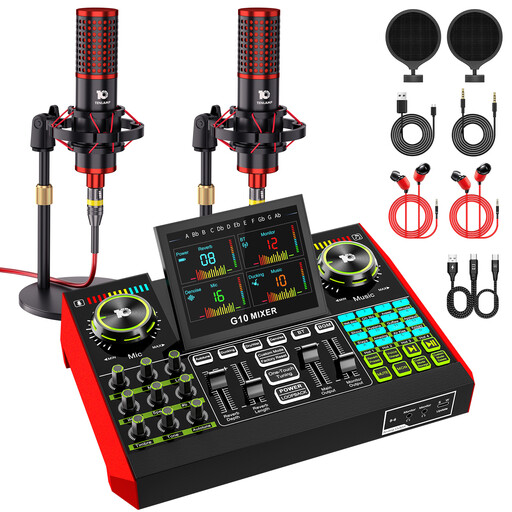
An audio interface kit with two microphones for a setup where the connections and simultaneous recording need to work with your computer and recording software.
 No image available
Yinkaer G10-P17-P17 podcast kit with two microphones
The kit includes two 3.5 mm condenser microphones, so it’s only suitable if these microphones and connections work with your recording setup.
Before buying, check that your computer and recording software can record both microphones at the same time in the way you need.
View at Joybuy
Frequently asked questions
Is an interface with two inputs enough for a choir?
It may be enough if you’re recording with exactly two choir microphones at the same time. If you want to record additional microphones simultaneously on separate tracks, plan for extra microphone preamps; the number of choir members alone doesn’t determine how many channels you need.
Do choir microphones need phantom power?
That depends on the microphones you’re using. Check their power requirements. According to their manufacturers, the Audient EVO 8 and Behringer UMC404HD offer switchable +48 V for compatible microphones.
How should I set up microphones for a choir rehearsal in my home studio?
Start with a test recording and try different distances and positions until the balance between the choir, accompaniment and room sound works for your needs. Shure’s recording guide identifies microphone placement as an important factor; there’s no single microphone count that suits every studio recording.
What legal points should I check before recording and publishing?
You can’t assume that recording and publishing are automatically permitted. Under certain conditions, § 201 StGB protects spoken words that are not intended for the public from unauthorised recording; you’ll need to check separately whether conversations during your rehearsal fall within its scope. Personal data must be processed on an applicable legal basis. If you rely on consent, the requirements explained by the BfDI apply. You’ll also need to check the relevant rights before making protected works available to the public. Recording and publishing are separate matters.


