
Lieferung heute & morgen

Qualitätsgarantie

Willkommens-Angebote freischalten: KOSTENLOSE Lieferung | Bis zu 80 % RABATT | Kostenlose 30-Tage-JoyPlus-Testphase
App herunterladen
Marker pens are available for a wide range of uses: highlighting, labelling, drawing, sketching or making permanent marks. However, the product name alone says little about how suitable a pen really is. A permanent marker is usually unsuitable for notes on paper, while a water-based watercolour marker will not deliver the desired results on smooth plastic.
Before buying, you should therefore look beyond the number of colours. Tip shape, ink base, paper compatibility and the cap mechanism all determine whether a marker set remains practical for everyday use.
A marker set with 36 or 48 colours may appear versatile. For the office, school or a bullet journal, however, a few clearly distinguishable colours are often sufficient. A wider colour range can make sense for artists’ pens, particularly for skin tones, shading or illustrations. What matters is whether the colour selection suits the project you have in mind.
Water-based markers are generally less odorous and suitable for many paper projects. However, they can bleed on absorbent paper or react when they come into contact with water. Permanent markers, on the other hand, use ink that adheres permanently to numerous surfaces. This can be useful for labelling, but it is difficult to remove from clothing, furniture or delicate surfaces.
With watercolour markers, water solubility is a desirable feature. The colour can be spread using water and a brush. This works most reliably on suitable watercolour paper.
A specification such as “1–5 mm” does not by itself describe the writing quality. With a Chisel Tip Marker, the line width depends on the angle. A fibre tip often produces more consistent lines, while a flexible brush tip creates dynamic strokes and areas of colour. Anyone who mainly highlights text needs different features from someone drawing fine outlines.
A dual-tip marker combines two uses in a single pen. It often features a fine tip for details and a brush or wedge tip for larger areas. For labelling, 0.4 to 0.5 mm can be practical, while highlighters generally offer a variable width of around 1 to 5 mm.
Also look for a pressure-resistant or reinforced tip if several people will be using the same pen. A soft brush tip is suitable for colour washes, but can change shape more quickly under heavy pressure.
The cap should be put back on fully after use. Many markers should be stored horizontally so that the ink remains evenly distributed. For longer journeys, secure caps and sturdy cases are important. For products containing small parts, remember: markers and caps should be kept out of the hands of children under three years of age. Product information relating to standards such as EN 71, ISO 11540 or BS 7272 should only be taken into account if explicitly stated by the manufacturer.
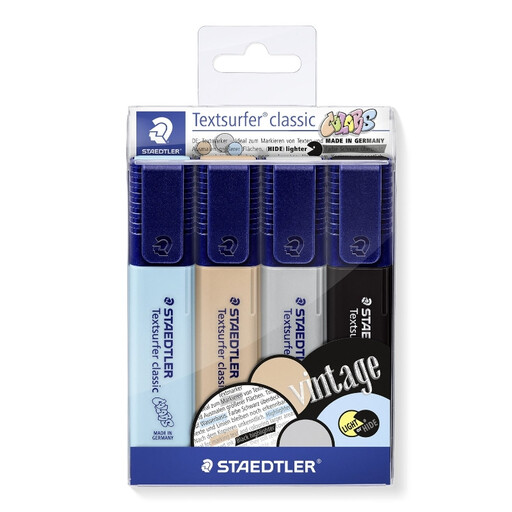
Why this product suits this profile: The set covers the standard highlighting colours for school, university and the office without requiring a very large collection of colours.
The focused selection reduces the risk of buying unnecessarily many similar colours for everyday use. According to the product details, the soft wedge tip offers a line width of around 1–5 mm.
Water-based ink, a large ink reservoir and a wedge tip designed for underlining and covering larger areas.
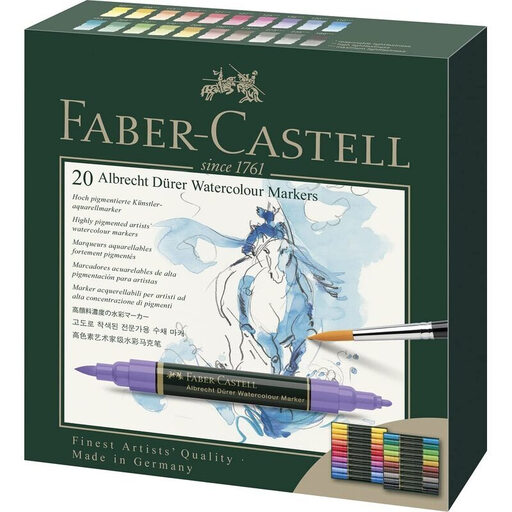
Why this product suits this profile: The set is aimed at illustrators, artists and hobby artists who want to combine drawing with water-soluble watercolour techniques.
The two tips on each marker make its purpose clear: the Brush Tip is for areas and dynamic lines, while the sturdy fibre tip is for details. The water-soluble ink is designed for watercolour techniques.
20 colours in a case, two tips per pen, water-based and water-soluble ink and, according to the product details, high lightfastness.
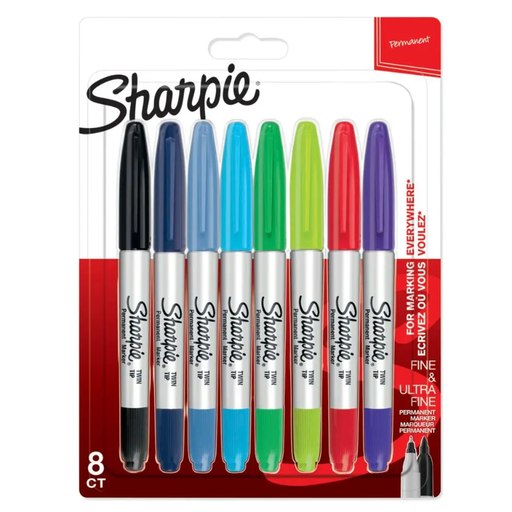
Why this product suits this profile: The combination of a fine and a standard tip is suitable for permanent labelling, project planning and creative work on a range of surfaces.
The two tips eliminate the need to buy several markers for different line widths. As this is permanent ink, the surface should be checked beforehand.
Eight colours, a fine 0.5-mm tip and a second tip for broader lines; according to the product description, quick-drying, water-resistant ink.
We have put together a complete, regularly updated list of products that fully meet these strict selection criteria and the safety regulations applicable in the EU.
For schoolbooks and worksheets, text markers with water-based ink and a variable wedge tip are usually a good choice. A line width of around 1–5 mm allows you to underline text as well as make broader highlights. With inkjet prints, look for smudge-resistant or quick-drying properties.
Service life depends on the amount of ink, frequency of use, storage and the cap. A large ink reservoir can extend the time between replacements when highlighting regularly. Caps should be closed immediately after writing. Horizontal storage is sensible for many water-based markers; the relevant manufacturer’s guidance remains decisive.
The price mainly depends on the number of colours, tip construction, ink type and packaging. A small highlighter set is often sufficient for simple notes. With artists’ pens or dual-tip markers, you also pay for colour gradations and the combined tip function. So do not compare only the set price; also consider how many pens you actually need and whether they are suitable for the intended surface.