
Lieferung heute & morgen

Qualitätsgarantie

Willkommens-Angebote freischalten: KOSTENLOSE Lieferung | Bis zu 80 % RABATT | Kostenlose 30-Tage-JoyPlus-Testphase
App herunterladen
A planter should hold plants securely, suit its intended location and blend seamlessly into your indoor or outdoor environment for the long term. In practice, however, three common purchasing decisions often lead to unnecessary costs: buying a decorative plant pot without adequate drainage, considering only the external rather than the internal dimensions, or choosing a material that is not suitable for the planned use.
It is particularly important to look closely at the technical specifications when choosing plant pots for indoors and outdoors. An attractive design alone says little about stability, water drainage or winter suitability.
A planter without a drainage hole can leave the soil permanently wet, which is unsuitable for many plant species. With a planter featuring drainage, you should also check whether excess water can actually run away and whether a drip tray is included.
For indoor use, a removable tray is practical because it protects furniture and windowsills from water stains. For outdoor areas, on the other hand, you need to check that the openings remain unobstructed and that water does not collect against a vulnerable exterior wall.
The external dimensions of a plant pot do not automatically correspond to the usable planting space. Wall thickness, an inner pot and a water reservoir can reduce the available soil volume. When choosing a planter, compare the following details:
A large planter can quickly look out of proportion in a small room. On a balcony or terrace, however, a narrow, tall model can be used as a privacy screen or room divider.
Ceramic, metal, plastic, fibreglass and stone-resin mixtures differ in terms of weight, resistance to breakage and care requirements. A ceramic plant pot, for example, is well suited to indoor spaces and sheltered areas, but should be placed on a stable, level surface. Tall planters made from lightweight materials need to be positioned securely outdoors so that wind or uneven loading does not cause them to tip over.
For an outdoor model, details about UV resistance, moisture resistance and temperature range are relevant. However, they do not replace suitable positioning. Even weather-resistant containers should be protected from strong impacts and treated or stored for winter in accordance with the manufacturer’s instructions.
The planter should suit the plant’s root space. A flower pot that is too small limits the volume of soil and can make watering more difficult. A container that is too large, on the other hand, retains more moisture than some plants need. For a tall container, a wide, sturdy base is recommended.
For balconies, you must also take the balcony’s load-bearing capacity into account. Soil and water add considerable weight. A plant container for a balcony or terrace should therefore be chosen not only according to the available space, but also according to its total weight.
A drainage hole is particularly important for plants that cannot tolerate permanently wet soil. Check whether:
For tall outdoor planters, a separate inner pot can be useful. It reduces the amount of soil required and makes it easier to move the plant.
A self-watering flower pot usually has a water reservoir from which the growing medium can absorb moisture. This can change watering intervals, but it does not eliminate the need to check the water level. Before buying, pay attention to the reservoir capacity, filling opening, ease of cleaning and suitability for the particular plant.
Not every houseplant needs the same amount of water. A reservoir should therefore not be treated as an automatic guarantee of effortless plant care.
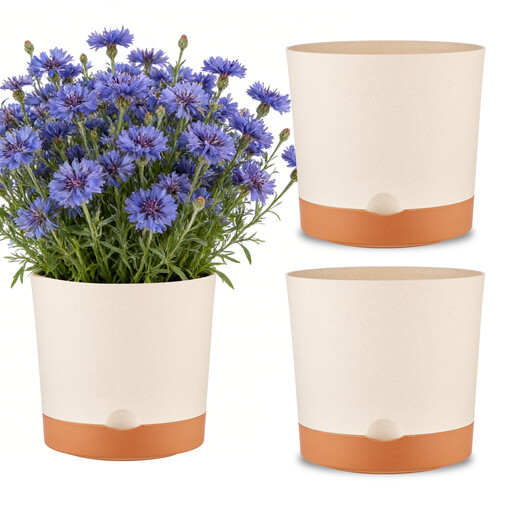
Why this product suits the profile: The set includes three pots, each with a diameter of 16.5cm, together with matching trays. The beige, matt finish is well suited to windowsills, balconies or small groups of plants.
The integrated water reservoir and matching trays make the design more practical than a purely decorative cover pot without water drainage. The water level should still be checked regularly.
Three matching plastic pots, each with a diameter of 16.5cm, featuring a self-watering design with a reservoir.

Why this product suits the profile: This black plant pot in matt ceramic is designed for compact indoor spaces such as windowsills, shelves or desks.
Two drainage holes and a removable ceramic tray are clearly specified. Excess water can be collected and emptied afterwards.
Dimensions of 25 × 12 × 10 cm, matt black ceramic, two drainage holes and a removable tray.
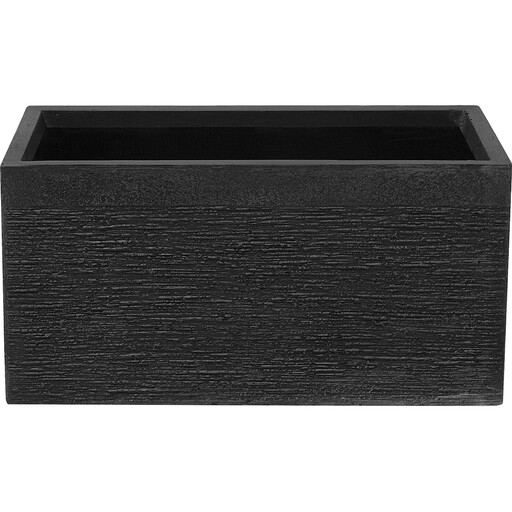
Why this product suits the profile: With a capacity of 42 litres, this elongated container is designed for room dividers, terraces and planted privacy screens.
The technical specifications list two drainage holes, UV resistance and a stated temperature range of -20 °C to 40 °C. An inner liner is recommended for the soil.
60 × 29 × 30 cm, 42-litre capacity, a black rectangular design, plus stated UV and weather resistance.
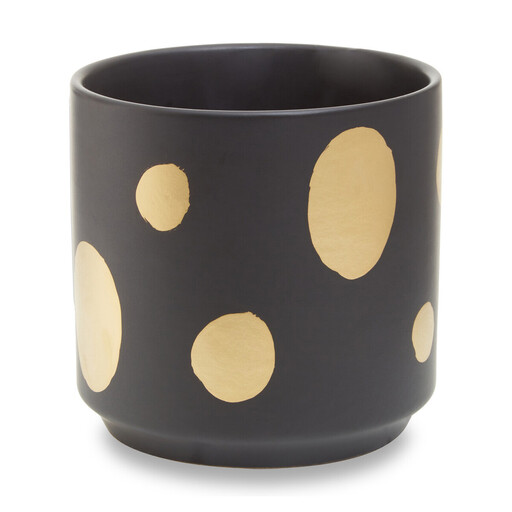
Why this product suits the profile: Measuring 14 × 14 × 14 cm, this decorative planter is suitable for smaller houseplants, workspaces or shelves.
Its compact size prevents the pot from dominating smaller surfaces. As no drainage hole is specified, it should be used as a cover pot or with a suitable inner pot.
Stoneware material, black finish with metallic dots and compact dimensions of 14 cm.
We have put together a complete, regularly updated list of products that fully meet these strict selection criteria and the safety regulations applicable in the EU.
Place every planter on a level, stable surface. Indoors, saucers should be emptied regularly. Drainage holes must not be blocked by soil, roots or standing water. Ceramic and glass should be protected from impacts.
For outdoor planters, check their stability before filling them. A heavily planted container can be difficult to move later. For materials at risk from frost, follow the manufacturer’s instructions for winter storage. Even a planter made from a material described as weather-resistant can still be damaged by heavy impacts or unsuitable positioning.
The new planter should provide enough space for the existing root ball without holding unnecessarily large amounts of excess soil. The key factors are the internal dimensions, height and actual capacity. With fast-growing plants, allowing a little extra room can be useful.
No. A cover pot can be used without a drainage hole if it contains a separate plant pot with drainage. For containers planted directly, controlled water drainage is often more practical. The right solution depends on the plant species, location and amount of water used.
Apart from the purchase price, there are normally no regular running costs. The water reservoir is refilled manually. Ongoing expenses may arise from replacement parts, additional plant inserts or growing medium. The important thing is to ensure that the reservoir remains accessible and is cleaned regularly.