Breakfast portion planner
You want to prepare several sealable individual portions after your weekly shop and choose jar sizes to suit how much you eat. Severin lists seven 150 ml jars for the JG 3518; Steba lists twelve 0.2 l jars for the JM 2.


For breakfast supplies after your weekly shop, choose a yoghurt maker with individual jars if you want to fill single portions straight away; for a larger batch, a container you can portion later is a good choice. A non-electric model could work if you can provide the required heat as instructed. If you use raw milk from the farmers’ market, the Federal Institute for Risk Assessment recommends boiling it before making yoghurt.
You want to prepare several sealable individual portions after your weekly shop and choose jar sizes to suit how much you eat. Severin lists seven 150 ml jars for the JG 3518; Steba lists twelve 0.2 l jars for the JM 2.
You want to make a larger batch and portion it at breakfast, or strain some of it. The Rommelsbacher JG 80 comes with large containers and a strainer; Ariete lists a filter sieve for the Yogurella 0621/10.
You want to make yoghurt without using electricity during fermentation and can provide the required heat yourself. My.Yo describes its 1-l maker as insulated to retain heat, rather than having electric temperature control.
| What you’re looking for | What to check before buying | Who it matters to |
|---|---|---|
| Ready-portioned breakfasts | Check the number and stated capacity of the jars, their lids and whether you have room for filled jars in the fridge. Severin lists seven 150 ml jars for the JG 3518; Steba lists twelve 0.2 l jars for the JM 2. | If I want to fill several individual, sealable jars with breakfast after my shop, the number and capacity need to suit how much I eat and the space in my fridge. Around 36% of consumers make ready-portioned breakfasts their main priority. |
| Batch size for a week’s supply | Match the stated capacity and container format to how much you plan to make, and allow for chilled storage space. Steba lists a total capacity of 2.4 l for the JM 2; the Rommelsbacher JG 80 comes with two 1.2 l XXL containers. | If I prefer to make a batch for the week and portion it myself later, I want the quantity to suit how much I eat and the chilled storage space I have. Around 29% of consumers prioritise batch size for their weekly supply. |
| Flexible preparation | Check which programmes are included and whether there’s a strainer. The manufacturer lists four temperature programmes for the Rommelsbacher JG 80; Ariete lists a filter sieve for the Yogurella 0621/10. | If I also want to make strained yoghurt or use different programmes, I check which features the specific model actually offers. Around 21% of consumers prioritise flexible preparation and consistency. |
| Fermentation without electricity | Check how heat is supplied, the container capacity and the instructions. My.Yo describes its 1-l maker as insulated to retain heat; you’ll need to provide the required heat using the specified method. | If I don’t want to use a socket during fermentation, I need to provide the required heat as instructed. Around 14% of consumers prioritise a non-electric fermentation process. |
The Rommelsbacher JG 80 product description states that it makes up to 1,200 g of yoghurt per batch. Don’t confuse this figure with the combined capacity of all the jars and containers supplied.
Compare the stated amount per batch with how much you need for the week, rather than looking only at the number or total capacity of the containers included.
My.Yo describes an insulated yoghurt maker. The appliance doesn’t generate the required heat itself.
Read the preparation steps before buying and check whether you can fit the required heat into your breakfast routine.
The Federal Institute for Risk Assessment warns that raw milk can contain pathogens. It recommends boiling raw milk before consumption. This advice also applies to homemade yoghurt that isn’t heated again afterwards.
If you use raw milk, boil it before making the yoghurt and use clean containers.
The JG 3518 is designed for seven individual 150 ml portions (Severin).
According to Steba, the JM 2 comes with twelve 0.2 l jars and has a total capacity of 2.4 l.
According to Rommelsbacher, the JG 80 Jona combines large containers, small ceramic pots and a strainer; the JG 40 comes with eight 150 ml jars.
The 1-l maker is a non-electric option with heat insulation (My.Yo).
Ariete lists a 1-l container and a filter sieve for the Yogurella 0621/10.
The models listed include options with individual jars and larger containers for batches you can portion later; some also come with a strainer. Parts intended to come into contact with food are subject to the relevant food-contact materials regulations, including Regulation (EC) No 1935/2004 (European Commission). Check the details on the specific product listing.
 No image available
This model is a good choice if you want to make a larger batch and portion it yourself later. The product name lists two XXL glass containers with capacities of 2,000 ml and 1,400 ml.
 No image available
This model could suit you if you’d like to choose between individual jars and a larger inner pot. It’s listed with nine borosilicate glass jars, a 1.6-l inner pot, temperature control, a timer and an OLED display; the material is stated as SUS304.
 No image available
If you want to prepare individual breakfast portions, this version comes with eight jars. The product name lists a total capacity of 1,440 ml, digital temperature control and a timer of up to 48 hours.
 No image available
This model is a good choice if you want to make a larger batch and strain it if needed. It’s listed with a capacity of 1.5 l, a power rating of 20 W, a strainer and a lid.
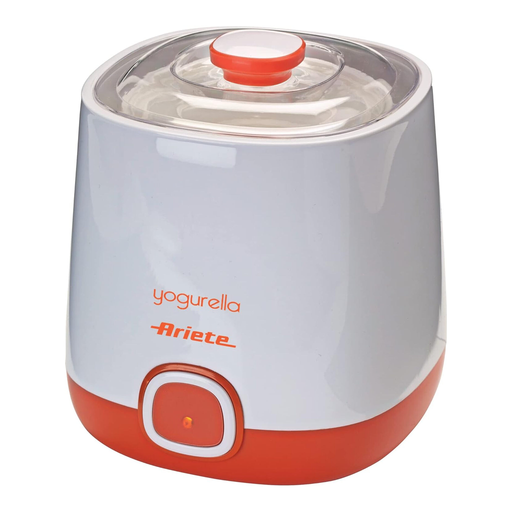 No image available
If you’re planning a smaller batch, a 1 l container could suit your needs. The capacity is listed as 1 l and the power rating as 20 W.
Don’t use raw milk without boiling it first. The Federal Institute for Risk Assessment recommends boiling raw milk before consumption; this advice also applies to homemade yoghurt that isn’t heated again afterwards. People who are particularly vulnerable should avoid unboiled raw milk altogether.
Individual jars save you having to portion the yoghurt later, while a large container works well for a batch you’ll divide up after making it. Choose based on how much you eat and the space in your fridge. If you opt for a large container, also check the stated amount per batch.
Use clean hands and equipment, and take care not to contaminate the containers. Once made, yoghurt should be kept in the fridge (Federal Centre for Nutrition); there’s no general shelf-life guarantee that applies to every homemade batch.
Yes. My.Yo describes heat insulation rather than electric temperature control, so you’ll need to provide the heat required for the process. Read the instructions before buying so you can plan for the recommended preparation steps.
Parts intended to come into contact with food are subject to the relevant EU regulations on food-contact materials, including Regulation (EC) No 1935/2004 (European Commission). This doesn’t in itself confirm that a specific product listing complies.