Families who regularly eat fresh yoghurt
You store yoghurt that needs to be kept chilled for your next meal. The Federal Centre for Nutrition recommends storing dairy products on the middle shelves; also follow the instructions on the packaging.


For fresh yoghurt, having enough usable fridge space is what matters most. Whether you need a freezer compartment depends on whether you regularly store frozen food. The Consumer Advice Centre recommends choosing an appliance size to suit your needs, while the Federal Centre for Nutrition recommends storing dairy products on the middle shelves. Follow the storage instructions on the yoghurt packaging, whatever the fridge model.
You store yoghurt that needs to be kept chilled for your next meal. The Federal Centre for Nutrition recommends storing dairy products on the middle shelves; also follow the instructions on the packaging.
You want to store other food alongside several pots of yoghurt. The Consumer Advice Centre recommends choosing an appliance size to suit your needs.
You need to balance the available floor space and door clearance with the amount of fridge space you need. The Consumer Advice Centre lists choosing the right appliance size as an important buying consideration.
A good fit if: you store frozen food elsewhere and want to use the appliance’s space for chilling.
Consider: There’s no dedicated freezer space in the appliance. You should still check the dimensions and annual energy consumption of the specific model.
A good fit if: you want to store frozen food in the same appliance as your fresh yoghurt on a regular basis.
Consider: The total capacity includes the freezer compartment, so compare the fridge and freezer capacities separately.
A good fit if: the space available in your kitchen limits your options, so you need to check the appliance dimensions and door clearance first.
Consider: A narrower appliance doesn’t necessarily mean enough shelf space or lower running costs.
Don’t choose based on total capacity alone. For family portions, consider the usable fridge space, whether you really need a freezer compartment and the dimensions of the space where the appliance will go.
| Priority | What to check when buying | Who should pay particular attention? |
|---|---|---|
| Suitable cooling | Check the fridge space and how easy the shelves are to reach. The Federal Centre for Nutrition recommends using the middle shelves for dairy products. | If I’m putting yoghurt that needs to be kept chilled away for a meal, I want a suitable place to store it and will follow the instructions on the packaging. Around 36% of consumers put suitable cooling first. |
| Usable fridge space | Compare the fridge capacity and shelves with the quantities you usually store. With a fridge freezer, consider the freezer capacity separately. The Consumer Advice Centre recommends choosing an appliance size to suit your needs. | For a family meal, I want to store other chilled ingredients alongside the yoghurt pots. Around 29% of consumers prioritise having enough usable fridge space. |
| Annual energy consumption | For appliances with the right amount of fridge space, compare the stated annual energy consumption in kWh. The EU energy label provides product information to help you compare. | Once I’ve found an appliance that suits my household, I also want to consider its stated annual energy consumption. Around 21% of consumers put running costs first when choosing an appliance. |
| Floor space and door clearance | Check the height, width and depth against the space where the appliance will go, and allow room to open the door. | If there’s only a limited gap in my kitchen, I want to make sure the appliance will fit and remain accessible before anything else. Around 14% of consumers prioritise the available floor space. |
With a fridge freezer, some of the total capacity is taken up by the freezer compartment. The Consumer Advice Centre recommends choosing an appliance size to suit your needs.
Compare the fridge and freezer capacities separately, and check that your pots and ingredients will fit on the shelves.
NoFrost relates to defrosting the freezer compartment; it doesn’t replace the storage instructions on yoghurt packaging. The Federal Centre for Nutrition recommends using the middle shelves for dairy products.
Follow the instructions on the packaging and store yoghurt on a suitable fridge shelf.
As well as the energy efficiency rating, the EU energy label shows the stated annual energy consumption.
Compare the annual energy consumption in kWh and consider how much fridge space your household needs.
The Rd 4600 and CBNdgc 5723 represent different appliance types: a freestanding fridge without a freezer compartment and a fridge freezer.
The KFN 4795 AD and KFN 4799 AD are freestanding fridge freezers for households that need freezer space as well as fridge space.
The KG39NAIAU iQ500 is a freestanding fridge freezer with separate fridge and freezer capacities.
The KGN39AIAU is a specific fridge freezer model, not a stand-in for the entire Bosch range.
The Joybuy products below include fridge freezers and a fridge without a freezer compartment, for households looking to keep yoghurt and other food chilled.
 No image available
For households that need freezer space as well as room for yoghurt and other chilled food.
262 l of fridge space and 113 l of freezer space; four shelves and adjustable temperature control.
FRESHConverter+ is also listed.
 No image available
For households that want to store chilled yoghurt and ingredients alongside frozen food in a separate freezer compartment.
121 l of fridge space and 52 l of freezer space; three glass shelves, a vegetable drawer and LED lighting.
External dimensions are 142.5 × 49.5 × 56.0 cm; the door is described as reversible.
 No image available
For households that want to chill yoghurt and other food without needing a freezer compartment in the appliance.
82 l of fridge space; adjustable glass shelves, door shelves and a vegetable drawer are listed.
 No image available
For households that want to store yoghurt and other chilled food alongside frozen food in one appliance.
187 l of fridge space and 75 l of freezer space; three of the four glass shelves are height-adjustable, and the temperature control is electronic.
54 cm wide and 176 cm high; the door is reversible.
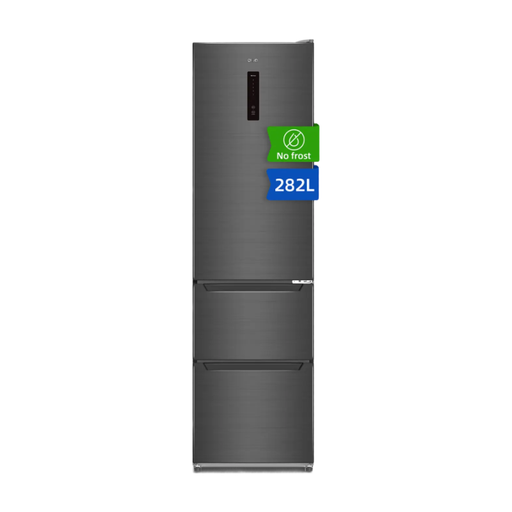 No image available
For households with limited kitchen width that need a freezer compartment as well as fridge space.
The description lists 197 l of fresh-food space, with separate fridge and freezer sections. Multi-Air-Flow, Dual Inverter and touch controls are also listed.
It measures 54 cm wide, 192 cm high and 58.6 cm deep. Allow extra space for ventilation and opening the door.
The Federal Centre for Nutrition recommends storing yoghurt and other dairy products on the middle shelves. Also follow the storage instructions on the relevant packaging.
The Consumer Advice Centre recommends 7 °C on the top shelf as a guide. Also follow the temperature and storage instructions for each food.
Yes. EU energy labelling requirements state that the energy label must be clearly displayed when new fridges and freezers are sold online. Second-hand products are exempt.
No. The Federal Environment Agency lists local collection points as a place to return old electrical appliances. If you arrange collection when your new appliance is delivered, check separately whether disconnection or other services are included.