Home cooks with very limited worktop space
If you have little worktop space, you’ll need to consider the required ventilation clearances and room to open the door as well as the oven’s external dimensions.


First, check that your fish pie dish fits inside the usable cooking space and that the oven, including the required ventilation clearances, will fit on your worktop. Top and bottom heat covers the basic baking function; some models also offer fan-assisted cooking, while particularly compact ovens may have limited cooking space. Before choosing a specific appliance, also check its applicable conformity information and CE marking.
If you have little worktop space, you’ll need to consider the required ventilation clearances and room to open the door as well as the oven’s external dimensions.
If you want to keep using your dish, measure it with the handles included and compare it with the usable internal dimensions of the specific oven.
If you want to bake a fish filling with a topping, check that the oven has top and bottom heat as a basic function, then decide whether you’d also like fan-assisted cooking as an optional setting.
When choosing a mini oven for fish pie with limited worktop space, let your main priority guide your comparison.
| Priority | What to look for when buying | Who is this most important for? |
|---|---|---|
| A safe place to position it | Measure your worktop and check the side and top clearances specified for the particular model. | If my worktop space is limited, the oven needs to fit in its intended spot with the required clearances. Around 36% of consumers put available space first. |
| A dish that fits | Measure the dish, including its handles, and compare it with the usable internal dimensions and shelf position; capacity in litres alone isn’t enough. | If I want to use my existing fish pie dish, I need a suitable cooking space, not just the right capacity in litres. Around 29% of consumers put dish fit first. |
| Heating settings for the pie and topping | Check whether the specific model has top and bottom heat and, where applicable, optional fan-assisted cooking. | If I need specific baking settings for the filling and topping, I check the heating functions on the exact model. Around 21% of consumers prioritise heating settings. |
| Cleaning and running costs | Check which parts can be removed and read the cleaning instructions; don’t compare energy use based on rated power alone. | If something spills over while baking or I use the oven regularly, I pay attention to cleaning and actual energy use. Around 14% of consumers put care and running costs first. |
For the Rommelsbacher BG 1055/E, the manufacturer requires 4 cm of clearance at the sides and 1 m above for ventilation. These requirements apply to this model and shouldn’t be assumed to apply to other ovens.
Check the instructions for the specific appliance and measure the space, including the clearances specified there.
If you can’t maintain the required clearances in the intended spot, you may need to find another location.
A capacity in litres doesn’t tell you whether the dish’s width, depth and height will fit inside the usable cooking space. The Rommelsbacher BG 1055/E specification for round dishes up to 25 cm in diameter doesn’t confirm that a rectangular dish will fit.
Measure the dish, including its handles, and compare the dimensions with the specifications for the exact model.
If your existing dish doesn’t fit, you may need a different ovenproof dish.
The consumer advice centre points out that rated power alone doesn’t provide a complete comparison of the energy used for a baking cycle.
Only compare actual energy use when the cooking method and usage are comparable.
The models listed differ considerably: the TO 2052 has a 9 l capacity, while the TO 2068 offers 20 l and fan-assisted cooking.
The BG 1055/E and BGE 1580/E differ in cooking capacity and the size of dish they can accommodate.
For the KB 27 U.2, Steba lists both internal and external dimensions to help you check whether the dish and the space will fit.
The TO 20 offers top and bottom heat and fan-assisted cooking; its external dimensions need to suit your available worktop space.
The countertop ovens below differ in capacity and features. Before deciding to buy, check the applicable conformity information and CE marking for the specific appliance; product features alone don’t provide this evidence.
 No image available
May suit consumers looking for a larger cooking space and adjustable temperature; check the dimensions against the space available.
32 l; external dimensions 52,3 × 36 × 32,2 cm; 100–250 °C; 60-minute timer; removable crumb tray. The order of the external dimensions isn’t specified.
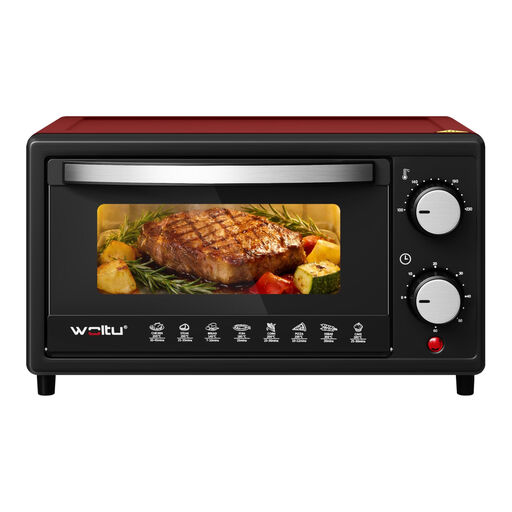 No image available
May suit consumers looking for a compact oven with top and bottom heat; check that your fish pie dish will actually fit inside.
10 l; external dimensions 37 × 26,5 × 21 cm; top and bottom heat; 100–230 °C; 60-minute timer. The order of the external dimensions isn’t specified.
 No image available
May suit consumers who want to choose between top heat, bottom heat and combined heat; the stated pizza size doesn’t confirm that a fish pie dish will fit.
28 l; temperature range 100–230 °C; top heat, bottom heat and combined heat; temperature control and timer.
No. Measure the dish, including its handles and height, and check it against the usable internal dimensions. The manufacturer’s specification for round dishes up to 25 cm in diameter for the Rommelsbacher BG 1055/E doesn’t confirm that a rectangular dish will fit.
It depends on the specific appliance and where it will stand. Rommelsbacher requires 4 cm of clearance at the sides and 1 m above the BG 1055/E for ventilation, and warns against built-in installation; these measurements don’t automatically apply to other models.
A browned topping alone isn’t enough to confirm this. The German Federal Institute for Risk Assessment recommends using a thermometer to check that raw animal products have reached at least 70 °C throughout for at least two minutes. Clean any utensils that have come into contact with raw fish before using them with other ingredients.
If the rated voltage falls within the scope of the EU Low Voltage Directive, covering 50–1.000 V AC, the directive’s requirements for conformity assessment and CE marking apply. The European Union describes the CE mark as the manufacturer’s declaration that applicable regulations have been met; it isn’t an independent baking test.
No. Your statutory rights apply to the seller if a product is faulty; a guarantee is an additional, voluntary promise. The consumer advice centre recommends checking the relevant guarantee terms separately.
Electrical waste shouldn’t go in your household rubbish. The German Environment Agency lists local recycling centres and, subject to the applicable conditions, returning the appliance to a retailer as disposal options.