Bakers with very little worktop space
If you only need crumbs for biscuit bases occasionally, a small appliance that you can put away after use could be a good option. Good Food’s guide also suggests using a sturdy bag and a rolling pin.


For small quantities of biscuit crumbs and limited worktop space, a compact mini chopper that’s easy to put away is usually the obvious choice. A compact food processor is a better fit if you also want to slice or grate. Compare the footprint, height, usable capacity and how easily you can control the texture in stages. If you only make biscuit bases occasionally, you can also crush the biscuits in a sturdy bag with a rolling pin.
If you only need crumbs for biscuit bases occasionally, a small appliance that you can put away after use could be a good option. Good Food’s guide also suggests using a sturdy bag and a rolling pin.
If you often make more crumbs, consider the bowl capacity alongside the space the appliance takes up. Rommelsbacher lists a 1.5-l glass bowl for the MZ 500, but this doesn’t confirm how many biscuits it can usefully process.
If you also want to slice or grate, and have somewhere to store the attachments, a compact food processor could be a good fit. Kenwood lists a blade, slicing discs and grating discs for the MultiPro Go FDP22.140GY.
The approximate proportions below relate to consumers considering a chopper for biscuit crumbs when worktop space is limited. Each figure represents the buyer’s main priority.
A good fit if: you’re processing small quantities and want to store the appliance as compactly as possible.
The trade-off: a small bowl may mean processing larger quantities in several batches.
A good fit if: you regularly want to slice or grate ingredients as well as make biscuit crumbs.
The trade-off: extra discs need storage space; Kenwood lists a height of 30 cm for the MultiPro Go FDP22.140GY.
A good fit if: you often prepare larger quantities and have space for the bowl and motor unit.
The trade-off: a larger stated capacity doesn’t automatically mean it can process a correspondingly large quantity of biscuits.
A good fit if: you only need biscuit crumbs occasionally and don’t want to find room for another appliance.
The trade-off: you crush the biscuits by hand rather than using an appliance.
| Priority | What to check before buying | Who should consider it? |
|---|---|---|
| Worktop and storage space | Compare the footprint, height when assembled, and space needed for the cable and accessories. | If you’re short on worktop space, compact dimensions and easy storage matter most. Consumers whose main priority is space make up around 36%. |
| Control over crumb size | Check the blade and whether the controls let you work in short bursts. | If you want a particular texture for your biscuit base, processing in stages is important. Consumers whose main priority is controlling crumb size make up around 29%. |
| Portion size and other tasks | Check the usable capacity, how many batches may be needed and which extra functions you’ll actually use. | If you often process larger quantities or other ingredients at the same time, capacity and useful functions matter. Consumers whose main priority is larger portions or other prep tasks make up around 21%. |
| Cleaning and number of parts | Check the instructions to see which removable parts are dishwasher-safe and how to remove the blade. | If you use the appliance frequently, having fewer parts and an easy cleaning routine can make everyday use simpler. Consumers who prioritise ease of cleaning make up around 14%. |
Total volume and working capacity can differ. Philips lists a total volume of 0.7 l for the HR1393/00 and HR1393/90 models, but a chopping capacity of 0.5 l.
Compare the quantity you plan to process with the working capacity stated in the instructions for your chosen model.
Larger quantities of biscuits may need to be processed in several batches.
A wattage rating describes an appliance specification, but it doesn’t prove what texture a particular model can achieve. There’s no shared, comparable biscuit-crumb test for the models mentioned here.
Choose based on worktop space, a suitable portion size and controls you can use precisely. Don’t rely on wattage alone to predict the result.
A compact food processor may come with extra discs as well as a blade. For occasional biscuit crumbs, Good Food also describes using a bag and rolling pin.
Think about whether you’ll actually use the slicing and grating functions. If not, compare a mini chopper with the manual method.
Extra attachments need storage space and can add to the cleaning.
The range includes both a mini chopper and a compact food processor for other prep tasks.
The 0.3-l KÜCHENminis chopper is designed for small quantities.
The MMR08A1 is a standalone universal chopper rather than a food processor with multiple discs.
The MZ 500 is an option if a larger bowl matters more to you than having the smallest possible appliance.
The MultiQuick 5 Pro MQ55236M combines a hand blender with a chopper.
The Joybuy options below range from mini to larger choppers. If an appliance is described as a meat chopper, check the instructions before buying to make sure it’s suitable for dry biscuits and the quantity you plan to process.
 No image available
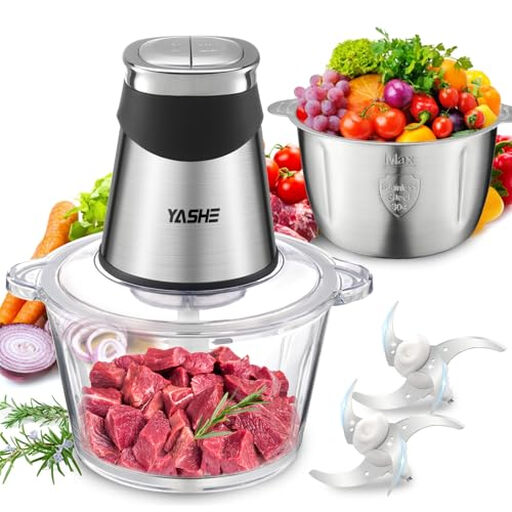
As this appliance is described as a meat chopper, check the instructions beforehand to see whether it can process dry ingredients and what its permitted capacity is.
Two bowls, made from glass and stainless steel, with capacities of 1.8 l and 2 l, 500 W, two speeds and two sets of blades.
 No image available
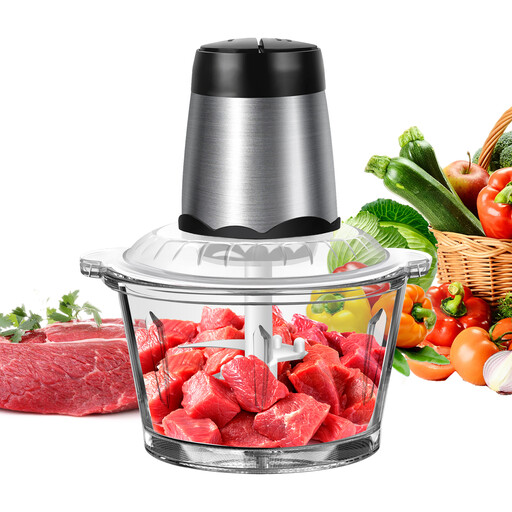
As this appliance is described as a meat chopper, check before buying whether the instructions specify dry biscuits as a suitable ingredient and allow for the quantity you want to process.
The product name lists a 2-l glass bowl and stainless steel blades; the description lists two speeds and a pulse function.
 No image available
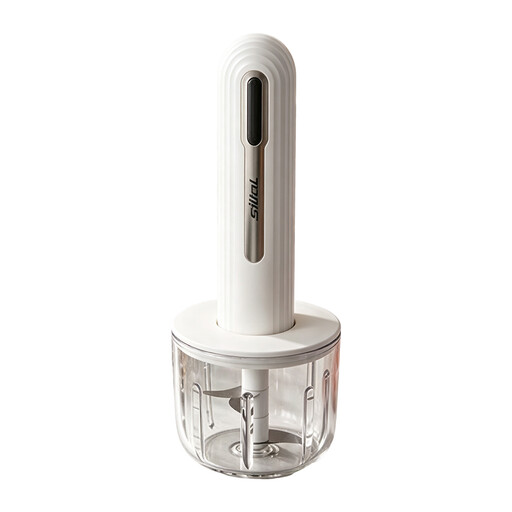
This is described as a compact mini chopper for small portions; check the instructions to see whether it’s suitable for dry biscuits.
The product name specifies cordless operation and a transparent bowl.
 No image available
If you’re considering different portion sizes, check whether the instructions specify that this model can process the quantity of dry biscuits you want.
The product name lists two glass bowls with capacities of 2 l and 0.6 l, as well as 300 W; the description lists two sets of blades and two speeds.
 No image available
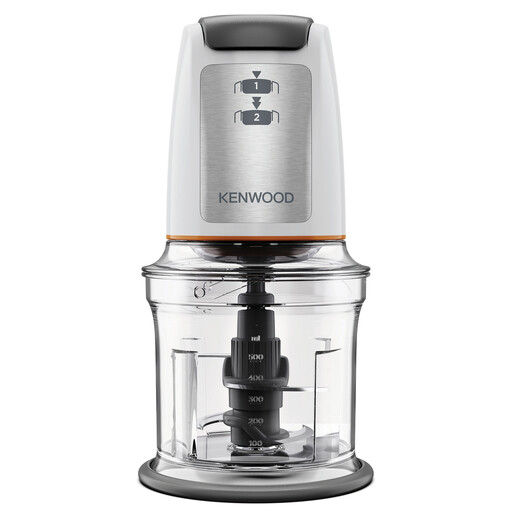
The product description lists biscuit crumbs as one possible use; check whether the appliance’s controls can achieve the texture you want.
The product name lists a 0.5-l bowl, two speeds and 500 W. Kenwood gives the dimensions of this model as 13,85 × 13,85 × 26,4 cm.
You can crush biscuits in a sturdy, clean bag with a rolling pin, or process them in a food processor using short pulses until they reach the texture you want. Good Food describes both methods. If you’re using an appliance, check the instructions and start with a small quantity.
Not necessarily. Philips lists a total volume of 0.7 l for the HR1393/00 and HR1393/90 models, but a chopping capacity of just 0.5 l. Don’t assume these figures apply to other models; check their individual instructions.
Check the appliance dimensions and allow space for the cable on your worktop. Only put parts in the dishwasher if the manufacturer says they’re dishwasher-safe. For the 0.3-l KÜCHENminis chopper, WMF specifically lists the bowl, lid and blade as removable, dishwasher-safe parts.
Online purchases generally come with a 14-day right to cancel. According to the consumer advice centre, depending on the circumstances, the period starts when the contract is made or when you receive the goods. Your statutory rights against the seller and a voluntary manufacturer’s guarantee are separate.
EU information lists CE marking as a requirement for electrical and electronic equipment. Your Europe explains that it is the manufacturer’s declaration that the product meets the relevant requirements; it says nothing about how well the appliance chops biscuits.