For regular, larger batches
You want to spread out as many citrus slices as possible from your market shop in as few batches as you can, so you’re mainly comparing the usable tray area.


If you regularly dry larger quantities of citrus slices, a dehydrator is an obvious choice. Compare the usable tray area with the amount you typically dry each week and the space available in your kitchen. For the occasional small batch, you could start by using your existing oven, although the Federal Centre for Nutrition (BZfE) describes oven drying as energy-intensive. The stated drying area alone doesn’t tell you how many of your slices will fit on the trays.
You want to spread out as many citrus slices as possible from your market shop in as few batches as you can, so you’re mainly comparing the usable tray area.
You regularly dry modest quantities, but need to weigh up the space for the appliance, both on your worktop and in storage, against the size of each batch.
You’re deciding between a planned drying routine with an adjustable appliance and the occasional use of the oven you already own.
A good fit if: You regularly dry smaller quantities and saving space matters more to you than having as much room as possible per batch.
The trade-off: A compact design doesn’t guarantee that your weekly batch will fit in one go. Check the number of trays and the settings on the specific model.
A good fit if: You regularly have lots of slices to dry after a market shop and can compare the available area with your usual batch.
The trade-off: More space can mean a larger appliance and more cleaning. It doesn’t guarantee a particular number of slices or a shorter drying time.
A good fit if: You only dry citrus slices occasionally and don’t want to buy another appliance just yet.
The trade-off: The BZfE describes oven drying as energy-intensive. Its general guidance recommends a low temperature and leaving the door slightly ajar so moisture can escape.
| What matters when buying | What to check | Who will find this especially important? |
|---|---|---|
| Space for your weekly batch | Compare the number of trays and usable area with the quantity and size of your slices; figures in square metres don’t guarantee a particular number of slices. | If I want to lay out lots of slices with space between them, usable area is my most important point of comparison. Around 36% of consumers put enough room for their weekly batch first. |
| Space in the kitchen | Compare the appliance’s external dimensions and number of trays with your available worktop and storage space, as well as the size of your usual batch. | In a small kitchen, I want to be able to fit the appliance in without losing sight of the batch size. Around 29% of consumers prioritise the space it takes up. |
| Settings for your routine | Check the temperature range and timer on the specific model; keep an eye on the slices while they dry and before storing them. | If I want to dehydrate food regularly, the right settings make it easier to plan, but they don’t replace checking on it. Around 21% of consumers prioritise an adjustable routine. |
| Oven or dedicated appliance | Consider how often you’ll dehydrate food and whether buying another appliance is worth the cost and space for you; don’t assume it will automatically save you money on electricity. | For occasional experiments, I want to check first whether my existing oven will do the job. Around 14% of consumers prioritise weighing up this option against buying another appliance. |
The amount you can dry also depends on the size and thickness of the slices and how much space you leave between them on the trays. The BZfE points out that size and thickness affect drying time.
Compare a typical weekly batch with the trays actually supplied and allow for more than one batch if needed.
The time you set alone won’t tell you whether the slices are dry enough; their size and thickness affect how long they need.
Check the food as it dries and let it cool before storing it in an airtight container.
The Rommelsbacher DA 650 has a stainless-steel housing, but it also comes with a plastic drying mat.
Check the material and what’s included for the parts your slices will actually rest on.
The BZfE lists an oven as one way to dehydrate food, but describes it as energy-intensive. This alone doesn’t tell you how much it will cost to run in your household.
Factor in how often you’ll use it and whether you already have an oven, rather than assuming a set payback period.
The DA 350 and DA 650 differ in their stated drying area and the number of trays or racks.
The KÜCHENminis Snack to go dehydrator is described as a compact appliance for smaller kitchens.
The ED 5’s stackable trays make it easy to compare with the needs of different batch sizes.
The Dörrex 0076.72M was mentioned as a model in a dehydrator test by F.A.Z. Kaufkompass.
This selection at Joybuy includes dehydrators for multi-tier batches and adjustable drying cycles. Compare the trays, temperature settings and timers with the quantity you usually dry and the space available in your kitchen.
 No image available
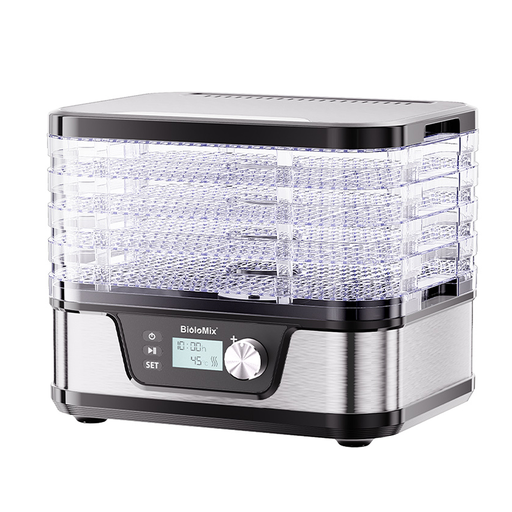
For a batch planned across several levels; the product details list five trays and 360° hot air circulation.
Temperature range: 35–75 °C. Adjustable timer: 24 hours.
 No image available
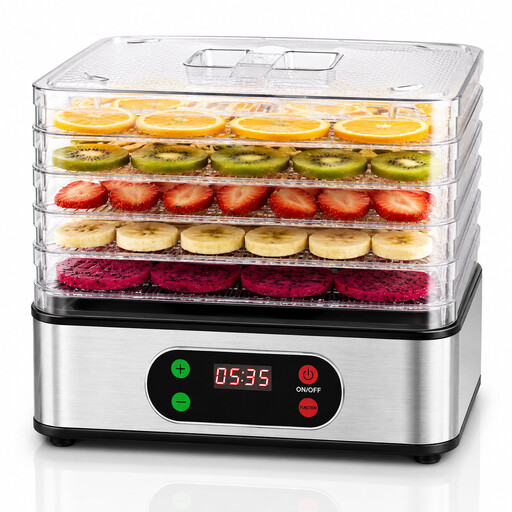
For adjustable drying cycles, provided you check the appliance dimensions and space between levels against the room you have available.
Temperature range: 35–70 °C. Timer: 0.5–72 hours in 30-minute increments. Power: 350 W. The description mentions a compact design and 3.5 cm between levels.
 No image available
For planning a multi-tier batch; the product details list ten trays and include fruit among the foods you can dehydrate.
Variable temperature settings, ten programmes and a 48-hour timer. Power: 850 W.
The BZfE recommends using organic citrus fruit. Before preparing it, wash the fruit thoroughly with hot water and rub it dry; dehydrating doesn’t replace this preparation.
According to the BZfE’s general guidance, dried fruit should still be slightly pliable; no juice should come out when you press it firmly. Leave it to cool, then store it in an airtight container in a dark, dry place. This guidance doesn’t guarantee a drying time for citrus slices.
Follow the instructions for the specific appliance. Steba says the ED 5 must be placed on a stable, level surface; unplug it and let it cool before cleaning. The electrical parts of this model must not be immersed in water. These instructions don’t automatically apply to other appliances.
The Verbraucherzentrale explains that when you buy goods, the retailer is responsible for ensuring they’re free from defects for two years. A voluntary manufacturer’s guarantee is separate; check its terms and conditions.
According to information from the European Union, electrical and electronic equipment placed on the market must generally carry the crossed-out wheeled-bin symbol. It indicates that the item should be collected separately at the end of its life; the symbol alone doesn’t prove how well a particular product dehydrates food or whether it’s safe to use.