What should you look for when buying?
For a dinner party, your choice mainly depends on how much you plan to make, how much space you have in the kitchen and when you’ll prepare everything. The German Federal Centre for Nutrition (BZfE) points out that drying time depends on the size and thickness of the slices.
| What matters |
What to check when buying |
Who should pay particular attention? |
| Space for lots of slices |
Check the tray dimensions, fruit diameter and spacing between slices together; the available area doesn’t guarantee a particular number of slices. |
If I want to prepare lots of garnishes at once, usable space matters more than the number of tiers alone. Around 36% of consumers put enough space for slices first. |
| A drying cycle you can plan |
Check the temperature range, timer duration and how the appliance switches off against your preparation schedule; you’ll still need to check how dry the slices are. |
If I need the oven for the food at the same time, I want to plan the drying cycle in advance and still check the result. Around 29% of consumers prioritise control over the process. |
| Compact size |
Consider the external dimensions, where you’ll put it, storage space and tray area; if you’ll use it rarely, weigh it up against your existing oven too. |
If I’ll only use it occasionally, I want to be able to store it easily and check whether the oven will do for a few slices. Around 21% of consumers put compact size first. |
| Cleaning and ongoing effort |
Check the cleaning instructions and whether replacement trays are available. If you’ll serve the peel too, choose organic fruit and wash and dry it thoroughly. |
If I’m serving the peel, I pay attention to choosing and cleaning the fruit and factor in the ongoing effort. Around 14% of consumers prioritise cleaning and ongoing maintenance. |
Dehydrators at Joybuy
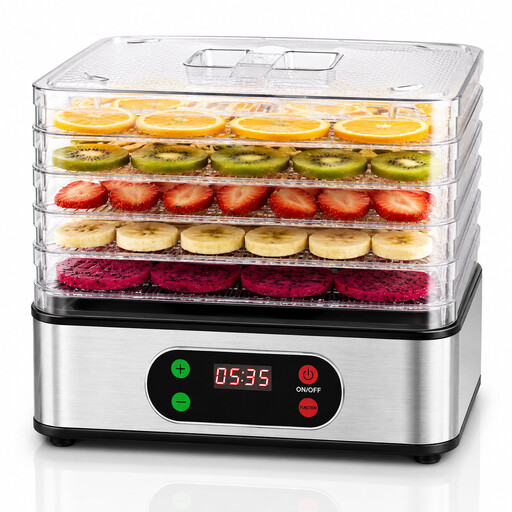
Here you’ll find Joybuy dehydrators for space-saving preparation, as well as models with several trays for preparing larger batches.
 No image available
Dehydrator with LED display, 35–70 °C, 0.5–72-hour timer, 350 W
This compact model could be a good fit if you’re preparing smaller batches and want an appliance that’s easy to store.
Temperature control: 35–70 °C. Timer: 0.5–72 hours in 30-minute increments. Power: 350 W. The description lists modular trays with 3.5 cm between tiers.
View at Joybuy
 No image available
Havenwell stainless steel dehydrator with 10 trays
The ten trays give you several levels for arranging slices; check their usable area and the space the appliance will take up in your kitchen.
Temperature control: variable. Timer: 48 hours. Power: 850 W. The product name states that the trays are made of stainless steel.
View at Joybuy
 No image available
Havenwell dehydrator with 8 stainless steel drying trays
Eight drying trays give you several levels for preparing your slices; compare the usable area with the diameter of your citrus fruit.
Temperature control: 35–85 °C. Timer: 48 hours. Power: 650 W. The product name states that this model has a touch display and an interior light.
View at Joybuy
Frequently asked questions
Can I dry the citrus slices on the day of my dinner party?
Don’t rely on a set number of hours: according to the German Federal Centre for Nutrition, drying time depends on factors including the size and thickness of the slices. Cut them as evenly as possible, check them as they dry and allow extra time.
Should I take care with the peel when using citrus slices in drinks?
Yes, if the peel will be added to a drink or dish. The German Federal Centre for Nutrition recommends using organic fruit if you’re using the peel, and advises washing the fruit thoroughly with hot water and rubbing it dry before preparing it. The consumer advice centre points out that “untreated” doesn’t necessarily mean the fruit was untreated throughout the growing process.
Can I use the oven instead?
Yes, the German Federal Centre for Nutrition also explains how to dry food in an oven. It recommends a low temperature of 40 to 50 °C and leaving the door slightly open so that moist air can escape; it also describes this method as energy-intensive. Check your oven’s instructions first.
What should I clean after drying, and what should I keep in case of a fault?
Clean the trays and appliance according to the instructions for your specific model, and keep your receipt and the model name. If there’s a fault, your statutory rights are generally against the seller; a manufacturer’s guarantee is separate, as the consumer advice centre explains.
What does the CE mark mean, and where should I take an appliance I no longer need?
The CE mark is the manufacturer’s declaration that the product meets the relevant EU requirements; it isn’t an independent quality mark. The German Federal Ministry for the Environment points out that waste electrical equipment should be taken to an authorised collection point. Retailer take-back is subject to the applicable legal requirements.


