Lunchbox preppers
If you regularly dry citrus slices for lunchboxes, check how dry they are before packing them. The BZfE says dried food is ready when it is still slightly pliable and no juice comes out when pressed firmly.


If you regularly prepare lunchboxes, prioritise drying space, airflow and easy-to-clean trays over wattage alone. Smaller appliances are better suited to individual portions, while larger tray areas let you prepare several lunchboxes at once. If you only dry fruit occasionally, your existing oven may be enough to get started; the German Federal Centre for Nutrition (BZfE) describes this method as energy-intensive. Check the dryness yourself, and opt for organic citrus fruit if you plan to eat the peel.
If you regularly dry citrus slices for lunchboxes, check how dry they are before packing them. The BZfE says dried food is ready when it is still slightly pliable and no juice comes out when pressed firmly.
If you prepare several portions at once, compare the drying area, the number and size of the trays, and whether there is enough space between the slices.
If worktop space is limited, a compact appliance could be a good fit. Bear in mind, though, that a smaller drying area may mean you need to run several batches.
A good fit if: you regularly prepare a few slices and have limited space.
The trade-off: A smaller usable area may mean extra batches. Check that the slices fit on the trays with space between them.
A good fit if: you want to dry several lunch portions or other fruit at the same time.
The trade-off: Compare the tray dimensions and the space needed for the specific appliance. The stated area alone does not tell you how many round slices will fit with space between them.
A good fit if: you only want to try drying a small amount occasionally.
The trade-off: The BZfE describes oven drying as energy-intensive, and moist air needs to be able to escape.
| What matters to you | What to check when buying | Who is this especially important to? |
|---|---|---|
| Evenly dried slices | Check for adjustable temperature, good airflow and accessible trays. The timer does not replace checking how dry the slices are. | If I want to put the slices straight into a lunchbox, it’s important to be able to check reliably that they’re dry enough. Around 36% of consumers are mainly concerned with making sure their citrus slices are dry enough to carry around. |
| Space for a weekly batch | Compare the number and dimensions of the trays with the amount you plan to dry, and leave space between the slices. | To prepare several lunch portions at once, I need enough space without crowding the slices. Around 29% of consumers prioritise having enough room for their weekly batch. |
| Footprint and ease of use | Check the external dimensions, the space needed to remove the trays, and the timer and automatic shut-off on the specific model. | If my kitchen has little free worktop space, the appliance needs to fit where I have room and work with my routine. Around 21% of consumers prioritise the space an appliance takes up. |
| Cleaning and food-contact surfaces | Check the material and cleaning instructions for the specific trays, as well as whether the parts that touch the slices are suitable for food contact. | After drying juicy fruit, I want to be able to clean the trays easily and know which parts come into contact with the slices. Around 14% of consumers consider care and food-contact surfaces their main concern. |
Drying time depends on factors including the size and thickness of the slices. So a set running time alone cannot tell you whether a batch is ready.
Arrange similarly sized slices with space between them and check how dry they are as they dry. The BZfE says they are ready when they are slightly pliable and no juice comes out when pressed firmly.
The term does not rule out treatment during cultivation. This matters if you plan to eat the peel.
Wash the fruit before preparing it. The consumer advice centre recommends organic citrus fruit if you plan to use the peel.
The rated power in watts does not show how much energy a particular batch of citrus fruit will use.
Factor in how often you plan to use the appliance when choosing one. To compare energy use, you need to measure the consumption for a batch.
According to WMF, the KÜCHENminis Snack to go food dehydrator is designed for small kitchens and snacks on the go.
The DA 450 and DA 650 models offer different amounts of drying space.
The DA506 is a tray-style option with a stated drying area of 0.65 m².
The Dörrex range includes versions with metal or plastic trays, with or without a timer.
Severin describes the OD 2940 as an appliance for drying fruit, vegetables and herbs.
These product options are suitable for drying fruit and vary in the number of trays, temperature control and timer features.
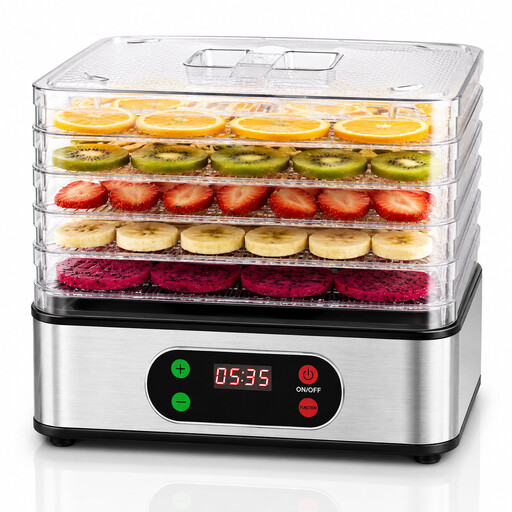 No image available
An option for drying fruit, with an adjustable temperature range and timer.
35–70 °C; timer from 0.5 to 72 hours in 30-minute increments; 350 W.
 No image available
The ten trays make this an option if you want to prepare several portions of fruit at once.
Ten stainless steel trays; variable temperature control; 48-hour timer; ten programmes; 850 W.
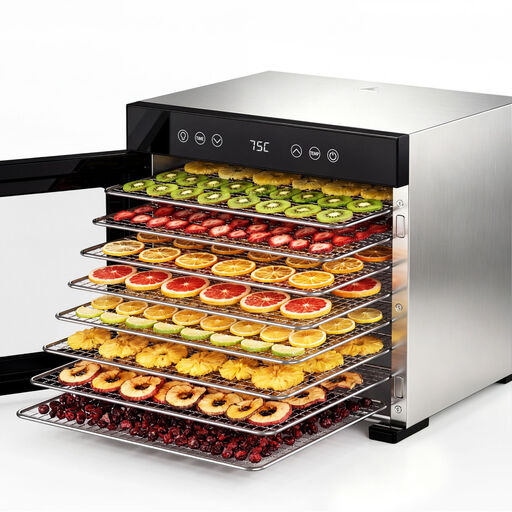 No image available
The eight trays make this an option for preparing several portions of fruit.
Eight stainless steel drying trays; 35–85 °C; 48-hour timer; touch display; interior light; 650 W.
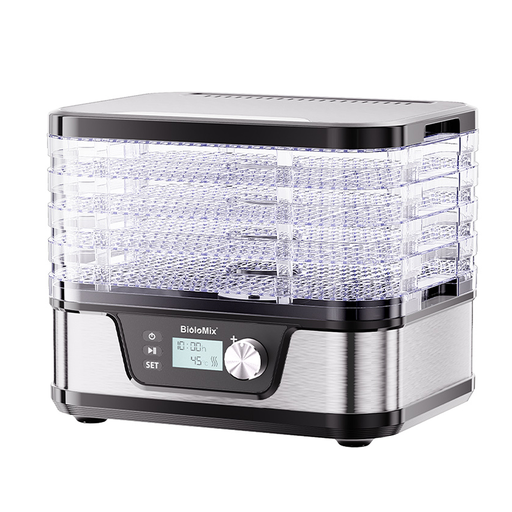 No image available
An option for drying fruit, with multiple trays and an adjustable timer.
Five trays; 35–75 °C; adjustable 24-hour timer; 360° hot air circulation.
Check the slices as they dry: according to the BZfE, dried food is ready when it is still slightly pliable and no juice comes out when pressed firmly. A set number of hours will not apply to every type of citrus or slice thickness.
Not without considering how the peel has been treated. The consumer advice centre points out that “untreated” does not rule out the use of pesticides during cultivation. Wash the fruit before preparing it; for peel you plan to eat, the consumer advice centre recommends organic citrus fruit.
Clean the trays according to the instructions for your appliance. Store the dried slices in a well-sealed container; the consumer advice centre recommends this for dried fruit.
CE marking is required for relevant electrical appliances, but it is not an independent quality mark. Drying trays and other parts intended to come into contact with the slices must meet the requirements for food-contact materials. The consumer advice centre also distinguishes between the statutory right to have faulty goods put right and a voluntary guarantee.