What should you look for when buying?
When drying citrus slices in a shared kitchen, the main things to weigh up are timing, space per batch, worktop footprint and careful storage.
| Buying consideration |
Points to check |
Especially important for |
| Timing and checking |
Timer and temperature settings; whether you can check the food during the cycle. |
If I want to fit a longer drying cycle around other kitchen use, I need an adjustable running time without relying on the timer to tell me when the slices are ready. Around 33% of consumers prioritise being able to plan their time in the kitchen. |
| Space per batch |
Usable drying area and rack dimensions; space between the slices. |
When drying several trays in one go, what matters to me is how much area can actually be used in a single layer. Around 34% of consumers put batch size first. |
| Worktop footprint |
Appliance dimensions and room to remove the racks; a suitable place to store it. |
If I share the kitchen and want to put the appliance away after drying, having the right space to use and store it matters more than drying the largest possible batch. Around 22% of consumers prioritise a compact footprint. |
| Peel and storage |
Fruit suitable for eating with the peel; checking dryness before packing. |
When drying citrus slices with the peel left on, I want to check the fruit I choose and how dry it is carefully. Around 11% of consumers prioritise preparation and safe storage. |
Dehydrators at Joybuy
The following dehydrators available at Joybuy have timers and are suitable for smaller or larger batches of fruit. Before buying, check the electrical compliance and CE marking for the model in question. The European Commission describes the scope of the Low Voltage Directive, which covers electrical equipment rated at 50 to 1,000 V AC.
 No image available
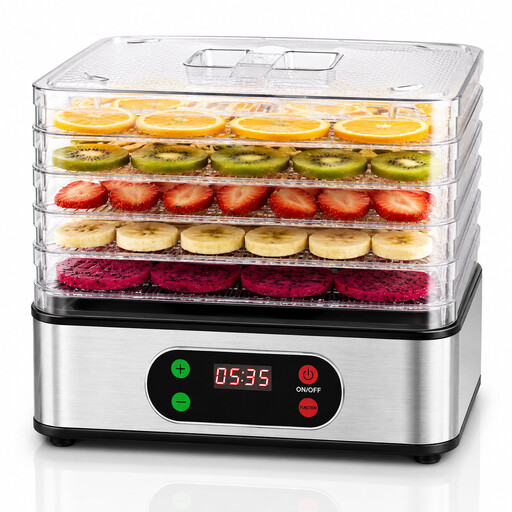
Dehydrator with LED display, 35–70 °C, 0.5–72 h timer
The adjustable timer can help you schedule a drying cycle, but you should still check the slices individually.
The product name lists 35–70 °C, a timer from 0.5–72 hours in 30-minute increments and 350 W. The description mentions modular trays with 3.5 cm between each level.
View at Joybuy
 No image available
Havenwell dehydrator with 10 stainless steel trays
An option to compare if you’re planning larger batches of fruit and have enough space for the appliance.
The product name lists 10 stainless steel trays, variable temperature control, a timer of up to 48 hours, 10 programmes and 850 W.
View at Joybuy
 No image available
Havenwell dehydrator with 8 stainless steel racks
The eight racks may be worth considering when comparing appliances for larger batches of fruit; check that it will fit in the space available in your kitchen.
The product name lists eight stainless steel racks, 35–85 °C, a timer of up to 48 hours, a touch display, interior lighting and 650 W.
View at Joybuy
Frequently asked questions
Can I take all the citrus slices out together after a set time on the timer?
No, not based on the timer alone. The University of Minnesota Extension lists food type, slice thickness and moisture among the factors that affect drying time. Arrange the slices in a single layer with space between them, check each one individually and remove those that are already dry while the others continue to dry.
Can I use citrus slices with the peel on in food or drinks later?
For peel you plan to use in cooking or baking, the Consumer Advice Centre of Rhineland-Palatinate recommends organic citrus fruit. It points out that “untreated” does not rule out the use of pesticides during cultivation. Wash the fruit before preparing it; drying doesn’t prove that treated peel is suitable to eat.
When can I pack dried citrus slices?
Let the slices cool and check that they’re completely dry before packing them. The Utah State University Extension recommends putting the pieces back in the dehydrator if moisture appears during conditioning. Store fully dried food somewhere protected from moisture.
What do CE marking and warranty rights mean when buying in Germany?
The European Commission describes requirements for electrical equipment within the scope of the Low Voltage Directive, which covers AC voltages from 50 to 1,000 V. CE marking indicates conformity; it isn’t a general approval seal issued by a central EU body. You should check separately whether a specific model meets all the applicable requirements. If a product is faulty, statutory consumer rights should be distinguished from a voluntary guarantee, as the Consumer Advice Centre explains.


