Who is a dehydrator right for?

Planners stocking up for future meals

You want to prepare several batches of citrus slices at once and use them later. Look for enough usable drying space, check how dry the slices are, and only store them in a dry, airtight container once they have cooled. The German Federal Centre for Nutrition (BZfE) points out that drying time depends, among other things, on the size and thickness of the food being dried.

Drying for smaller households

You tend to dry smaller quantities, so you need to balance the space available with the size of each batch. A compact appliance could be a good fit, as long as there’s enough room on the trays to lay the slices out with a gap between them.

Hands-on home cooks who like to keep an eye on things

You want to control the temperature and running time, check the slices as they dry and clean the trays easily afterwards. Compare the controls and cleaning instructions for each model.

What should you look for when buying one?

Compact stackable dehydrator

A good fit if: You dry small batches and have limited worktop space. WMF lists five stackable trays, a temperature range of 30–70 °C and a timer of up to 24 hours for its KÜCHENminis model.

The trade-off: Its smaller size may limit how much you can dry in one go. Check that your slices will fit on the trays with enough space between them.

Dehydrator with more drying space

A good fit if: You regularly prepare food for several meals to come. The manufacturer lists 0.5 m² of drying space, seven trays, a temperature range of 35–75 °C and a timer of up to 99 hours for the Rommelsbacher DA 650.

The trade-off: More space takes up more room and won’t automatically shorten drying time. Check the food as it dries rather than relying on the timer alone.

Use your existing oven

A good fit if: You only dry citrus slices occasionally and don’t want to buy another appliance just yet.

The trade-off: The BZfE describes drying food in an oven as energy-intensive. At a low temperature, it recommends leaving the door slightly open so moisture can escape.

Priority What to look for when buying Who it matters most to
Stocking up for future meals Usable tray space and room between the slices; check they are dry before storing. If I’m preparing several meals in advance, I need enough space for a batch and want to make sure the slices are dry before storing them. Around 36% of consumers put stocking up for later first.
Even drying Air circulation and space between the slices; adjustable temperature and the ability to check the food as it dries. When slices are juicy or vary in thickness, I want to check how dry they are before packing them away. Around 29% of consumers prioritise even, thorough drying.
Small batches and limited space Compare the external dimensions and usable tray space, not just the number of tiers. If I only dry small quantities occasionally, I don’t want to use more space than necessary. A compact footprint is the most important buying priority for around 21% of consumers.
Cleaning and running costs Check the cleaning instructions and how easy the trays are to access; consider energy use per batch under your own conditions. I want to clean the trays easily after repeated use and get a sense of the ongoing costs. Around 14% of consumers put cleaning and running costs first.

Common buying and usage mistakes

  • Assuming the maximum timer setting means the slices are fully dried

    The time needed depends, among other things, on the size and thickness of the slices. Setting a timer doesn’t prove that the food is dry enough to pack away.

    Slice the fruit as evenly as possible, leave space between the slices on the trays and check the result before storing. As a general check, the BZfE says that no juice should come out when you press firmly.

  • Comparing only the number of tiers

    For citrus slices, usable space and room between them matter too. Overcrowded trays can prevent food from drying evenly.

    Compare the tray dimensions and the space the appliance takes up, and leave room between the slices.

  • Assuming ‘untreated’ means the peel hasn’t been treated

    The Rhineland-Palatinate Consumer Advice Centre points out that ‘untreated’ doesn’t rule out treatment while the fruit was growing.

    If you want to use the peel, follow the Consumer Advice Centre’s recommendation to choose organic fruit. Wash the fruit thoroughly before preparing it, then rub it dry; the BZfE recommends this too.

Dehydrator brands at a glance

WMF

The KÜCHENminis model is worth considering if you want to dry smaller batches and have limited space.

  • WMF lists five stackable trays, a temperature range of 30–70 °C and a timer of up to 24 hours.
  • Check that the usable space is sufficient to lay out your slices with a gap between them. The manufacturer’s specifications are not independent evidence of even drying.

Rommelsbacher

The DA 650 is a specific model with several trays and more drying space.

  • Rommelsbacher lists seven trays, 0.5 m² of drying space, a temperature range of 35–75 °C and a timer of up to 99 hours for the DA 650. The manufacturer directs customers to the relevant product page for spare parts and accessories.
  • These specifications apply to the DA 650, not every appliance in the range. More space doesn’t automatically mean shorter drying times.

COSORI

The 5-tray dehydrator is designed for small to medium batches where temperature control and a timer are useful.

  • The manufacturer lists five trays and a temperature range of 35–75 °C.
  • Check the layout of the specific model to make sure there’s enough room for your slices on the trays. The product specifications are not independent evidence of drying performance.

Klarstein

According to Klarstein, the Bananarama range features a stackable system.

  • The retailer describes the appliance as having a timer and adjustable temperature.
  • Check the features of the specific version. Claims about quiet or even operation come from the retailer.

Stöckli Haushalt

The dörrex appliances offer another design, with stackable trays.

  • For the 0076.70M model, Stöckli lists three metal trays, a 12-hour timer and active warm-air circulation.
  • The F.A.Z. Buying Guide’s test covers model 0076.72M. Without evidence that the versions are equivalent, this different model number shouldn’t be treated as the same as the manufacturer’s specifications for the 0076.70M.

Dehydrators at Joybuy

The Joybuy options below range from a compact dehydrator to models with eight or ten trays. For citrus slices, the usable space and enough room to lay them out matter just as much as the number of tiers.
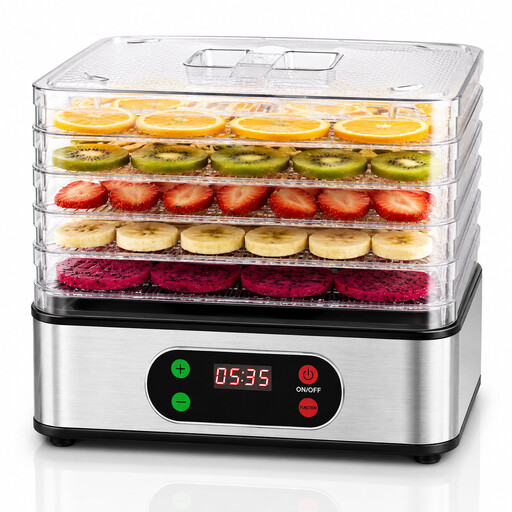
Dehydrator with LED display and temperature control

Dehydrator with LED display, 35–70 °C, 0.5–72-hour timer

For smaller batches and limited storage space; the description mentions a compact design and flexible tray configurations.

The title lists a temperature range of 35–70 °C, a timer from 0.5 to 72 hours in 30-minute increments and 350 W. The description states that there is 3.5 cm between the tiers and that removable parts are dishwasher-safe.

View at Joybuy

Havenwell dehydrator with ten stainless steel trays

Havenwell dehydrator with 10 stainless steel trays and 48-hour timer

Ten trays are useful when preparing larger quantities. Check that the actual drying space suits your citrus slices and the room you have available.

The title lists ten stainless steel trays, a 48-hour timer, ten programmes and 850 W. The description mentions adjustable temperature settings and dishwasher-safe trays.

View at Joybuy

Havenwell dehydrator with eight stainless steel trays

Havenwell dehydrator with 8 stainless steel trays, 35–85 °C

Eight trays are useful for larger batches. Consider the space available and the room needed between the citrus slices when making your choice.

The title lists eight trays, a temperature range of 35–85 °C, a 48-hour timer and 650 W. The description mentions a touchscreen display and interior light.

View at Joybuy

Frequently asked questions

How should I prepare citrus slices with the peel on?

If you want to use the peel, the Rhineland-Palatinate Consumer Advice Centre recommends organic fruit: ‘untreated’ doesn’t rule out treatment while the fruit was growing. Wash the fruit thoroughly before preparing it, then rub it dry; the BZfE recommends this too.

When can I pack away the dried slices?

Only pack the slices away once they’re sufficiently dry and have cooled. As a general check, the BZfE says that no juice should come out when you press firmly; Rommelsbacher recommends letting dried food cool thoroughly before packing it away. Then store it somewhere dry and dark, in an airtight container.

What should I know about electricity use?

The BZfE describes drying food in an oven as energy-intensive and says a dehydrator can be more energy-efficient for larger quantities. To make a meaningful comparison, you’ll need the actual measured energy use per batch and the same electricity tariff; the rated power alone isn’t enough to calculate running costs.

What should I do if an appliance is faulty?

For a purchase made in the EU, you have a statutory two-year guarantee from the seller, starting when you receive the goods. Any additional manufacturer’s guarantee offered doesn’t replace these statutory rights. Keep your purchase and delivery receipts.

How can I tell what to look for in terms of product safety?

Electrical appliances covered by the relevant EU product rules must carry the CE marking. According to the European Union, the manufacturer uses it to declare that the product complies with the applicable rules; it is not an independent quality mark. Check the marking and the information for the specific appliance.