What should you look for when buying?
For batches of citrus slices, the number of levels isn’t the only thing that matters. Compare usable area, how easy it is to check the fruit and the space the appliance takes up against the quantities you usually dry.
| Consideration |
What to check before buying |
Who it matters to |
| Usable area for larger batches |
Compare the rack dimensions and number of levels with the space needed to lay out slices without crowding them. The manufacturer lists six trays and 0.6 m² of area for the Rommelsbacher DA 900. |
If I want to lay out lots of slices at once with space between them, I need enough usable area; around 33% of consumers put batch size first. |
| Checking the slices before storage |
Compare the temperature settings and how easy the levels are to access. Slice the fruit evenly, then check it while it dries and again before packing it away. |
If I want to store the slices, I need to be able to check how dry they are myself; around 27% of consumers prioritise this. |
| Space and smaller batches |
Consider the external dimensions, including the space needed to load and unload the appliance, alongside the usable drying area. Rommelsbacher lists the DA 350 as measuring 31,50 × 33,70 × 25,30 cm. |
If my kitchen has limited worktop and storage space, the appliance needs to fit in comfortably, even if that means planning several batches; around 20% of consumers put space requirements first. |
| Purchase and running costs |
Consider how often you’ll use it, how long it runs for and how easy it is to clean. To compare electricity use, measuring consumption with a similar load is more useful than looking at the rated power alone. |
If I only dry citrus fruit occasionally, I want to weigh up the effort of buying another appliance against using the oven I already have; around 20% of consumers prioritise effort and cost. |
Joybuy food dehydrators for citrus batches
The following Joybuy listings are food dehydrators with several drying levels, designed for drying fruit in batches. Compare the temperature range, timer and number of trays with the quantities you usually prepare. For the specific listing, also check that the parts that come into contact with food meet the requirements of Regulation (EC) No 1935/2004, and that the required CE marking and accompanying documents in German are provided. The European Commission outlines the requirements for food contact materials, while the German Federal Network Agency explains how to check CE marking and the required accompanying documents.
 No image available
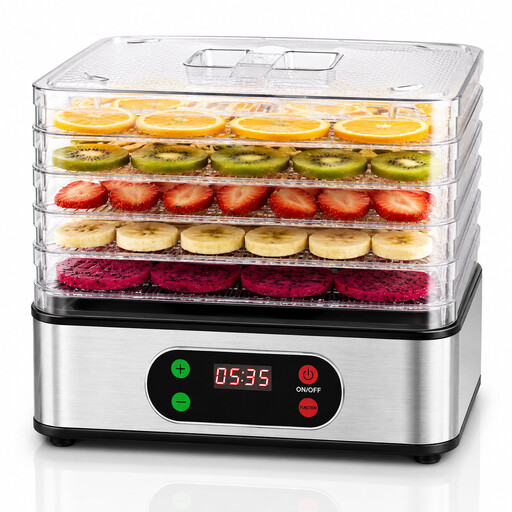
Food dehydrator with LED display, 35–70 °C
Temperature control and a timer give you options for setting up drying cycles in advance.
Temperature range: 35–70 °C.
Timer: 0,5–72 hours in 30-minute increments.
The stated gap between levels is 3,5 cm.
Before buying, check that the parts that come into contact with food are suitable and that the required listing documents are available.
View at Joybuy
 No image available
Havenwell stainless steel food dehydrator with 10 trays
Ten trays provide several levels for drying in batches; using evenly sized slices and leaving enough space between them makes planning easier.
Includes ten stainless steel trays.
Variable temperature settings and a timer of up to 48 hours.
Ten preset programmes; stated power: 850 W.
Before buying, check that the parts that come into contact with food are suitable and that the required listing documents are available.
View at Joybuy
 No image available
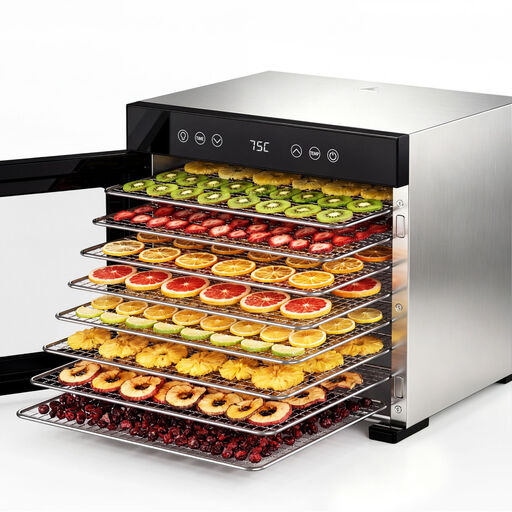
Havenwell food dehydrator with 8 stainless steel drying racks
Eight drying levels are designed to hold several racks at once; the actual quantity depends on the size of the slices and the space between them.
Temperature range: 35–85 °C.
Timer of up to 48 hours; stated power: 650 W.
Features a touch display and interior light.
Before buying, check that the parts that come into contact with food are suitable and that the required listing documents are available.
View at Joybuy
 No image available
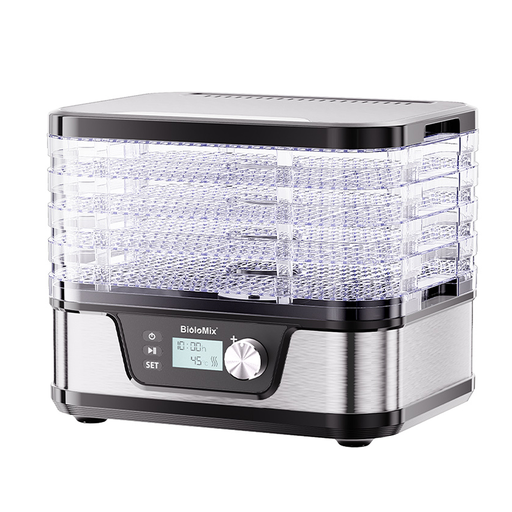
BioloMix BFD1300 food dehydrator with 5 trays
Five trays offer several levels for small to medium batches; compare the usable area with the diameter of your slices.
Temperature range: 35–75 °C.
Timer of up to 24 hours.
The product information lists 360° hot air circulation.
Before buying, check that the parts that come into contact with food are suitable and that the required listing documents are available.
View at Joybuy
Frequently asked questions
How should I prepare citrus slices if I want to eat the peel?
For peel you plan to cook or bake with, the Consumer Advice Centre of Rhineland-Palatinate recommends organic citrus fruit. The label ‘untreated’ doesn’t rule out treatments while the fruit was growing, so wash and dry it before preparing it. Drying doesn’t automatically make previously treated peel suitable for cooking.
When can I store dried slices?
The Federal Centre for Nutrition describes dried food as still slightly pliable, but with no juice coming out when pressed firmly. As drying time depends, among other things, on thickness, and the German Federal Institute for Risk Assessment identifies insufficient drying and improper storage as possible conditions for mould, check the slices before packing them away. The timer ending doesn’t, on its own, prove they’re dry enough.
How much electricity does a batch use?
It depends on the appliance’s actual power consumption while running and how much you load into it. Rommelsbacher lists 600 W as the DA 900’s maximum heating output, and explains that the thermostat switches the heating element off at intervals. For this reason, measuring consumption over a complete drying cycle gives you a more useful comparison than the rated power alone.
What are my rights when buying a food dehydrator online?
According to the European Union’s Your Europe website, distance purchases from a trader generally come with a 14-day withdrawal period from the date of delivery; exceptions and the rules on return costs also apply. Faulty goods are also covered by a legal guarantee of at least two years. This is separate from any voluntary manufacturer’s warranty.
What regulations apply to the appliance and drying racks?
When placed on the EU market, materials that come into contact with food must meet the requirements of Regulation (EC) No 1935/2004. The electrical appliance must also meet the applicable CE requirements and come with any required accompanying documents in German. The German Federal Network Agency points out that CE marking isn’t an independent quality mark, so check the information for the specific listing.


