Small portions, limited space
If you regularly dry slices for yourself, look for rack space that suits your portion and an appliance that’s easy to put away.


If you regularly dry single portions, a compact dehydrator with adjustable temperature is likely to suit you best, provided its usable rack space is large enough for your slices. For the occasional experiment, using an oven you already own means you can avoid buying another appliance; however, the Federal Centre for Nutrition (BZfE) describes oven drying as energy-intensive. More drying space makes sense if you also plan to dry other foods or several portions, but it will take up more room.
If you regularly dry slices for yourself, look for rack space that suits your portion and an appliance that’s easy to put away.
If you want to adjust the temperature and running time and check the food as it dries, compare the settings available on each model.
If you only dry citrus fruit occasionally, see whether your existing oven will do the job before buying another appliance.
A good fit if: you regularly dry small portions of citrus and have limited space.
Things to consider: The number of racks alone won’t tell you whether the usable space is right for your portion.
A good fit if: you often want to dry other foods as well as citrus, or prepare several portions.
Things to consider: Extra space takes up more room when the appliance is in use and when you store it.
A good fit if: you only dry food occasionally and want to try it out before deciding whether you’ll do it regularly.
Things to consider: The BZfE describes oven drying as energy-intensive.
| Consideration | What to check before buying | Who it matters most to |
|---|---|---|
| Portion size and space | Compare the usable drying area, number of racks, and the appliance’s dimensions when in use and in storage. Allow space between the slices. | If I’m only drying food for myself, I don’t want to store an unnecessarily large appliance. Around 36% of consumers prioritise small portions and a compact footprint. |
| Settings and control | Check the temperature range and timer on the specific model. The BZfE says drying time depends on the size and thickness of the food, so check how dry it is as you go. | If I want to set the temperature and running time to suit the food and check its condition myself, the controls are important. Around 29% of consumers prioritise control over the drying process. |
| Appliance or oven | Think about how often you dry food. To compare electricity costs, you’ll need the actual consumption in kWh and your tariff; the wattage alone isn’t enough. | If I only dry citrus slices occasionally, I wonder whether I need a dedicated appliance or whether my oven will do. Around 21% of consumers put the value of buying an appliance first. |
| Cleaning and peel | Check the cleaning instructions for the specific appliance. The BZfE recommends organic fruit if you’re using the peel, and says to wash it thoroughly before preparing it. | If I’m using the peel too, I want equipment that’s easy to clean and fruit that’s suitable. Around 14% of consumers prioritise cleaning and using the peel. |
For a single portion, what matters is whether the slices fit on the usable drying area. Extra tiers can take up space when the appliance is in use and in storage, even if you don’t need them for the amount you usually dry.
Picture a typical portion on the racks and allow space between the slices before choosing the appliance size.
The BZfE says drying time depends on the size and thickness of the food. A timer setting doesn’t replace checking the slices.
Cut the slices as evenly as possible and check how dry they are during the process, rather than relying on the timer alone.
When you dry whole slices, the peel dries too. The BZfE recommends organic fruit if you’re using the peel.
Wash and dry the fruit thoroughly before slicing, and check the labelling.
The rated power alone doesn’t show how much energy a drying cycle actually uses.
To compare costs, you’ll need the actual consumption in kWh and your electricity tariff. Compare appliances and methods using the same portion size.
The KÜCHENminis Snack to go is a stackable option for small portions and limited space.
The DA 350 is an option if you often dry other foods as well as citrus, or prepare several portions.
The DA506 and DA510 models are worth considering if you’re planning to use more trays or dry other foods too.
The OD 2940 is an option for drying fruit, vegetables and herbs.
The Dörrex is a useful point of comparison if you’re looking for an appliance with a timer and temperature control.
The Joybuy picks below offer adjustable temperature and running-time settings. If you only dry individual portions of citrus, pay particular attention to whether the number of trays and the appliance size suit your space and the amount you usually prepare.
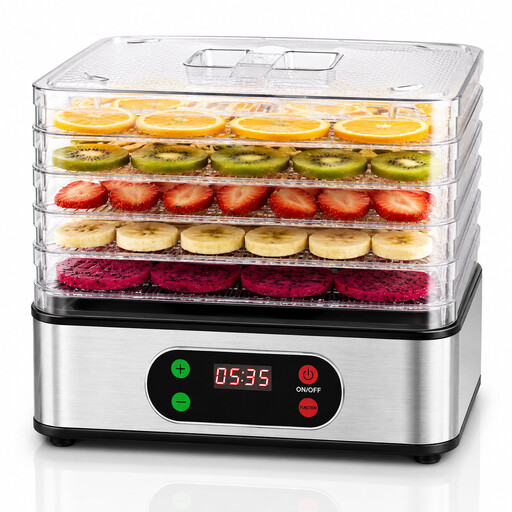 No image available
An option if you want to set the temperature and running time for your drying cycle.
Temperature range: 35–70 °C.
Timer: 0.5–72 hours in 30-minute increments.
Rated power: 350 W; BPA-free according to the product name.
 No image available
The ten trays may be useful for larger quantities or other drying needs; check that the appliance has enough room for your individual portions.
Variable temperature control and a timer of up to 48 hours.
Rated power: 850 W; ten preset programmes according to the product name.
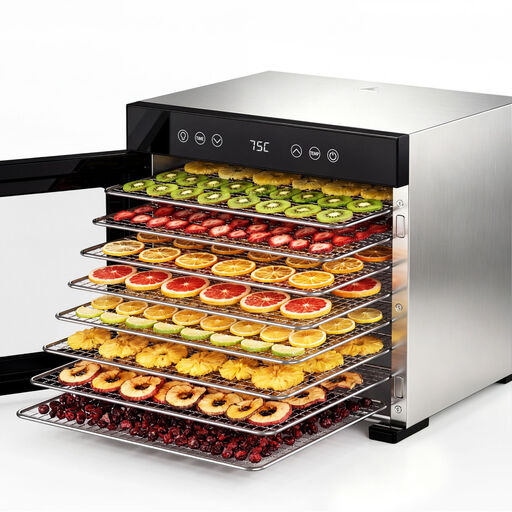 No image available
An option if you want to set the temperature and drying time; check that the eight racks are right for the portions you usually prepare.
Temperature range: 35–85 °C.
Timer of up to 48 hours; rated power: 650 W.
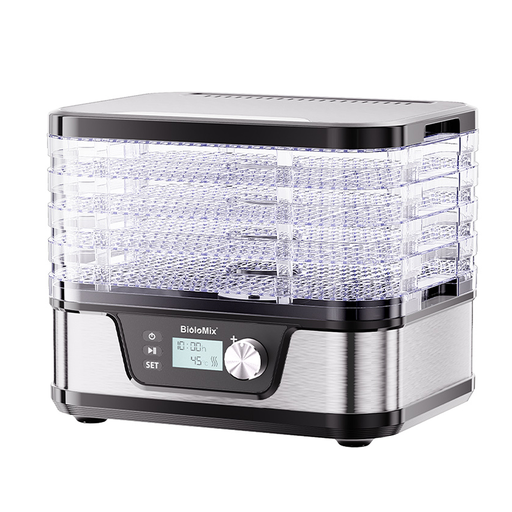 No image available
Adjustable temperature and a timer are useful if you want to tailor the drying process to your citrus slices.
Temperature range: 35–75 °C.
Timer of up to 24 hours; five trays.
Wash the fruit thoroughly and pat it dry. If you’re using the peel, the BZfE recommends organic fruit. Rommelsbacher’s drying guide suggests 5–7 mm-thick slices at 55–60 °C for 5–9 hours as a starting point, and recommends checking them regularly by sight and touch. These timings won’t guarantee the same result in every appliance.
As a general guide, the BZfE says the food should still be slightly pliable, with no juice coming out when you press it firmly. Let fully dried slices cool before packing them away. Rommelsbacher’s drying guide recommends clean, airtight jars and checking the contents from time to time.
No. To work out the cost of a drying cycle, you need the actual energy consumption in kWh and your electricity price per kWh; the wattage alone doesn’t take account of the running time or actual power use. The BZfE describes drying food in an oven as energy-intensive, but doesn’t give a cost for your portion.
Your statutory rights against the seller are separate from any voluntary guarantee. If there’s a fault, the first step is usually to ask for the product to be repaired or replaced. A dehydrator that has reached the end of its life shouldn’t go in household waste; take it to a designated collection point or use a take-back scheme for waste electrical equipment.
The European Commission lists electrical and electronic equipment as a product category that may require CE marking, and explains that the manufacturer is responsible for ensuring compliance. CE marking isn’t an independent quality mark guaranteeing even drying. For the specific appliance, check its markings, the manufacturer’s information and the instruction manual.