Hosts preparing lots of slices
If you’re preparing food for several family members, compare the usable tray area and how many batches you might need. Rommelsbacher and Steba list the surface area or tray dimensions for their respective models.


If you’re preparing a large batch or plan to dehydrate food regularly, it’s worth weighing up a dehydrator’s usable tray area against the space it takes up. For a small batch on a one-off occasion, your existing oven may be enough. A timer can make planning easier, but it won’t guarantee that the slices are dry or ready by a set time. Slice thickness, how much you load and careful preparation all matter.
If you’re preparing food for several family members, compare the usable tray area and how many batches you might need. Rommelsbacher and Steba list the surface area or tray dimensions for their respective models.
If you only dehydrate food for occasional visits, weigh up buying an extra appliance against using your existing oven and the storage space you’ll need. The Consumer Advice Centre describes an oven as a possible option for a one-off batch.
If you want to get organised before your guests arrive, a timer may be a useful feature. According to the Federal Centre for Nutrition, drying time depends on factors including the size and thickness of the pieces, so allow extra time.
A good fit if: you want to arrange lots of slices in one batch and the tray dimensions suit your kitchen.
Things to consider: the surface area and number of tiers don’t guarantee a particular capacity; also consider where you’ll keep the appliance and store it when not in use.
A good fit if: you’re happy to prepare smaller batches or run several cycles, and want to put the appliance away afterwards.
Things to consider: ‘compact’ doesn’t tell you the usable tray area. Compare the dimensions with the amount you plan to dry.
A good fit if: you’re only preparing a modest one-off batch and don’t want to store another appliance.
Things to consider: moisture needs to escape while food is drying. The Federal Centre for Nutrition says that drying food in an oven uses more energy than using a food dehydrator.
| Priority | What to check when buying | Who is it important to? |
|---|---|---|
| Room for your batch | Compare the usable tray dimensions and total area with the amount you plan to arrange in a single layer. | If I’m preparing lots of slices for several guests, the usable area really matters. Around 36% of consumers focus primarily on batch size. |
| Purchase and storage | Consider whether you’ll use it again after your visit, as well as the appliance’s dimensions and where you’ll store it. | For a one-off occasion, I don’t want to buy and store an appliance I’ll hardly use again. For around 29% of consumers, occasional use and limited space are the main considerations. |
| Planning before guests arrive | Check the timer and automatic shut-off; allow extra time and check that the slices are dry enough before packing them. | If the slices need to be ready for a set time, I need a routine I can plan around, with time to check them too. Around 21% of consumers put planning around a deadline first. |
| Cleaning and preparation | Follow the model’s cleaning instructions; choose citrus fruit with care if using the peel, then wash and dry it thoroughly. | After dehydrating, I want to keep cleaning the trays to a minimum and prepare the peel properly. For around 14% of consumers, easy cleaning is the top priority. |
The actual capacity depends on the tray dimensions, the size of the slices and the space needed for air to circulate.
Compare the tray dimensions with the amount you plan to arrange in a single layer, rather than looking only at the number of tiers.
If all the slices won’t fit at once, you may need to run additional drying cycles.
A timer ends or controls the cycle, but it doesn’t check how much moisture is left. According to the Federal Centre for Nutrition, drying time depends on factors including the size and thickness of the pieces.
Allow extra time and check how dry the slices are before packing them.
You may need to check the slices or run another drying cycle, which could add to your preparations before the visit.
The Consumer Advice Centre points out that this label doesn’t rule out the use of plant protection products during cultivation.
If you’re going to eat the peel, the Consumer Advice Centre recommends organic citrus fruit. Wash the fruit before preparing it and rub it dry.
Your existing oven could be an alternative for a one-off batch. The Federal Centre for Nutrition says that drying food in an oven uses more energy than using a food dehydrator.
Before buying, consider whether you’ll use the appliance again, how large your batch is and where you can store it. Don’t use this information to estimate a specific saving on your electricity bill.
An extra appliance will need to be stored after use.
The DA 650 is an option with a stated drying area for larger batches.
The ED 6 has stainless steel trays with stated dimensions, so you can compare them with the amount you plan to dry.
WMF describes the KÜCHENminis Snack to go food dehydrator as a compact option supplied with five trays.
The documented food dehydrator with five trays is another option for smaller batches.
Severin describes the OD 2940 as a food dehydrator for fruit, vegetables and herbs.
This selection at Joybuy includes food dehydrators with multiple trays for preparing batches. The temperature and timer details are taken from each product title.
 No image available
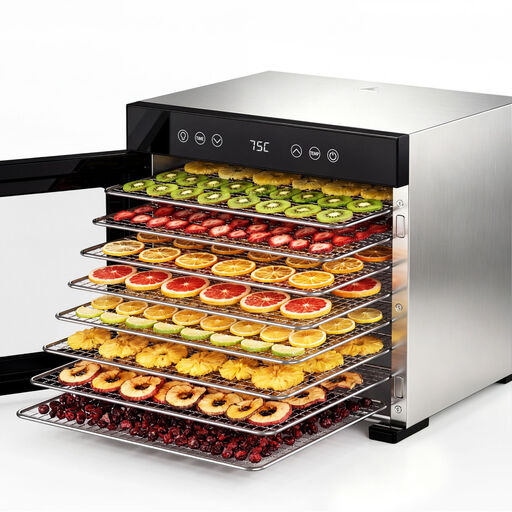
The ten trays are worth considering if you’re comparing the number of levels available for a prepared batch.
Variable temperature control, a 48-hour timer, 10 presets and 850 W are listed in the product title.
 No image available
Eight drying trays give you a specific figure to compare when deciding how many levels you need for your batch.
The product title lists 650 W, 35–85 °C, a 48-hour timer, a touch display and an interior light.
You can’t work that out reliably from the number of tiers alone. Compare the usable tray dimensions with the size of your slices, and arrange them in a single layer with space between them for air to circulate.
Check the slices as they dry. According to the Federal Centre for Nutrition, they’re ready when they’re still slightly pliable and no juice comes out when you press them firmly. Leave them to cool before packing; Rommelsbacher recommends clean, airtight jars. The drying time needed depends on factors including the type of citrus fruit and slice thickness.
If you’re going to eat the peel, the Consumer Advice Centre recommends organic citrus fruit. Wash the fruit before preparing it and rub it dry. According to the Consumer Advice Centre, ‘untreated’ doesn’t rule out the use of plant protection products during cultivation.
According to Your Europe, goods bought in the EU are covered by a legal guarantee for at least two years from the date you receive them. This is separate from any voluntary manufacturer’s warranty. The retailer is responsible for handling legal claims.
No. Electrical waste must be collected separately. According to the German Environment Agency, local collection points generally accept it free of charge.