
Lieferung heute & morgen

Qualitätsgarantie

Willkommens-Angebote freischalten: KOSTENLOSE Lieferung | Bis zu 80 % RABATT | Kostenlose 30-Tage-JoyPlus-Testphase
App herunterladen
A women's and men's city e-bike should perform reliably in urban traffic, on the commute to work and when doing the shopping. However, choosing the right model is often more complicated than it first appears. Specifications such as ‘up to 120 km range’, ‘250 watts’ or ‘fat-bike tyres’ describe individual features only. What really matters is whether the motor, battery, frame, brakes and equipment are suitable for how you intend to use the bike.
The stated range usually applies under specific conditions. Assistance level, rider weight, temperature, hills, tyre pressure and the surface you are riding on all affect energy consumption. An e-bike with a long range cannot therefore be identified solely by its watt-hour rating.
Look out for:
A 250-watt pedelec generally provides assistance up to a maximum of 25 km/h in Germany, provided it is configured as the relevant EPAC. However, the wattage alone says little about how the bike feels to ride. Torque, measured in Newton metres, is also important for hills and frequent starts.
An e-bike with a mid-drive motor can use the power through the bicycle’s gears and often feels well balanced on changing gradients. A hub motor, on the other hand, may have a simpler design and, depending on the model, can be suitable for flatter routes or specific frame concepts.
A step-through frame makes getting on and off easier, but it still needs to suit your height and preferred riding position. Check the frame size, saddle height, handlebar position and maximum permitted gross weight. A step-through e-bike is not automatically equally comfortable for everyone.
Wide tyres are also sometimes advertised as a universal solution. They can offer advantages on loose surfaces, but they increase weight and rolling resistance. For narrow cycle stands, stairs or public transport, a folding e-bike is often more practical.
For everyday riding, five assistance levels and an easy-to-reach control unit are useful. A 7- or 9-speed gear system makes it easier to adapt to hills and headwinds. An e-bike with a Shimano 9-speed gear system, such as one fitted with Shimano Alivio, offers more gear ratios than a simpler 7-speed system.
On a trekking e-bike with 28-inch wheels, the larger wheels roll efficiently over tarmac and paved paths. Smaller 20-inch wheels, on the other hand, are common on folding bikes and help create a compact folded size.
Battery capacity is measured in watt-hours. A 418 Wh battery is more compact than an 864 Wh or 960 Wh model, but may be sufficient for short commutes. Figures such as ‘up to 80 km’ or ‘up to 120 km’ are manufacturer estimates and should be treated as a guide.
A removable, lockable battery makes it easier to:
Lithium-ion batteries should only be charged with the supplied charger and protected from moisture, intense heat and frost.
Hydraulic disc brakes transfer braking force through a fluid-filled line. They offer precise control, but the brake pads and lines need to be checked regularly. Mechanical disc brakes work with a Bowden cable and have a different construction.
For an e-bike compliant with Germany’s StVZO road regulations, the lighting, reflectors, bell and other required components must all be suitable for the specific configuration. Check the details for the particular model and the equipment supplied. For city riding, a pannier rack, mudguards, chain guard and sturdy stand are generally more relevant than especially high motor power.
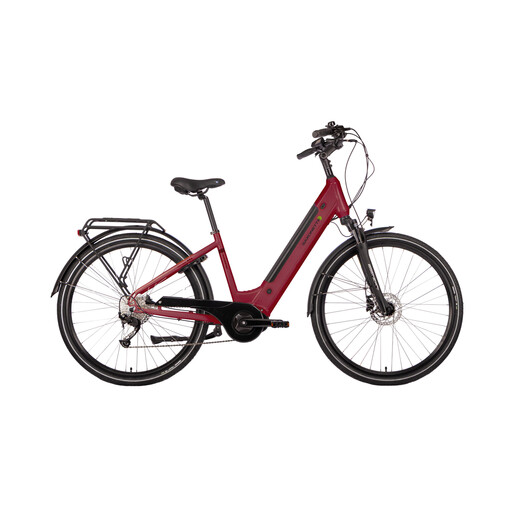
Why this product suits this profile: The wave frame makes getting on easier. The pannier rack, mudguards, chain guard and lighting cover the needs of typical everyday journeys.
The product details specify 250 watts, 70 Nm, 418 Wh and a range of up to 80 km, rather than relying solely on vague performance claims.
SFM mid-drive motor, Shimano Alivio 9-speed gear system and Tektro hydraulic brakes; maximum load according to the product details: 130 kg.
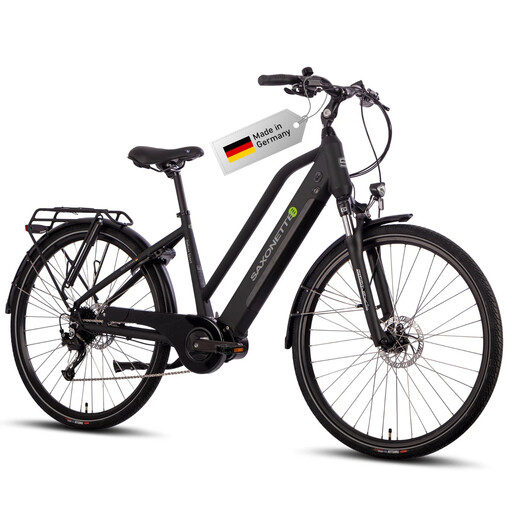
Why this product suits this profile: The 28-inch design combines easy step-through access with equipment designed for longer everyday journeys and touring routes.
The range of up to 120 km is expressly stated as dependent on riding conditions. According to the product details, the battery is removable and can be charged either on or off the bike.
418 Wh battery, 70 Nm mid-drive motor, Shimano Alivio 9-speed gear system and hydraulic disc brakes; stated load capacity: 130 kg.
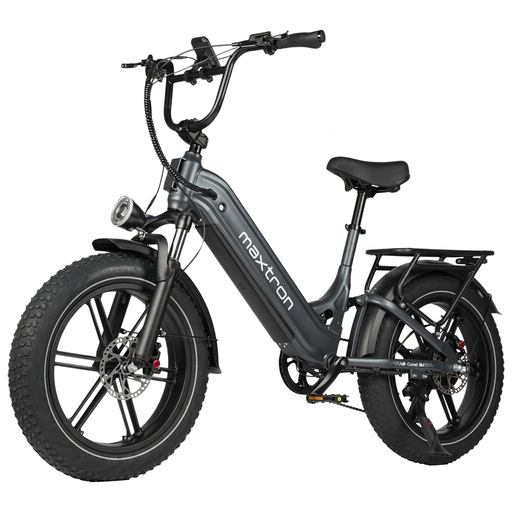
Why this product suits this profile: The wide 20-inch fat-bike tyres and pannier rack will appeal to riders who switch between tarmac, gravel and unpaved paths.
The selection combines the stated range with an 864 Wh battery, a removable battery and a stated maximum speed of 25 km/h.
Hydraulic disc brakes, lockable battery, lockout suspension fork and Shimano 7-speed gear system according to the product description.
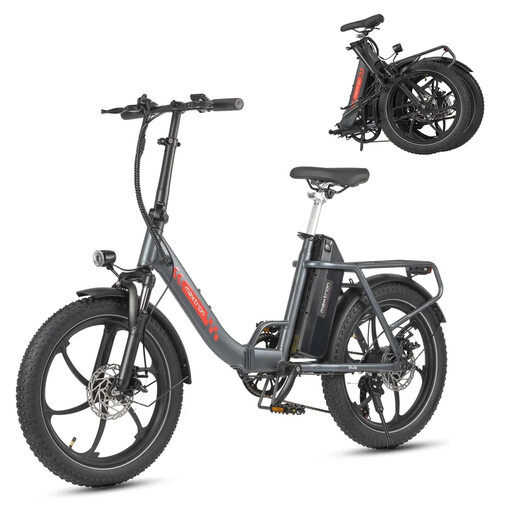
Why this product suits this profile: The folding frame is designed for small flats, car boots or combined journeys by bus and train. Its suitability should be checked against the transport rules of the relevant operator.
The folding design is combined with a removable 960 Wh battery, mudguards, pannier rack and lighting. Check the folded dimensions and weight before buying.
20-inch fat tyres, 250-watt rear motor, 7-speed gear system and mechanical disc brakes; stated load capacity: 120 kg.
We have put together a complete, regularly updated list of products that fully meet these strict selection criteria and the safety regulations applicable in the EU.
Before ordering a women's and men's city e-bike, you should check the following points:
The cost depends on the battery capacity, electricity tariff and charging losses. A 418 Wh battery requires less energy for a full charge than an 864 Wh or 960 Wh model. The running cost also depends on how often the battery is charged and whether it was completely empty beforehand.
Its service life depends on charging cycles, temperature, storage, use and care. Use the supplied charger, avoid extreme temperatures and store the battery in a dry place when taking longer breaks, without fully discharging it. If you notice unusual heat generation, damage or visible deformation, stop using the battery.
An e-bike configured as a pedelec, with assistance up to 25 km/h, generally does not require a driving licence or registration in Germany. The specific technical configuration and applicable traffic regulations are decisive. If you intend to use the bike on public roads, check the manufacturer’s information on StVZO compliance, as well as the lighting and safety equipment.