
Lieferung heute & morgen

Qualitätsgarantie

Willkommens-Angebote freischalten: KOSTENLOSE Lieferung | Bis zu 80 % RABATT | Kostenlose 30-Tage-JoyPlus-Testphase
App herunterladen
A clamp-fit double roller blind without drilling can quickly provide privacy and sun protection in rented homes, children’s bedrooms or offices, without leaving holes in the window frame. However, not every clamp bracket will fit every window. Terms such as ‘day and night’, ‘opaque’ and ‘thermal blind’ are also sometimes used differently by retailers.
Before you buy, avoid these three common mistakes:
Measure the thickness of the window sash or the window rebate where the clamp bracket will sit. WOLTU double roller blinds typically fit frames 13 to 23 mm thick, depending on the model. Other versions are designed for narrower frames.
Not every no-drill blind is suitable for every type of window. Roof windows, wooden frames, sliding windows, fixed glazing and some tilt windows may not be suitable. The blind or its fittings must also not obstruct the window handle.
For a double roller blind for a window, the stated overall width often includes the brackets. The fabric itself is narrower. If you’re buying a privacy blind for your window, follow these steps:
For example, a glass panel 46 cm wide may need a blind with an ordered width of around 50 cm. Use this as a guide, and always check the measurements against your specific window.
A day-and-night double roller blind has two layers of fabric that move past each other. Using the chain, you can position the sheer and opaque stripes so that they overlap partly or fully. This lets you adjust the room from light-filtering to more private and shaded.
This is different from a light-filtering blackout blind with a coated backing. If you want to keep as much outside light as possible out of a bedroom, look for terms such as opaque and blackout, check whether the backing is coated, and read the specific product description. A no-drill thermal blind may also have a coated backing, but that does not automatically guarantee a particular room temperature or energy saving.
Polyester is the main material used in the double roller blinds featured here. It can usually be cleaned with a soft brush or a slightly damp cloth. Abrasive or harsh cleaning products may damage the surface and the stripe pattern.
A chain lets you adjust the blind flexibly, but it must be secured out of the reach of young children. For families with children, a cordless blind with a grip handle may be a suitable alternative. Whatever the model, make sure the brackets are secure before using the blind regularly.
For a door or a frequently used patio door, it’s also important to consider the fitting position, clearance around the handle and freedom of movement. A blind for a window or door should not knock against fittings or get caught when you open the sash.
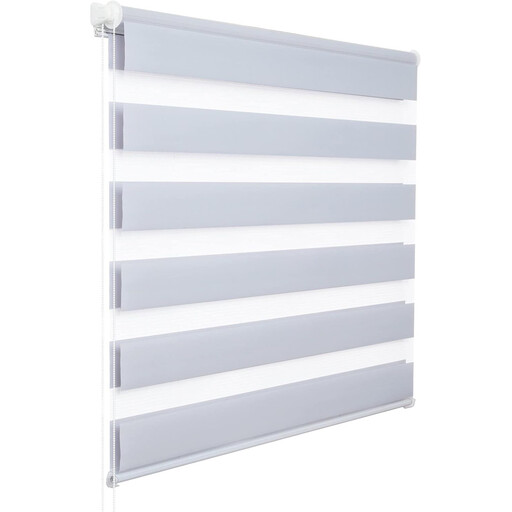
Why this product suits this need: The grey finish is a practical choice for rooms where you want privacy and adjustable light control. The chain can be fitted on either the left or right.
The suitable frame thickness of 13–23 mm is clearly stated. The fabric is also noted as being around 4–5 cm narrower.
100% polyester, wipe-clean with a damp cloth, clamp-fit installation without drilling and optional screw fitting.

Why this product suits this need: The coated backing makes this a good option if you want to block out more light and prefer a blind without a pull chain.
The product details clearly state the suitable frame thickness of 16–22 mm, the approximate fabric width and that it is not suitable for roof windows.
Cordless operation using the bottom grip, coated backing, water-repellent polyester and two fitting options.

Why this product suits this need: The top-down and bottom-up operation lets you position the blind flexibly, making it suitable for windows and doors in bedrooms, living rooms or home offices.
The suitable clamp-fit range of 10–23 mm is clearly stated. The product is also noted as unsuitable for roof windows.
Honeycomb structure, metal frame, moisture-repellent polyester and stepless adjustment using two grips.

Why this product suits this need: The option of clamp or screw fitting means you can adapt it to a rented home or a permanent installation later on.
The product details state the suitable frame thickness of 13–23 mm and note that roof, sliding and wooden windows may not be suitable.
Alternating sheer and opaque fabric panels, a chain that can be fitted on the left or right, and included accessories.
We’ve put together a complete, regularly updated list of products that meet these strict selection criteria and fully comply with the safety regulations in force in the EU.
First, measure the width of the glass and the height of the entire window frame. Then check the frame thickness against the stated clamp-fit range. Also bear in mind that the fabric may be narrower than the ordered width.
How long it lasts depends on choosing the right frame thickness, fitting it carefully and how often it is used. A correctly fitted clamp bracket should be stable enough for its intended use indoors. Check regularly that all the brackets are secure before operating the blind.
No. A manually operated double roller blind, zebra blind or thermal blind without drilling does not need an electrical connection. The only ongoing costs are for cleaning and, if needed, replacement parts or a new blind later on.