
Lieferung heute & morgen

Qualitätsgarantie

Willkommens-Angebote freischalten: KOSTENLOSE Lieferung | Bis zu 80 % RABATT | Kostenlose 30-Tage-JoyPlus-Testphase
App herunterladen
A clamp-fit pleated blind without drilling can be a practical way to improve privacy and keep out the sun in rented homes, offices and living spaces. It is usually fitted to the window sash with clamp brackets or attached to the frame with adhesive pads. This avoids drill holes, and the window blind can often be removed when you move.
However, not every clamp-fit pleated blind will suit every window. These three common buying mistakes are among the most likely to lead to the wrong choice:
Measure the visible width of the glass, the frame height and the thickness of the window sash. For many pleated blinds, a width of around 3 to 4 cm more than the glass width is recommended. This helps cover the glass without blocking handles or protruding fittings.
For a door or patio door, also check that:
If you’re looking for a pleated blind in a specific size, bear in mind that the range of standard sizes may be limited, depending on the model. An oversized blind can’t always be safely trimmed to fit.
A light-filtering pleated blind softens daylight and can reduce visibility from outside. However, it won’t provide complete blackout. A privacy pleated blind prevents people from seeing directly in, but depending on the fabric, it may still let in diffused light.
For bedrooms or rooms where you work at a screen, you may want to consider options that block more light. Even so, check the wording in the product description: retailers don’t always use “blackout”, “light-blocking” and “room-darkening” consistently. Even opaque fabric can leave gaps at the sides where light gets through.
A pleated blind with clamp brackets attaches to the window sash without drilling into the frame. Check which frame thickness the brackets are designed for. Some models, for example, are suitable for frames between 10 and 23 mm or between 16 and 22 mm thick.
Adhesive fitting, on the other hand, requires a clean, dry and preferably smooth surface. Rough, uneven or heavily textured frames can affect how well the adhesive holds. Polyester is a common material for pleated blinds, but in rooms with high humidity, it shouldn’t be assumed to be waterproof. Moisture-resistant doesn’t mean the material should be exposed to water for long periods.
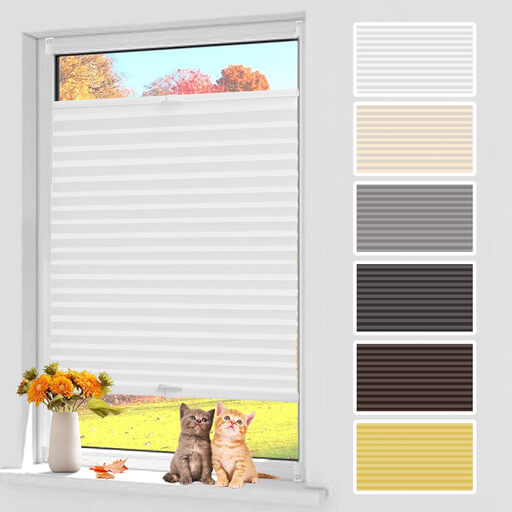
Why it suits this type of buyer: Its compact size is a good fit for smaller standard windows. According to the product description, it can be fitted without tools using the clamp-fit system. The white polyester fabric is designed to help regulate light and provide privacy.
The stated width of 60 cm makes it easier to narrow down your choice. Before buying, though, check that the frame width is compatible with the clamp mechanism.
60 × 100 cm, white polyester, clamp-fit installation and adjustable height, according to the product details.

Why it suits this type of buyer: This version combines clamp-fit and drilled installation options, a handle-free operating mechanism and coated polyester fabric. It could be a good choice for bedrooms and living rooms if you want simple operation without a pull cord.
The product details specify a suitable frame thickness of 16–22 mm. This lets you check before ordering whether clamp-fit installation will work with your window.
80 × 150 cm, clamp-fit installation without drilling, operated using the bottom rail and coated polyester fabric, according to the product description.

Why it suits this type of buyer: The double honeycomb structure and top- and bottom-operated design make it a good option for rooms where you often adjust the light and privacy, such as bedrooms, studies and bathrooms.
The product description gives a suitable frame thickness of 10–23 mm and notes that the blind isn’t suitable for roof windows. These details help you check compatibility.
50 × 130 cm, polyester honeycomb pleated blind, clamp-fit brackets for frames measuring 10–23 mm thick and operating handles on both sides, according to the supplier.
We’ve put together a complete, regularly updated list of products that meet these strict selection criteria and fully comply with the safety regulations in force in the EU.
Before fitting, clean the window frame with a suitable residue-free cleaner and let it dry completely. Clamp brackets should sit evenly and mustn’t distort the seal. If you’re using adhesive pads, it’s a good idea to check they’re secure before operating the blind fully for the first time.
A soft, slightly damp cloth is usually all you need for cleaning. Harsh cleaners, abrasive products and strong pulling can damage the fabric, coating or operating mechanism. If the product has cords, keep them out of children’s reach. Check the brackets regularly to make sure they’re secure.
No. Many models are designed for rectangular tilt-and-turn windows. Roof windows, sliding windows, wooden windows and very wide frames may not be suitable. The key things to check are the frame thickness, window shape, glass width and the distance from the handles and seals.
How long it lasts depends on the material, how it’s fitted, how much sunlight it gets and how it’s operated. A securely fitted clamp bracket, careful adjustment and regular cleaning can all help reduce wear. With adhesive fitting, heat, dust or moisture can weaken the bond over time.
In many cases, yes, as it doesn’t leave drill holes. Before fitting, though, check whether the clamp brackets or adhesive pads could leave marks on the frame. For a rented home, it’s also worth choosing a model whose fitting method is explicitly designed for your frame thickness and surface.