
Lieferung heute & morgen

Qualitätsgarantie

Willkommens-Angebote freischalten: KOSTENLOSE Lieferung | Bis zu 80 % RABATT | Kostenlose 30-Tage-JoyPlus-Testphase
App herunterladen
A clamp-fit roller blind without drilling is a practical choice for rented homes, rooms you use temporarily and windows with delicate frames. It is usually fitted using clamps on the window sash or adhesive brackets, leaving your walls and window largely undamaged. However, not every model will fit every window.
The most common buying mistakes aren’t about design. They’re caused by inaccurate measurements, choosing the wrong fitting method or expecting the blind to control light in a way it wasn’t designed to.
For many clamp-fit roller blinds, the stated width includes the brackets, so the actual fabric is narrower. According to the product details, the difference for the WOLTU blackout roller blind is around 4 cm. If you measure only the glass and don’t allow for the brackets, you may not get enough privacy or protection from the sun at the sides.
A semi-transparent pleated blind without drilling filters daylight and protects your privacy, but still lets light into the room. A day and night blind without drilling, with alternating sheer and opaque stripes, lets you adjust the light flexibly, but doesn’t automatically provide complete blackout.
For bedrooms or rooms with light-sensitive screens, choose a model specifically described as a blackout blind. According to WOLTU’s product information, its blackout roller blind has a silver-coated backing and is designed to block out light completely. The actual result will also depend on gaps at the sides, the fitting position and the size of your window.
Check the thickness of your window frame before you buy. Some models are designed for frames measuring 13 to 23 mm, while others fit 16 to 22 mm or 10 to 23 mm. Seals, handles and protruding fittings can also get in the way during installation.
Not every roller blind for windows and doors is suitable for roof windows, wooden windows or sliding windows. Check the product description carefully for any such restrictions.
You’ll need three measurements to find the right clamp-fit roller blind for your window:
For many day and night blinds, the recommended order width is around 4 cm wider than the glass. At the same time, the blind mustn’t cover the window handle. For doors, check that the clamp brackets have enough clearance from the door frame when you open and close the door.
A light-filtering pleated blind or day and night blind is often a good choice for living rooms, kitchens and offices. In a bedroom, a thermal blind or a blind with a coated backing may be a good option. In bathrooms and kitchens, moisture-resistant, wipe-clean polyester fabrics are practical.
Chain-operated blinds let you adjust the light in stages, but the chain must be securely fastened and kept out of children’s reach. Models with a handle on the bottom rail don’t need an operating chain. According to the manufacturer, the WOLTU blackout roller blind is operated using the bottom aluminium rail.
Whatever the system, keep small fitting parts out of children’s reach. Secure operating chains and cords so they don’t pose a risk of entanglement.
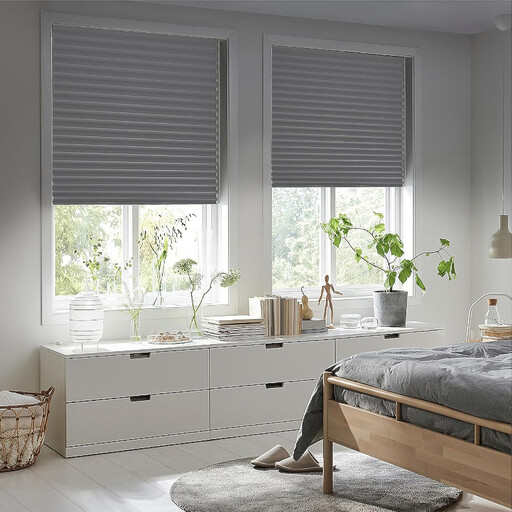
Why this product suits you: The light-filtering fabric offers a simple way to cover windows or doors without drilling. The product description says it can be fitted using clamps or adhesive brackets.
The product description calls the fabric semi-transparent, so it doesn’t promise complete blackout if you’re simply looking for a way to filter light.
Light-filtering polyester fabric, 75 x 200 cm dimensions and two described fitting options that don’t require drilling.

Why this product suits you: This model is designed for buyers who want blackout performance, a clearly specified frame fit and operation without a chain.
The product details specify both the suitable frame thickness of 16–22 mm and the difference between the overall width and the fabric width.
200 g/m² polyester according to the product details, silver-coated backing, clamp or drill fitting, and operation using the bottom aluminium rail.

Why this product suits you: According to the product description, the double honeycomb structure and clamp brackets make it suitable for rooms where blackout and flexible positioning are important.
The product details specify the suitable frame range of 10–23 mm and state that the blind isn’t suitable for roof windows. This makes it easy to check whether it will fit before you buy.
Opaque polyester fabric according to the product description, top and bottom operating handles, and a moisture-repellent surface.
We’ve put together a complete, regularly updated list of products that meet these strict selection criteria and the safety regulations in force in the EU.
A clamp-fit system is particularly suitable as a roller blind solution for rented homes. For adhesive or suction-cup fittings, the surface must be smooth, clean and dry. Textured walls or uneven frames can affect how well they stick.
How long they last depends on the frame thickness, materials, load and whether they’re fitted correctly. Check that the clamp brackets are secure regularly. If you open the window often, the brackets may move more than they would on a roller blind fixed in place with screws.
Many models are designed for both windows and doors. Before you buy, check the door frame thickness, handle position and opening direction. The blind mustn’t block the handle or hit the frame when the door opens.
A manually operated blind doesn’t need electricity. Chain-operated blinds, handle-operated models and pleated blinds all work mechanically. Manufacturers may describe a thermal effect for coated or honeycomb fabrics, but that doesn’t allow you to make a general claim about specific heating or cooling costs.