Which setup suits you?

Teachers recording groups

If you want to capture several learners playing together for a discussion later, you need a practical position that works for the whole group. The Lower Saxony education portal describes percussion as a classroom activity involving several learners.

Teachers recording individual instruments

If you want to make a particular instrument stand out against other classroom noise, direction and distance are crucial. Shure explains that directional microphones pick up sound from in front particularly strongly.

Recordists with an existing XLR setup

If you already have suitable inputs, you can choose between a focused recording of one instrument and a condenser microphone or stereo pair. RØDE and Audio-Technica specify different connection and power requirements for their respective microphones.

What to look for when buying

What you need What to check before buying Who this matters most to
Making one instrument stand out Check the polar pattern, possible positions near the instrument and the XLR recording path you’ll need. If I want to record a particular instrument clearly despite other sounds in the room, close positioning is important. Around 33% of consumers prioritise recording an individual instrument.
Recording a group with minimal fuss Check the microphone arrangement, a stable position and whether you can monitor the recording. If I want to capture several playing positions together, I need to be able to position the device appropriately in the room. Around 25% of consumers prioritise straightforward group recording.
Capturing detail and stereo Check whether one microphone is enough or whether two separate inputs are available for a stereo pair. If the focus is on the detail of each strike or the instruments’ positions in the room, the setup needs to suit that. Around 25% of consumers prioritise detail and stereo recording.
Connections and equipment requirements Check the connection, number of channels, phantom power and, for a recorder, its power supply and storage media. If I first need to work out how to connect the microphone to my existing equipment, the whole signal chain matters. Around 17% of consumers prioritise compatible recording equipment.

Common buying mistakes

  • Assuming 32-bit float prevents all distortion

    The recording format doesn’t change the fact that built-in microphones have model-specific sound pressure limits. Zoom gives a maximum of 120 dB SPL for the H1essential’s microphones, while Tascam specifies up to 125 dB SPL for the DR-05XP.

    Compare the specifications for the exact model and listen to a test recording made from the intended position in the room.

  • Planning to use a close-up microphone for the whole group

    A microphone aimed at one instrument won’t automatically capture the different playing positions evenly. Sound On Sound points out that a single close-up snare microphone won’t give you a complete drum recording.

    Before you buy, decide whether one instrument or the whole group will be the main sound source.

    Depending on the coverage you want, recording a group may require extra microphones, inputs and stands.

  • Confusing an XLR microphone with a standalone recorder

    An XLR microphone can’t record a file on its own without a suitable recording device. Audio-Technica specifies 48 V phantom power for the AT2020.

    Check the exact model name, the available inputs and the power supply required before you decide.

  • Focusing only on the number of microphones

    When several microphones record the same source, phase differences can change the sound when the signals are combined. Shure describes potential phase problems when recording drums with several microphones.

    Listen to the combined recording and adjust the microphone positions if needed.

Key brands at a glance

Shure

Shure says the SM57 is designed for drums, percussion and instruments, making it a possible choice for a focused recording of one instrument.

  • For recording to a computer, Shure offers a separate XLR-to-USB bundle.
  • A single close-up microphone won’t automatically give you a balanced recording of the whole group.

Zoom

The H1essential is a standalone recorder with built-in X/Y microphones, making it quick to set up for recording a group.

  • Zoom specifies 32-bit float and a maximum of 120 dB SPL for the built-in microphones.
  • These specifications don’t guarantee that every loud percussion recording will be distortion-free or eliminate room reverberation.

Tascam

The DR-05XP is a portable stereo recorder with built-in omnidirectional microphones, for recording without a separate XLR microphone setup.

  • Tascam specifies 32-bit float and a maximum sound pressure level of 125 dB SPL for the microphones.
  • Omnidirectional microphones pick up sound from several directions, so positioning is especially important in a lively room.

RØDE

The M5 is available as a matched pair of small-diaphragm condenser microphones for anyone looking for an XLR stereo setup.

  • RØDE specifies XLR, P24/P48 power and a maximum of 140 dB SPL.
  • You’ll need compatible inputs and a suitable position for the pair.

Audio-Technica

The AT2020 is a single XLR condenser microphone for recordists with compatible recording equipment.

  • Audio-Technica specifies 48 V phantom power and a maximum of 144 dB SPL at 1 kHz and 1% THD.
  • This is a single microphone, not a stereo pair; the stated limit isn’t a measurement of a classroom recording.

Joybuy product selection

The selection below includes a podcast microphone kit with a 3.5 mm condenser microphone and audio mixer. For classroom percussion, check that the connection and recording setup are right for your device and intended use.
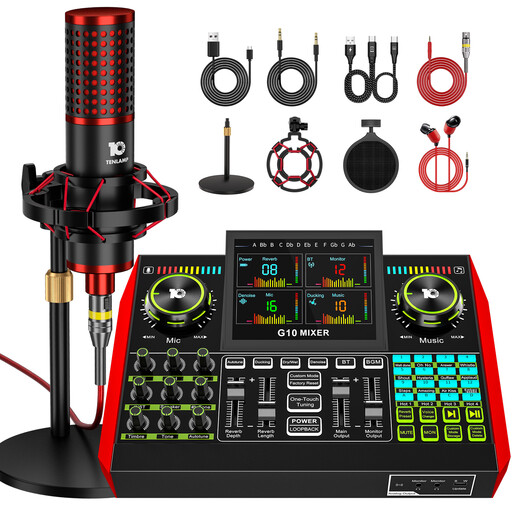
Yinkaer G10-P17 podcast microphone kit with audio mixer

Yinkaer G10-P17 podcast microphone kit

The product name suggests this kit is intended for podcast recording. Before buying, check that the microphone and mixer are suitable for your recording device and for recording percussion.

3.5 mm condenser microphone and audio mixer.

The product description lists compatibility with PCs and mobile devices, as well as a built-in battery.

Joybuy

Frequently asked questions

How should I get started with recording in the classroom?

First, decide whether you want to focus on one instrument or the whole group. Position the microphone or recorder accordingly, then listen to a short recording made from the actual spot. The polar pattern affects how much sound is picked up from outside the main axis.

Do I need an audio interface or phantom power for the AT2020?

According to Audio-Technica, the AT2020 requires 48 V phantom power from a suitable mixer, recording device or separate power supply. Also check what you’ll actually use to record the signal.

Does 32-bit float prevent all distortion?

No. Zoom and Tascam list 32-bit float as a recording feature, but also specify model-dependent maximum sound pressure levels for their built-in microphones. The recording format, microphone’s sound pressure limit and positioning need to be considered separately.

Can I record conversations during lessons or publish the recording?

In Germany, § 201 of the German Criminal Code prohibits recording someone else’s non-publicly spoken words without authorisation. Whether a particular classroom recording is authorised depends on the circumstances. Before recording anyone whose voice can be heard, check the purpose and legal basis with the school. For publishing podcasts featuring recorded people, the Ministry of Education of North Rhine-Westphalia explains the consent requirements. This guidance applies to that state and is not a uniform rule for all German states.

What extra equipment should I check before buying?

An XLR setup may require suitable cables and inputs, and possibly phantom power. If you’re buying a standalone recorder, check the power supply and storage media for the specific model.